Claim your exclusiveevent discount
Thanks for visiting us at our booth. Unlock your exclusive event pricing and see how we build what drives performance — measuring Power Skills and turning development into real, visible impact.
Validated through large-scale, real-world research
The Power Skills model and scoring engine behind Ignis is grounded in two decades of AI-enabled skills assessment research spanning more than 100,000 individual profiles.



Real skill data for every hiring, development, and succession decision
Ignis gives you a science-backed Power Skills baseline for every employee — so you always know where to invest, where the gaps are and whether your programs are working.
Targeted investment
Use real skill profiles — not self-reported guesses — to focus development spend where it will move the needle.
Measurable progress
Establish a baseline, run your programs, then track actual skill growth over time — not just completion rates.
Safer succession decisions
Spot readiness and leadership potential before roles change and stakes are higher.
Stronger internal mobility
Match people to opportunities with evidence, not assumptions or organizational politics.
A shared language for talent
Give leaders, coaches and HR a common framework for capability conversations across the organization.
Frequently asked questions
How would Ignis fit into our existing leadership and L&D programs?
Ignis sits alongside your current programs as an assessment layer. You can use it before and after leadership cohorts, high-potential programs or manager academies to baseline participants’ Power Skills and measure how those skills change over time, without redesigning your core curriculum.
Do we need to replace our current assessments?
No. Ignis is designed to complement, not replace, tools like 360s, engagement surveys and personality or preference assessments. It adds a behavior-based view of applied skills that you can feed into existing talent reviews, succession planning and development planning.
How much change management will this require for our teams?
For employees, Ignis feels like working through realistic work situations online, not like learning a new system. For HR and L&D, the main change is deciding where to plug the data into processes you already run (for example, which programs or cohorts to baseline, and where to surface Power Skills in talent review packs). Most clients start small with one or two programs and expand from there.
Can we start with a specific population instead of rolling it out company-wide?
Yes. A typical starting point is a contained use case — new managers, a high-potential cohort, a critical function or one business unit — to prove value and refine how you use the insights before scaling.
How does Ignis help us measure impact?
Ignis gives you clear before-and-after shifts in Power Skills at the individual, cohort and organisational levels. You can line those up against metrics you already track — such as promotion rates, retention in key roles, engagement scores or program completion — to tell a concrete impact story, even if you don’t connect every result to a dollar figure.
How long does the assessment take, and will people see it as a burden?
Each Power Skill is measured through its own module, typically 15–20 minutes, and you choose how many skills to include for a given audience. Because the format uses realistic work scenarios instead of abstract statements, participants generally experience it as relevant development insight, not as one more generic survey.
How do managers and participants actually use the results in practice?
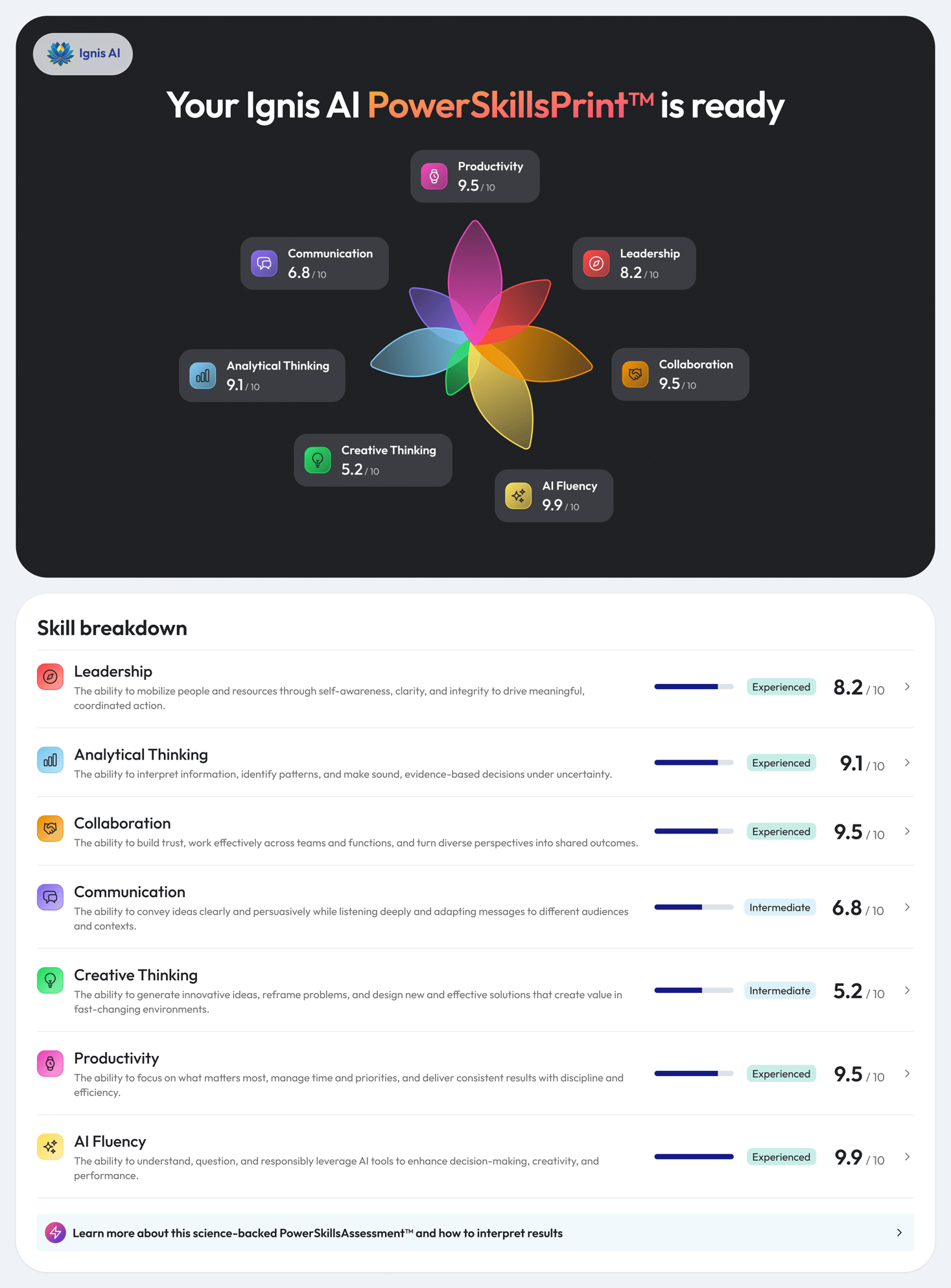
Participants receive a PowerSkillsPrint™ showing relative strengths and growth areas, which can anchor development plans and coaching conversations. Managers and HR see aggregated views across teams, cohorts and levels, so they can target development resources, shape program content and bring concrete Power Skills data into talent reviews and succession discussions.
How reliable are the scores for use in high-stakes decisions?
Ignis is built on research-validated rubrics and Bayesian proficiency models that have been tested across large populations. AI scoring focuses on the content and quality of responses in structured scenarios, not on demographic markers. Scores are designed to be a strong, auditable input into decisions — used alongside, not in place of, other evidence such as performance and potential assessments.
What about bias, fairness and legal risk?
Scenario-based assessment reduces the social desirability and self-presentation bias inherent in self-report personality tests. Ignis’s scoring models are trained and evaluated with fairness in mind, and the methodology is transparent enough to support internal review by your legal, compliance and DEI partners. The intent is to give you more consistent, documented evidence, not to introduce a new black box.
You’re a startup. Why should I trust you with high-stakes talent decisions?
Fair question. Our methodology was built by researchers who designed assessments for the OECD, Harvard, and Microsoft — deployed across 70+ countries with tens of thousands of participants. We’re new as a company. The science behind us is not.