The Trouble With Skills Inventories
There's no shortage of tools to help you create a skills inventory these days. However, that doesn't mean we feel like we can trust what's in them.
90% of organizations already use skills data in some HR decisions, Fuel50's 2026 research found, even though 78% say their skills mapping is outdated or nonexistent. Gartner-sourced analysis puts the share of organizations with reliable data on their workforce's current skills at 8%.
What Is a Skills Inventory?
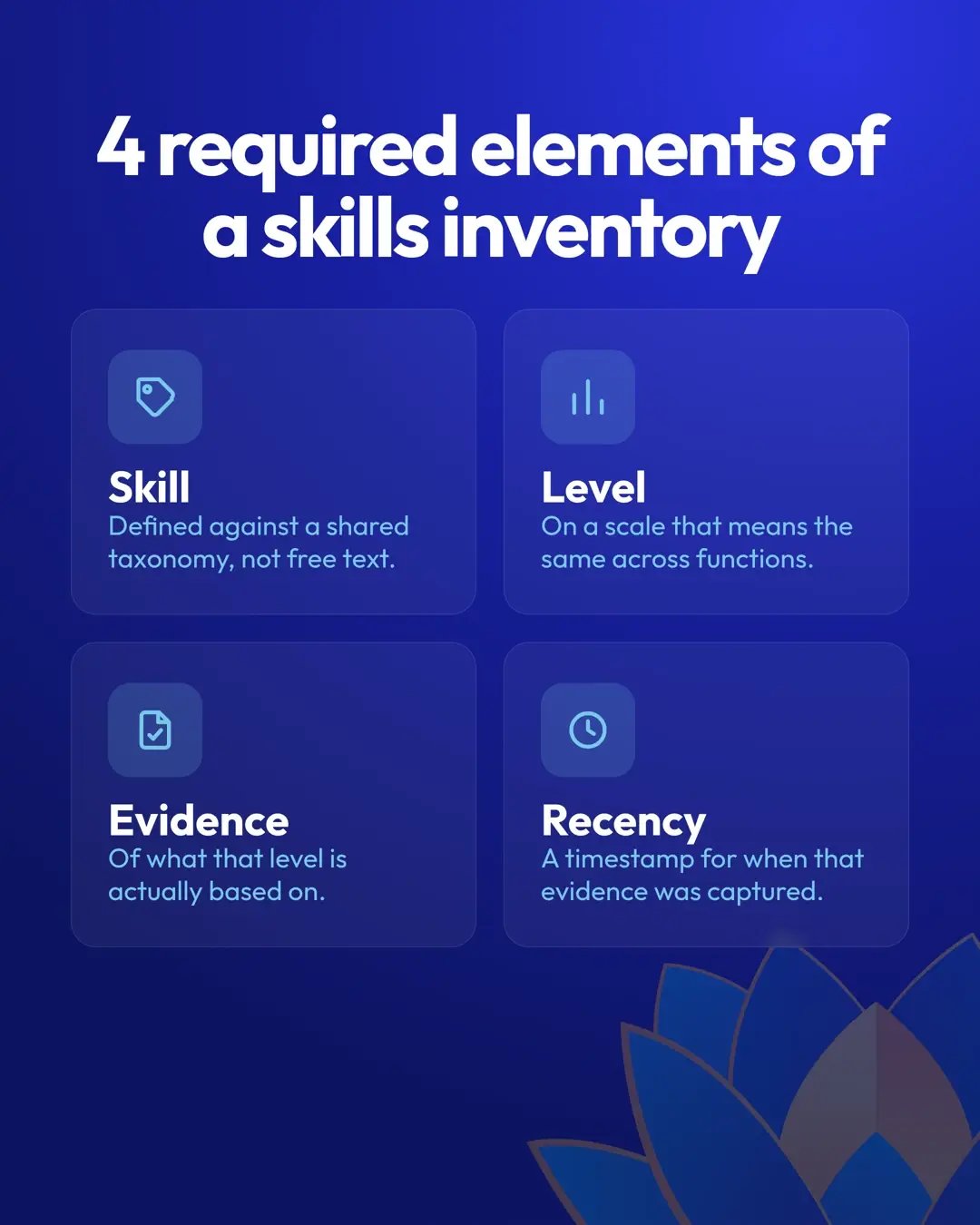
An employee skills inventory is a structured record of the capabilities within your organization, showing which people hold which skills, at what level and on what evidence. A usable inventory records more than a name and a rating. Each entry should carry:
- Skill, defined against a shared taxonomy rather than free text.
- Level, on a scale that means the same thing across functions.
- Evidence, of what the level is based on.
- Recency, a timestamp showing when that evidence was captured.
A skills inventory is different from a skills matrix, which is a table that maps people against the skills their team or organization needs, showing each person's proficiency in each area. It gives leaders a quick view of available capability, coverage risks, and skill gaps.
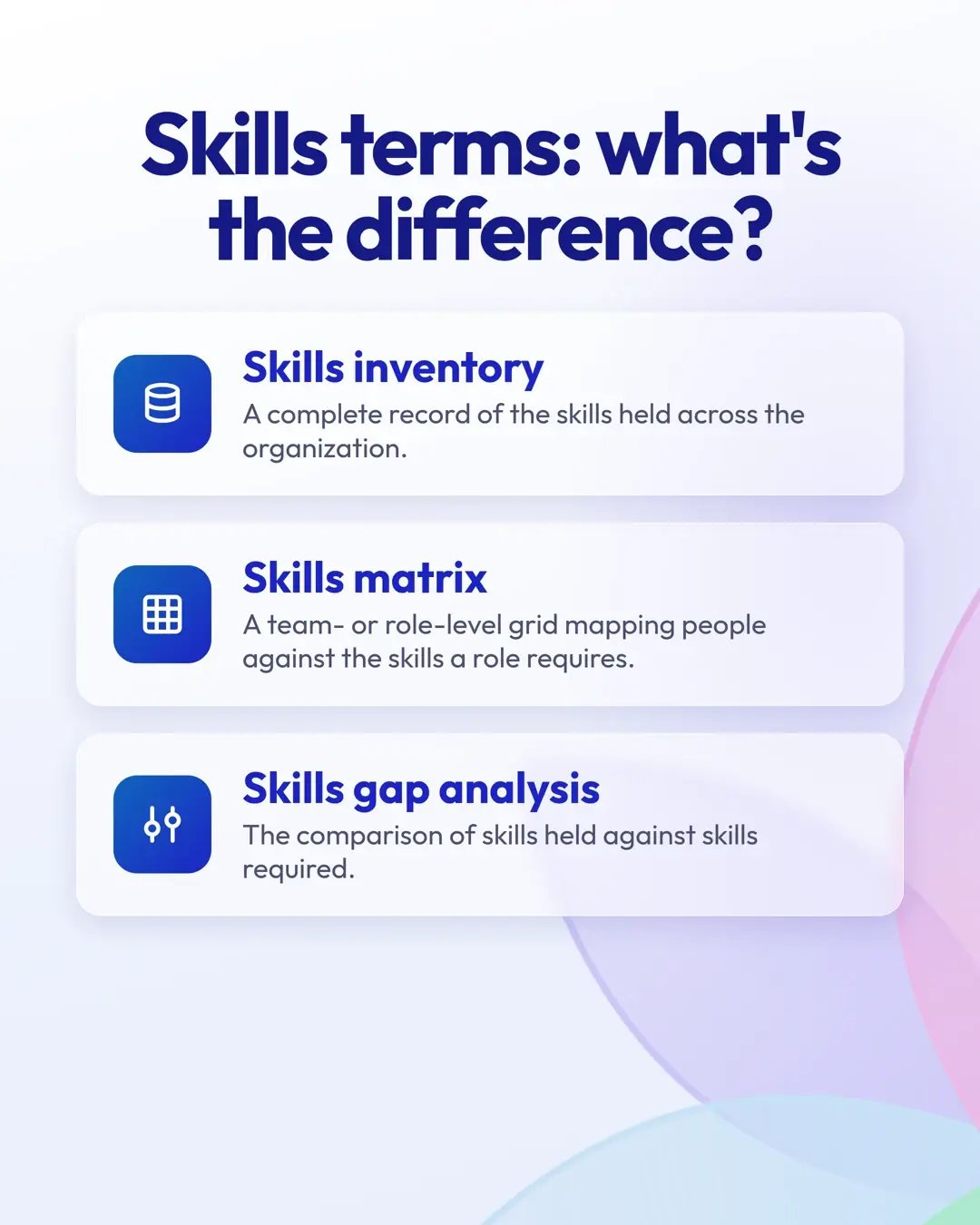
Skills Inventory vs Skills Matrix vs Skills Gap Analysis
| Term | What It Is | What It Tells You |
|---|---|---|
| Skills inventory | The data layer, a complete record of skills held across the organization | What skills do we have, and where? |
| Skills matrix | The visual display, typically a team- or role-level grid of people against required skills | Who on this team can do what? |
| Skills gap analysis | The action layer, the comparison of skills held against skills required | What are we missing, and what do we do about it? |
Why Skills Inventories Go Stale
Most of the lack of trust in skills inventories comes down to how the data is collected around specific skills, and whether it's being tracked by a skills manager or skills management software. A few of the shortcomings:
- Self-assessment measures confidence, not capability. When you ask people to rate themselves, you learn how they see themselves. Some inflate. Many, particularly deep specialists, undersell expertise they've internalized to the point of not noticing it. Either way, the resulting number describes a self-image. An independent 2026 AI skills benchmark, based on 88,753 assessments, found verified AI proficiency running meaningfully behind what employees reported about themselves. The gap widens where the stakes are highest.
- Manager sign-off ratifies a partial view. A manager sees a slice of an employee's work, filtered through the projects they happened to assign. However, manager approval of a self-rating doesn't verify it. It merely adds a second unverified opinion while giving the entry an official look.
- Nothing triggers a refresh. Most inventories are updated annually, if at all, even though skills are live variables. Skills change with the work people do, and static profiles don't. Within months, most skills inventories describe a workforce that no longer exists.
As a result, most skills inventories are built from what people say about themselves rather than from what anyone observed. Workforce-data practitioners believe the share of self-reported data is north of 80%. Even if the figure is treated as a field estimate rather than a measured benchmark, the pattern it describes is troubling. The dashboard may look precise, but the data underneath it is largely unverified.
The cost of acting on these skills assessment gaps is not abstract. McKinsey found that productivity disparities between top and bottom performers can widen by up to 800% as task complexity increases. Staffing complex work based on inflated ratings leads to costly, hidden resource-allocation errors.
How to Build a Skills Inventory
Creating a thorough skills inventory will result in better strategic workforce planning, hiring, learning and development, as well as create a better experience for employees who want their work valued.
Step 1: Define Your Skills Taxonomy
- Start narrow. A skills inventory that catalogs every skill never gets finished. Start with a skills inventory template and adapt it to the skills your business depends on.
- Cover technical and "soft" skills. Technical skills are role-specific and easy to define. The harder, more valuable set is what we call Power Skills: creative thinking, communication, collaboration, leadership, analytical thinking, productivity, and AI fluency. There's nothing soft about them. These skills determine whether or not complex work succeeds and should always be included in skills inventory examples.
- Write behavioral definitions for every skill and level. If two managers apply "level 3 collaboration" differently, the taxonomy isn't finished.
Step 2: Choose How You'll Assess Current Skill Levels
- Challenge each skill. Ask what evidence would convince a skeptical executive that the rating is real.
- Rank your methods. Self-assessment is easy to acquire but less reliable. Manager input adds context. Certifications and demonstrated work provide independent evidence. Scenario-based observation, where people face situations that require skill, add nuance.
- Pair each method with a confidence weight, so observed performance doesn't rank equal to a checkbox.
Step 3: Centralize and Structure the Data
- Unify your data. The goal is one system of record, on one taxonomy and one scale. Skills data scattered across an HRIS, an LMS, spreadsheets, and a talent review deck aren't actionable.
- Structure each record so it can be easily audited later, including person, skill, level, evidence type, assessment date, and confidence weight. Those last three fields let you ask "how much of this is more than a year old?" or "how much rests on self-report alone?" and get an answer.
Step 4: Identify Skill Gaps
- Find out what you're missing. The gap analysis takes the inventory findings and compares them with what your talent strategy actually requires to guide decisions about training and development, career paths, hiring, and succession planning.
- Define required levels for critical roles and initiatives, run the comparison, and prioritize gaps by business impact. Skills database software makes this analysis easier.
Step 5: Refresh on Triggers, Not the Calendar
Once a year updates aren't enough. Treat skill as a live variable instead, and refresh on key triggers, such as project completion, role change, a new certification or a major initiative launch. Another effective approach is to set a staleness threshold in advance. For example, 12 months can work for stable technical skills. Shorter timeframes are better for fast-moving critical skills like collaboration.
Finally, audit a sample of entries against real work output on a set cadence, then report the inventory's own data quality (coverage, average evidence age, share verified versus self-reported) alongside the skills data itself.
Putting Your Skills Inventory to Work
Closing your skills gap means insisting every entry carry a skill defined against a shared taxonomy, a level that means the same thing across teams, evidence for how that level was set, and a timestamp you can trust.
Once that's in place, your skills inventory stops being a static catalog and becomes something you can use to make critical talent management decisions.
Learn how Ignis can strengthen your skills inventory.
Frequently Asked Questions About Skills Inventories
Do you need software to build a skills inventory?
You don't strictly need dedicated software to build a skills inventory, but you do need one system of record, and that's harder to maintain in a spreadsheet than it sounds. Purpose-built skills database software makes it easier to enforce a single taxonomy, track evidence automatically, and audit entries later.
What should be included in a skills inventory template?
A skills inventory template needs four fields for every entry: the skill itself, defined against a shared taxonomy; a level, on a scale that means the same thing across functions; evidence, showing what the level is based on; and recency, a timestamp for when that evidence was captured.
How is a skills inventory different from a performance review?
The difference between a skills inventory and a performance review is what each one measures and how often. A performance review typically happens once or twice a year and evaluates how someone did against goals or expectations over that period, often folding in a self-assessment component or a manager's overall impression. A skills inventory is an ongoing catalog of which skills someone holds, at what level, and on what evidence, meant to be current at any given moment rather than tied to a review cycle. A performance review can feed evidence into a skills inventory entry, but the two aren't interchangeable.