How to Measure Soft Skills (and Why Self-Reporting Doesn't Cut It)
Most organizations measure soft skills by asking people to rate themselves. That's not a measurement of soft skills. It's a measurement of self-image, and the two aren't the same thing.
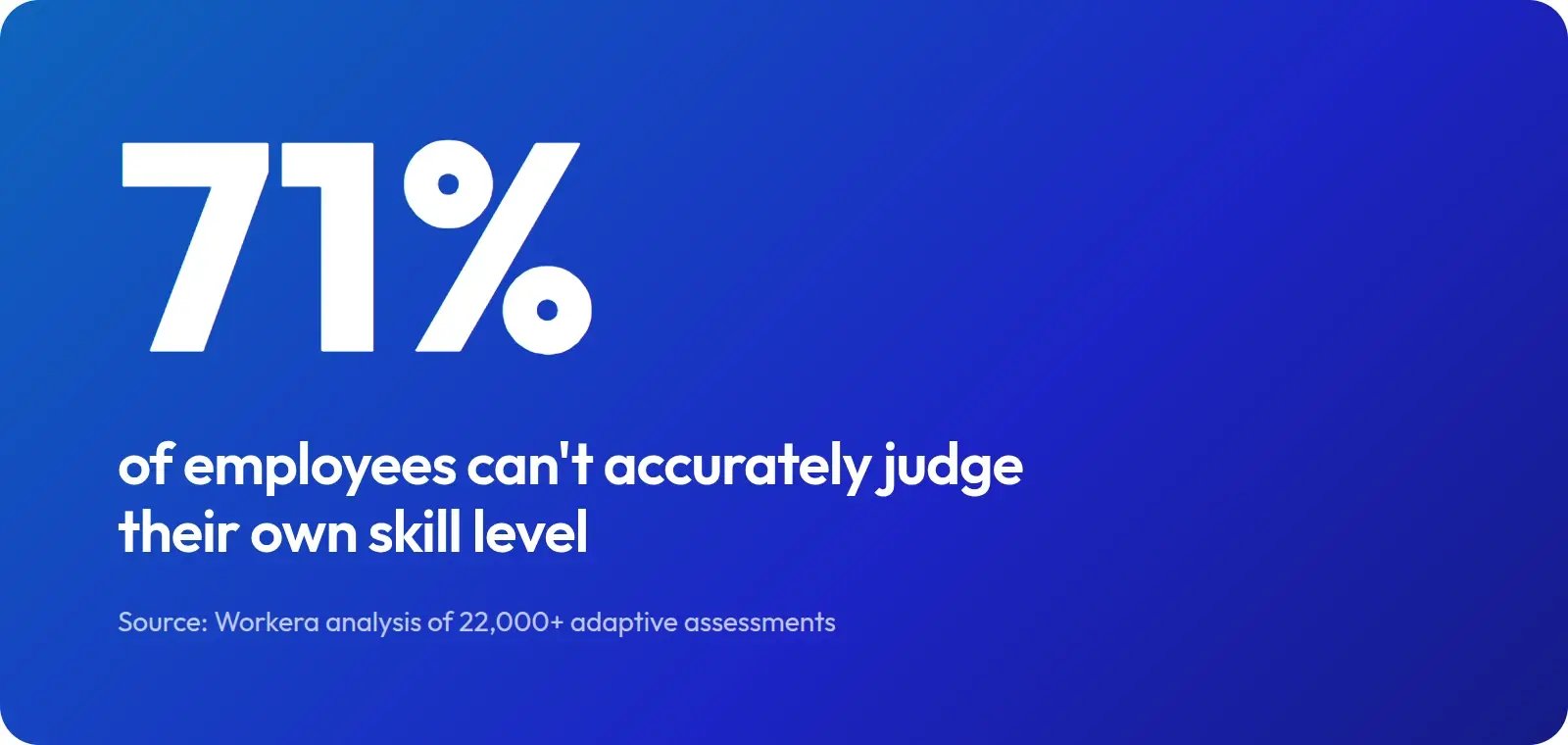
Seventy-one percent of employees cannot accurately judge their own skill level, according to a Workera analysis of more than 22,000 adaptive assessments. Ask anyone to rate their own communication skills, and most will say above average, which is mathematically impossible at scale. These skills are genuinely hard to see in ourselves, which is why self-reporting produces unreliable data. What’s being measured is confidence, not capability.
What Are Soft Skills?
Soft skills are the applied capabilities that determine how someone performs, including how they lead under pressure, communicate across differences, collaborate in ambiguous situations, and make decisions when the stakes are real.
These aren't personality traits or preferences. They're demonstrated, learnable behaviors that can be observed, assessed, and developed over time.
Soft Skills vs. Hard Skills
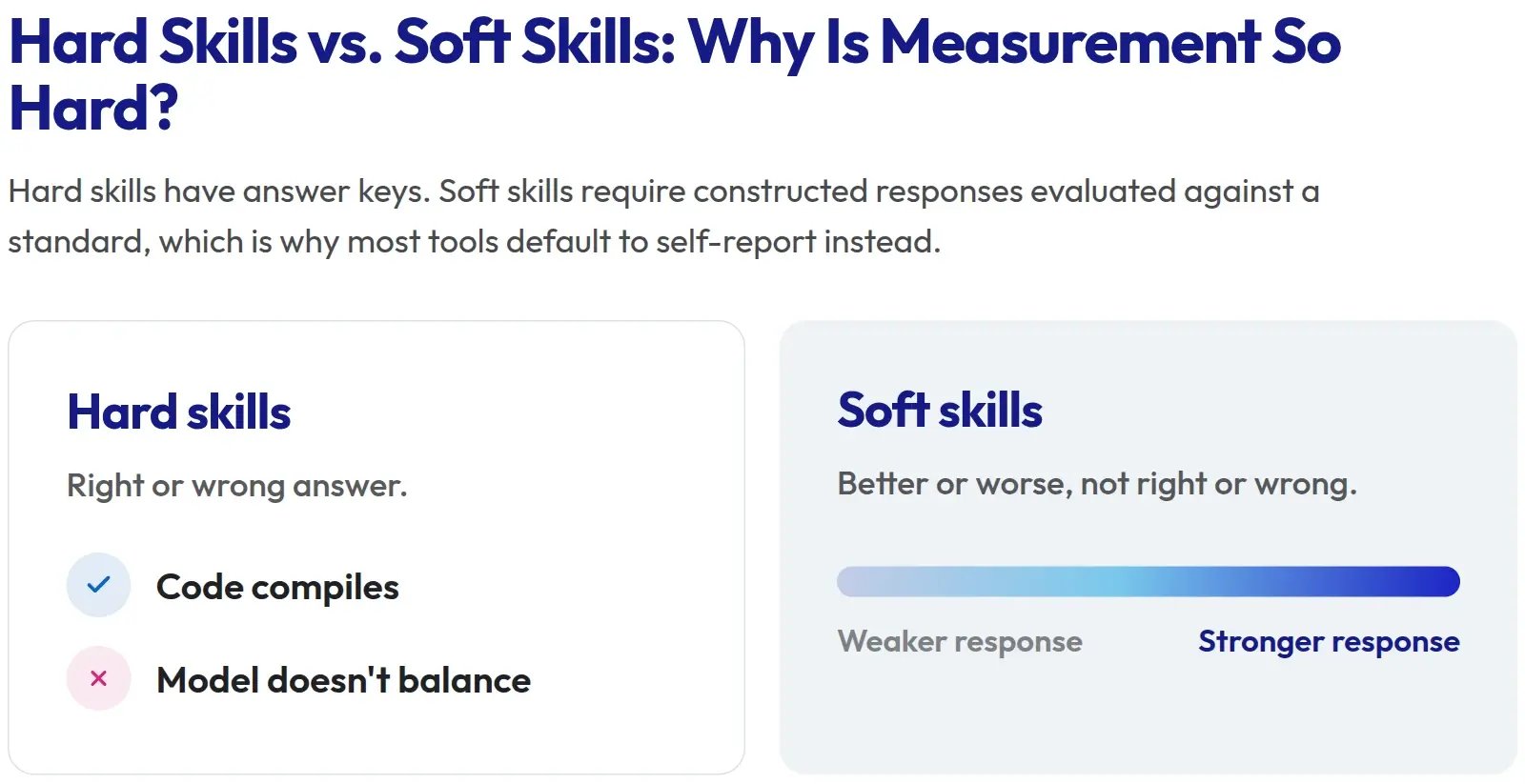
Hard skills are specific and concrete. Code either compiles or it doesn't. A financial model either balances or it doesn't. There's a right answer, and you can check for it.
Soft skills are different. When someone is navigating a team conflict, communicating a difficult decision, or thinking creatively under constraint, there's no single correct response. Better and worse answers exist, but you can't score them with a multiple-choice key.
What Are Power Skills?
Power Skills are the uniquely human, interpersonal, and behavioral capabilities that drive success in the workplace, such as communication, leadership, and collaboration. They overlap heavily with traditional "soft" skills, but we believe that naming downplays how critical they are in an AI-accelerated world as well as how learnable they are.
Learn more about the research behind Power Skills.
Why Soft Skills Measurement Is So Hard
Soft skills are hard to measure because they show up as context-dependent behaviors and judgments, self-assessment is unreliable and performance must be interpreted against nuanced standards rather than a simple test score.
There's No Single Right Answer
Assessing soft skills is fundamentally different from assessing technical skills. While technical skills have answer keys, soft skills require constructed responses. You can't evaluate how someone leads a team conflict by asking them to pick A, B, C, or D. You need to see what they do in a realistic situation and then evaluate the quality of that response against a meaningful standard.
This is why most tools default to self-report or personality inventories, which are easier to score. But “easier to score” and “more accurate” aren't the same thing, and in this case, they're nearly opposites.
Self-Assessment Is Unreliable
People are poor judges of their own soft skills. The above-average paradox isn't vanity so much as a genuine blind spot. We rarely get clear feedback on how our communication lands, whether our leadership approach is building trust, or whether our decisions under pressure hold up to scrutiny.
Personality tests and competency ratings don't solve this. Soft skills self-assessment tools produce unreliable data because they measure confidence and self-perception rather than demonstrated capability. The data reflects how people see themselves, which is a systematically unreliable predictor of how they perform.
A Single Snapshot Isn't Enough
Even when you put someone in a realistic scenario, a single observation isn't sufficient because skills don't show up uniformly across contexts. Someone who communicates brilliantly in writing may struggle in real-time conflict, and someone who collaborates well on familiar teams may fall apart with new people.
Inferring a person's actual skill level from a single task produces noisy, misleading results. Measuring skills reliably requires multiple observations and a statistical method to infer the underlying capability from the resulting pattern, rather than relying on a single score.
How to Measure Soft Skills Development
To assess skills you have to watch people do the work in context, then score what they did against clear, role-specific criteria.
Step 1: Define What Proficiency Looks Like
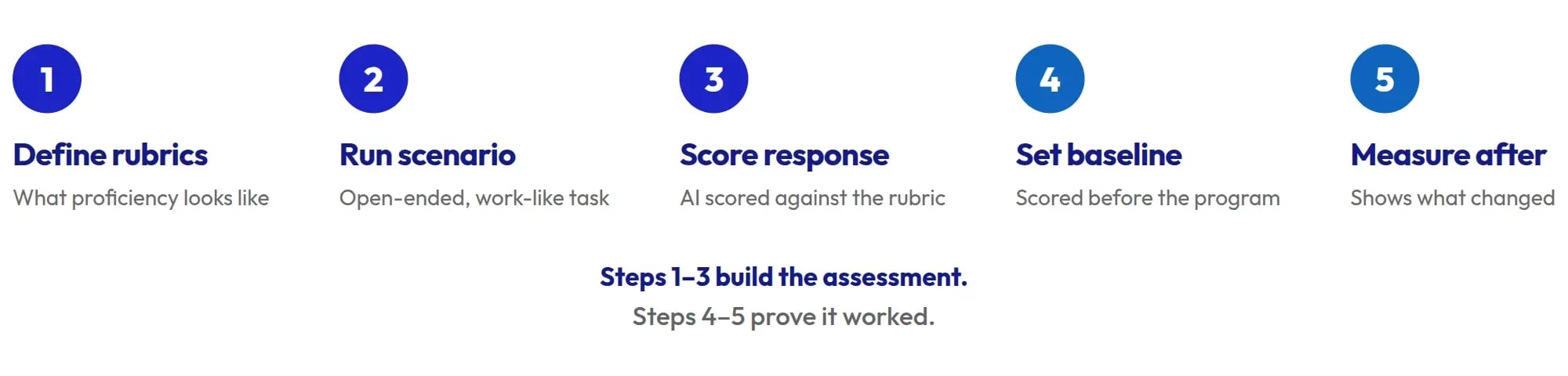
Before any assessment takes place, the human work of defining a skill comes first. Assessment and subject matter experts build detailed rubrics that describe what each skill looks like at different career levels.
For communication, someone early in their development might convey ideas clearly most of the time but miss what isn't being said, the tension underneath a disagreement or the anxiety a direct report isn't naming. Someone more advanced listens in a way that surfaces what people aren't saying, reframes charged situations to move the group forward, and stays composed under pressure.
These descriptions aren't obvious, and they require expertise, iteration and validation to get right. Without them, you're not measuring a skill so much as something that merely feels like one.
Step 2: Put People in Realistic Scenarios
The assessment presents work-like situations that require participants to respond in their own words. It isn't multiple choice or a rating scale, but an open-ended constructed response that produces observable behavioral evidence.
In the Ignis PowerSkillsPrint™, for example, a participant watches a short video of a virtual team meeting where two colleagues are at odds, then answers as the team lead: how would they handle it? Someone who says "I'd just make a decision and move on" is demonstrating something meaningfully different from someone who recognizes the underlying tension, creates space for both perspectives, and thinks about preserving trust across the team. Both answers might sound reasonable, but one reflects a substantially deeper understanding of how teams work.
This is what behavioral assessment captures that a personality quiz can't: actual demonstrated judgment rather than preferences or self-image.
Step 3: Score Responses Against Validated Rubrics
The rubric built in Step 1 is now applied. The AI is given that rubric alongside previously scored, real-life responses as reference points: concrete examples of what a high-quality response looks like versus a weaker one. This grounds the scoring in actual human judgment rather than abstract criteria.
Multiple independent scoring models run on each response, and their outputs are compared to reduce variance and increase confidence. Every score comes with a written rationale that makes human review efficient and builds a growing library of explained examples over time.
Early results show AI scores agree with human expert scores at a level consistent with high-quality professional assessment. The AI is what makes the approach scalable, while the human-built rubrics and review process are what make it trustworthy.
Step 4: Establish a Skills Baseline Before Programs
For L&D applications, the assessment is run before a development program begins. This isn't a satisfaction survey or a pre-test of content knowledge, but a scored skills profile that measures demonstrated capability before the participant has encountered the program.
That baseline is what makes change measurable; without it, you have no starting point to compare against.
Step 5: Measure After Programs to Show What Changed
The same assessment method, run after the program completes, produces a second scored profile. The comparison between the two is where the data becomes useful: showing which skills moved, how much, for which individuals, and across the cohort as a whole.
This is what a defensible budget conversation looks like. Not "58 employees completed the leadership training," but rather, "Leadership proficiency across the cohort shifted from X to Y, with the strongest gains in communication and collaborative decision-making." That's the before-and-after story budget holders are asking for, and it's the foundation of any credible effort to measure training effectiveness.
Download Beyond the Gut Check, Ignis's guide to the science of measuring the skills that drive performance.
5 Ways AI Can Help Measure Soft Skills
AI doesn’t replace assessment science or human judgment; it makes rigorous soft-skills measurement scalable, consistent, and statistically stronger for L&D teams.
- Scaling expert scoring of open-ended responses. L&D leaders are using AI to apply expert-built rubrics to thousands of constructed responses, scenario answers, role plays and simulated conversations without losing the nuance that makes those assessments valuable.
- Grounding scores in validated rubrics and examples. In mature implementations, AI isn’t “freestyling” its judgments. It’s scoring against skill definitions and examples created by assessment scientists and subject matter experts. For soft skills, the system is trained on real, human-scored responses that illustrate what strong, middling, and weak performance actually looks like
- Applying more sophisticated statistical models to results. Rather than reporting a single score per skill from a single task, AI-enabled assessment uses techniques like latent variable modeling to estimate underlying proficiency from multiple observations. Each scenario contributes evidence about a person’s capability, and the model infers a probabilistic proficiency estimate that is more reliable than any single data point. For L&D, that means you can talk about skill movement over time in a way that holds up under scrutiny.
- Supporting fairness and bias checks in scoring. When soft-skill assessments inform hiring, promotion, or succession decisions, L&D leaders need to know whether scores are fair. AI makes it possible to audit scoring patterns across demographics, roles, and regions, see where models might be under- or over-scoring particular groups, and adjust rubrics, training data, or review workflows accordingly. Done well, this improves consistency relative to ad-hoc human impressions.
- Turning assessment data into skills intelligence reporting for the business. Finally, AI helps L&D leaders roll individual scores up into an aggregate picture of the organization’s soft-skills strengths and gaps. By aggregating results across cohorts, teams, and programs, you can see where communication, collaboration, or change-leadership capability is strong, where it’s fragile, and how that’s shifting over time. That skills-intelligence layer is what connects assessment to workforce planning, succession, and strategic L&D investments.
This only works if the AI has the right inputs, however. A general-purpose language model handed a prompt won't produce psychometrically valid scores. The Ignis scoring methodology is grounded in two decades of AI-enabled assessment research developed alongside the OECD, Harvard, NSF, and Microsoft.
Why Measuring Soft Skills Is Worth the Effort
Soft skills' reputation for being unmeasurable was never about the nature of the skills, but about the adequacy of the tools, and those tools have changed.
When soft skills can be measured with rigor, the decisions that depend on them change across L&D, hiring, succession, and workforce planning. Development investments become defensible, programs get evaluated on what they changed rather than whether people showed up, and skills data becomes actionable.
Frequently Asked Questions
Can soft skills be measured objectively?
Yes, with the right methodology. The challenge is that soft skills require constructed responses, not selected ones, which means traditional scoring approaches don't apply. Scenario-based assessment combined with validated rubrics and AI scoring produces consistent, comparable results that hold up to psychometric scrutiny.
Soft skills vs. personality tests: what's the difference?
A personality test asks how you typically think or prefer to behave, so it measures self-reported traits. A soft skills assessment places you in a realistic work scenario and evaluates your performance. One produces a description of who you are, while the other produces evidence of what you can do. That distinction is also how to assess soft skills in candidates without defaulting to a personality inventory. For talent acquisition and other talent decisions, demonstrated capability is the more reliable predictor of performance.
How does pre- and post-training assessment work?
The same scenario-based assessment is run before beginning a development program and again after it ends. The “before” score establishes a skills baseline, and the “after” score shows what changed. The comparison gives L&D leaders actual evidence of skill movement at both the individual and cohort levels, rather than only completion records and satisfaction scores.
How accurate is AI scoring of soft skills?
When built on validated rubrics, expert-scored reference responses, and multiple independent scoring models, AI scores agree with human expert scores at a level consistent with high-quality professional assessment. The accuracy depends entirely on the quality of the methodology underneath the model, not just the model itself.
How long does a soft skills assessment take?
The Ignis PowerSkillsPrint™ typically takes 30-45 minutes to complete. It's designed to be thorough enough to produce reliable scores without being burdensome for participants.