Soft Skills Assessment: A Complete Guide for HR and L&D Leaders
The CFO asks an L&D leader for the expected business impact of a new leadership development program. A hiring manager wants a better way to predict whether a candidate who interviewed well will perform well on the job. They are both looking for a reliable soft skills assessment.
What Is a Soft Skills Assessment?
A soft skills assessment is a structured way to evaluate how a person would perform in complex, collaborative work, not just who they are or how they describe themselves. Where personality tools focus on who you are (traits, preferences, and tendencies) a soft skills assessment focuses on what you can do, using realistic situations to see how someone thinks, communicates, leads, and collaborates under real-world constraints.
In the Ignis model, this capability is organized around seven power skills: a small set of cross-cutting, observable behaviors that show up in how people understand problems, make decisions, manage themselves, work with others, and move work forward. By scoring performance against these power skills in context, a soft skills assessment turns vague ideas like “good judgment” or “strong leadership” into concrete, measurable evidence of how someone shows up on the job.
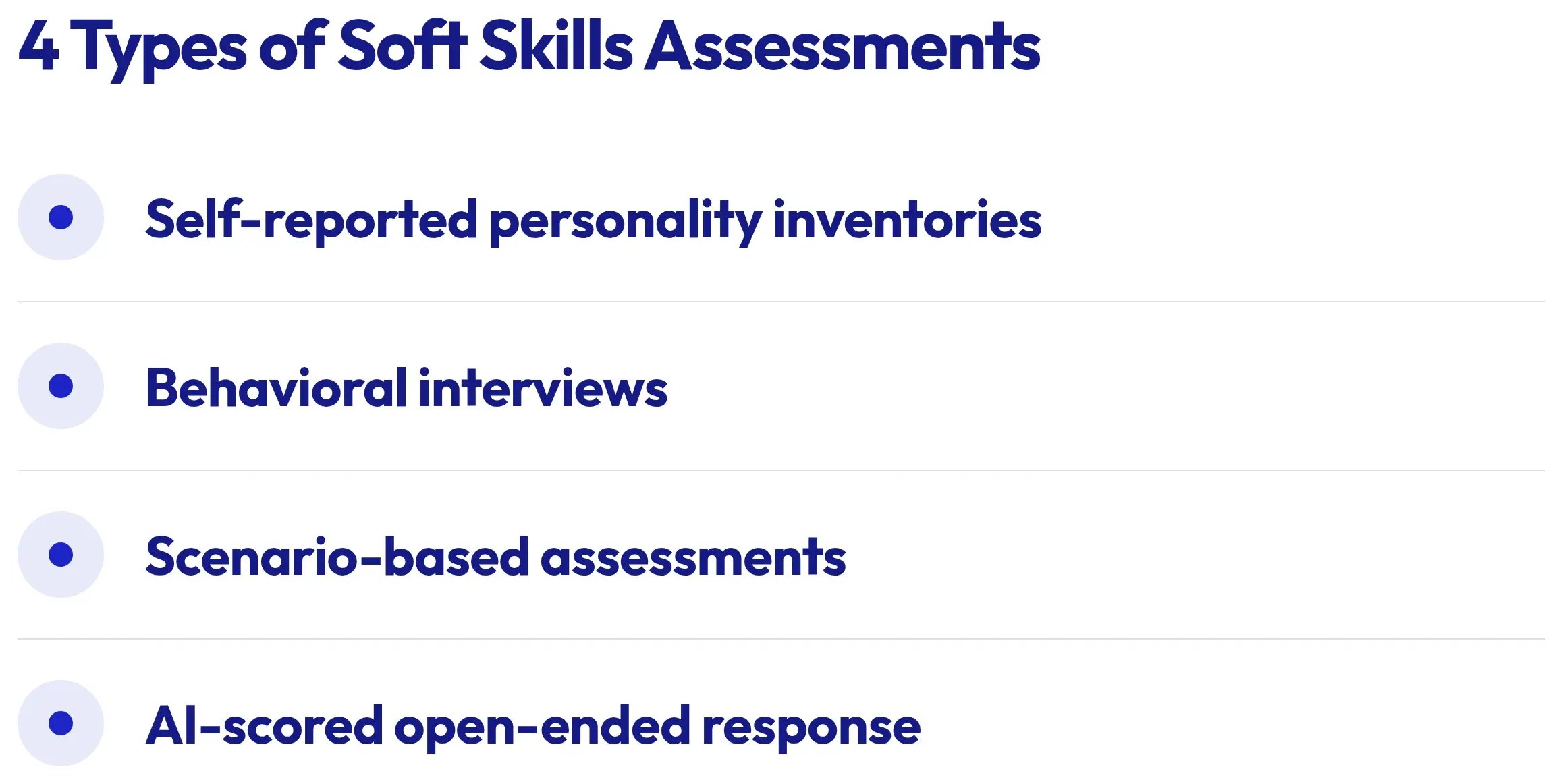 4 Types of Soft Skills Assessments
Soft skills can be measured in several different ways, and each method captures a slightly different view of how a person shows up in the work.
Self-reported personality inventories
Self-reported personality inventories ask people to describe their own tendencies, preferences, and patterns. These tools are useful for building self-awareness and creating a shared language around style, but they still rely on what individuals say about themselves, often in ideal or abstract terms. As a result, they are generally better suited for reflection and team discussions than for high-stakes decisions about demonstrated capability.
Behavioral interviews
Behavioral interviews use structured questions about past experiences (“Tell me about a time when…”) to infer how someone might behave in the future. When they are well designed, they follow a consistent script, probe for specific examples, and score responses against clear criteria, which makes them more reliable than unstructured conversations. However, they still depend on memory, storytelling skill, and interviewer judgment, and they can easily reward practiced narratives over the behaviors that show up under real pressure.
Scenario-based assessments
Scenario-based assessments present people with realistic, work-like situations and ask them to choose a response, rank options, or describe what they would do. Because these scenarios mirror the ambiguity, trade-offs, and constraints of actual roles, they are better at revealing how someone thinks, prioritizes, and collaborates in context.
When responses are scored with a consistent rubric, scenario-based assessments provide a more direct read on soft skills as they are likely to appear on the job, not just in theory.
AI-scored open-ended response
AI-scored open-ended response assessments ask people to respond in their own words by writing, speaking, or both to prompts that simulate real work situations. Instead of selecting from predefined options, participants explain how they would approach a problem, communicate with stakeholders, or navigate a conflict, and those responses are scored using models trained on expert judgments.
This format combines the richness of free-form answers with the consistency and scalability of automated scoring, making it possible to evaluate soft skills at scale while still capturing nuance in how people reason and communicate.
Comparing Types of Soft Skills Assessments
| Assessment type | What it measures | Best used for |
|---|---|---|
| Self-report / personality inventory | Self-described traits and preferences | Self-awareness, shared team language, coaching conversations |
| Behavioral interview | Past experiences and narrated behavior | Complementing other evidence in later-stage hiring |
| Scenario-based assessment | Decisions and behavior in realistic situations | Pre-hire and internal assessments of role-relevant soft skills |
| AI-scored open-ended response | Reasoning, communication, and judgment in context | Scaled, high-fidelity read on how people think and communicate |
Why Soft Skills Are So Hard to Measure
Soft skills may seem intuitive, but assessing them accurately is a nontrivial measurement problem.
- Right-answer problem: Assessments for technical skills are straightforward; there’s usually a clear right or wrong answer. Many soft skill assessments inadvertently reward test-taking skill rather than revealing communication or creative thinking skills.
- Self-report reliability problem: Surveys and personality inventories depend on how people see themselves (or want to be seen), which makes the data vulnerable to social desirability, optimism, and uneven self-awareness.
- Context-dependence problem: The same person may show very different behavior across roles, cultures, and situations, so a single, decontextualized score often hides more than it reveals about real-life capability.
When to Use Soft Skills Assessments
Soft skills assessments are most effective when they are tied to specific moments in the employee lifecycle, especially where clearer evidence of behavior can change the outcome of a development program or a hiring decision.
Soft Skills Assessment for L&D Programs
In learning and development programs, a soft skills assessment can be used to create a clear before-and-after picture of how participants behave in realistic work situations.
A baseline assessment at the start of a program captures current responses to scenarios involving conflict, ambiguity, priority-setting, and collaboration, turning broad goals like “stronger leadership” into concrete, observable capabilities. After the program, participants complete the same or a parallel assessment, producing a scored profile that shows where capabilities have strengthened, where they have remained flat, and which individuals may need a different kind of support to close a skills gap.
This pre/post structure gives L&D leaders credible evidence that development efforts are driving real behavioral change rather than just delivering positive experiences. They can show stakeholders how specific cohorts have shifted on targeted capabilities, connect those shifts to performance outcomes or promotion readiness, and refine program design based on which skills move most. For a deeper look at how this works in practice, see the Ignis learning and development use case.
Soft Skills Assessment for Talent Acquisition
In talent acquisition, soft skills assessments introduce a structured, pre-hire, scenario-based evaluation that complements interviews rather than trying to replace them. Job candidates are placed in realistic, role-specific situations, such as juggling conflicting priorities, dealing with a difficult stakeholder, or making a decision with incomplete information, and their responses are scored against a consistent standard. This surfaces how candidates communicate, make trade-offs, escalate issues, and collaborate under constraints, long before they are in the role.
The result is a layer of behavioral evidence that traditional interviews, which often reward rehearsal and confidence, routinely miss. Hiring teams gain a clearer view of candidates’ strengths and risk factors, can probe more precisely in later stages, and can make offers with greater confidence about how someone will operate day to day. Because every candidate completes the same scenarios under the same conditions, these assessments also add a more comparable, more defensible basis for decisions.
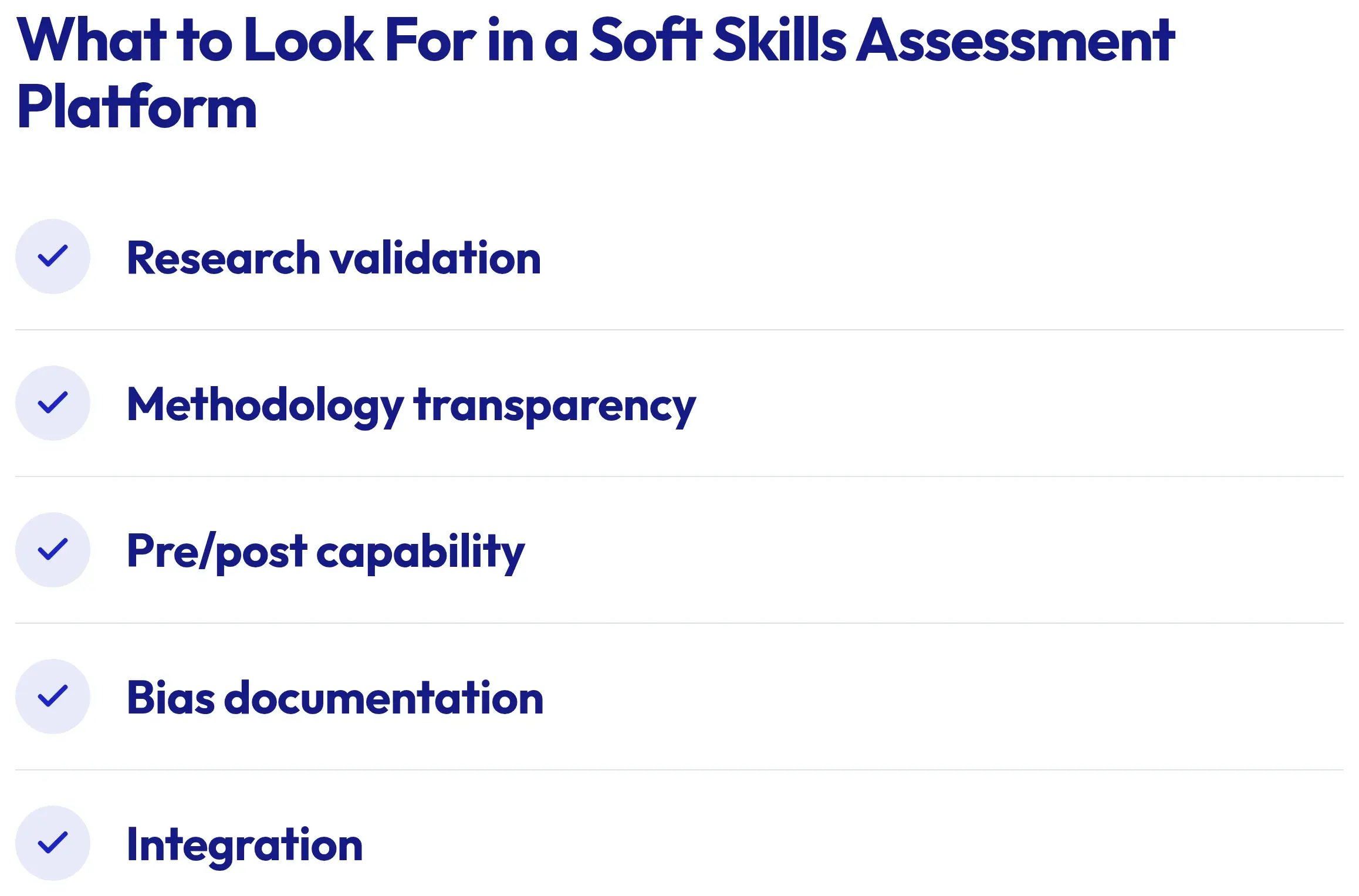 What to Look For in a Soft Skills Assessment Platform
When evaluating soft skills assessment platforms, it helps to look beyond surface features and focus on whether the underlying science, design, and integrations can support fair, predictive, and repeatable decisions about human capability.
- Research validation: A credible soft skills assessment platform should provide clear evidence that its measures predict real outcomes, such as performance, promotion, or retention, backed by documented reliability and validity studies rather than marketing claims alone.
- Methodology transparency: The platform should openly explain how scenarios are designed, how responses are captured, and how scoring works, so it is clear what is being measured and how results should be interpreted.
- Pre/post capability: Strong platforms support both baseline and follow-up assessments, making it possible to measure capability at multiple points in time and see whether coaching, training, or role changes are shifting behavior.
- Bias documentation: The provider should publish analysis of potential bias and adverse impact, including how different demographic groups perform and what safeguards are in place to reduce unfair disadvantage in high-stakes decisions.
-
Integration: A practical platform connects smoothly to existing systems (ATS, HRIS, LMS, analytics tools) so assessments can be triggered automatically, results are easy to access, and insights can flow into day-to-day hiring and development workflows.
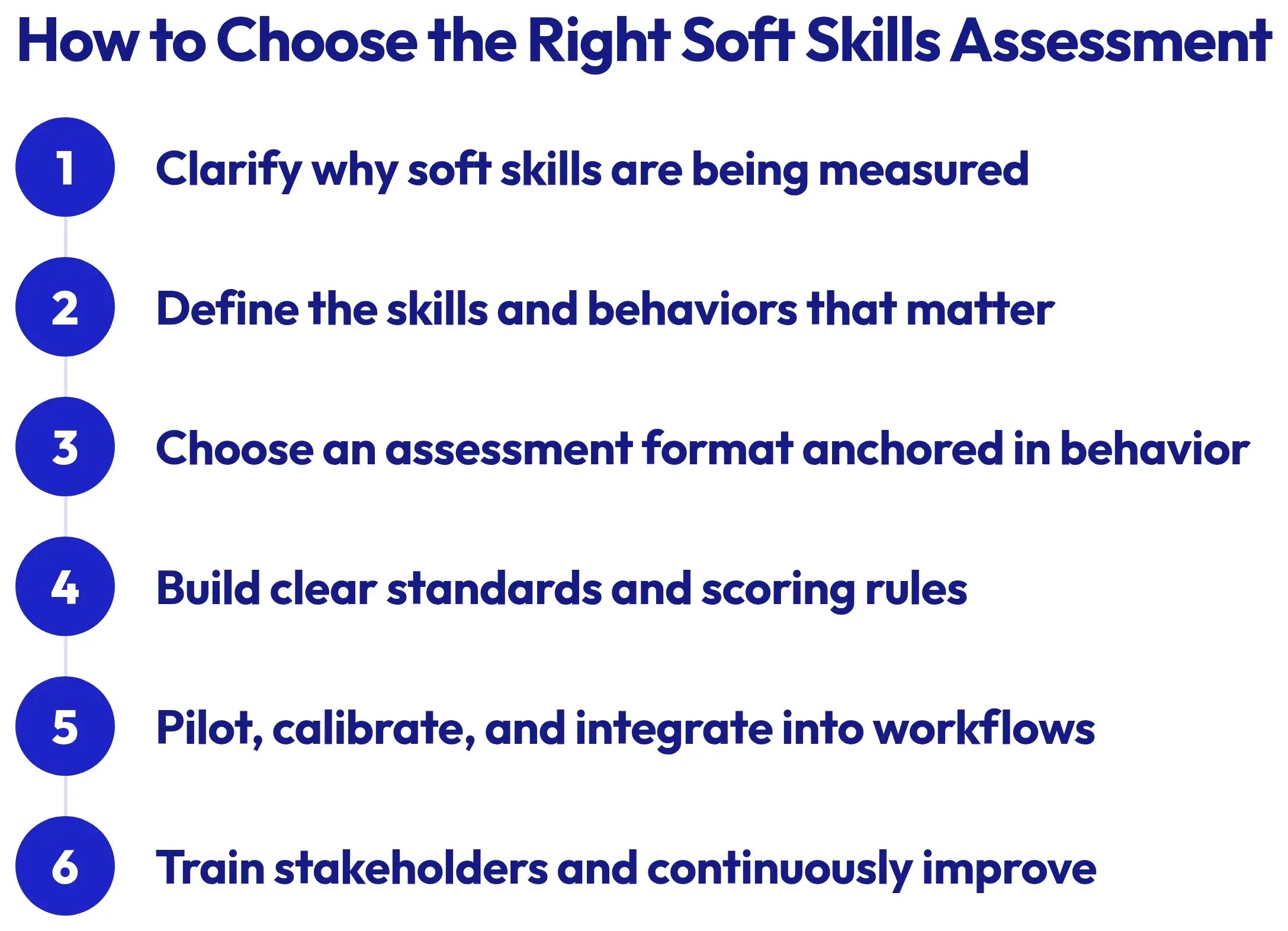 How to Choose the Right Soft Skills Assessment
Choosing the right soft skills assessment is a staged process that starts with clarifying why soft skills are being measured and which behaviors matter most, then selects and calibrates a behavior-based tool that can be embedded into your hiring and development workflows.
Step 1: Clarify why soft skills are being measured
The process starts by getting clear on why soft skills need to be measured and how the results will be used. An organization defines whether the primary goal is better hiring decisions, promotion readiness, leadership development, team coaching, or an external credential. From there, it becomes easier to pinpoint where decisions could meaningfully change because of the assessment, such as who advances in a hiring funnel, who enters a development program, or how performance expectations are communicated. That keeps the entire effort grounded in real outcomes instead of abstract interest.
Step 2: Define the skills and behaviors that matter
Once the purpose is clear, attention shifts to the specific roles and situations where soft skills make or break performance. Critical jobs and typical challenges are examined, and those are translated into observable behaviors like handling conflict constructively, asking clarifying questions, prioritizing under pressure, or escalating issues appropriately. These behaviors are then grouped into a concise set of core capabilities, such as communication, collaboration, judgment, adaptability, and leadership, so that the assessment focuses on what really matters rather than an endless list of generic traits.
Step 3: Choose an assessment format anchored in behavior
With target capabilities defined, the next step is to choose an assessment approach that elicits real behavior instead of just collecting self-descriptions. Preference is given to formats like simulations, situational judgment tasks, structured work samples, or other scenario-based exercises that mirror real-world situations and force realistic trade-offs. This ensures that soft skills are evaluated through what a person does in context, including how they respond to ambiguity, competing priorities, or difficult stakeholders, rather than through personality labels or self-ratings that may not translate into performance.
Step 4: Build clear standards and scoring rules
After the format is selected, the assessment needs clear standards so that performance can be interpreted consistently. Behaviorally anchored rubrics are created for each scenario, describing what below-standard, acceptable, and excellent responses look like in concrete terms. These standards are calibrated to the expectations of different roles. For example, what is acceptable judgment for an individual contributor might be insufficient for a people leader, and are refined with input from HR, hiring managers, and proven high performers, so that scores reflect the organization’s real bar rather than one person’s opinion.
Step 5: Pilot, calibrate, and integrate into workflows
Before an assessment is fully adopted, it is piloted with a representative group that includes high performers, average performers, and recent hires in relevant roles. Their results are compared to known outcomes like performance ratings, manager feedback, and promotion history, and qualitative feedback is gathered on realism, clarity, and fairness. Based on those insights, rubrics are adjusted, score ranges are set, and decision rules are clarified. The assessment is then integrated into existing hiring or development workflows at specific touchpoints, with clear ownership for administration, interpretation, and feedback so that it becomes a natural part of how the organization operates.
Step 6: Train stakeholders and continuously improve
Finally, stakeholders are trained on how to read and use the results responsibly, with practical examples that show what different score profiles mean and how they should influence decisions. Managers and HR partners learn to combine assessment results with interviews, track records, and other evidence, rather than over-weighting a single data point. Over time, outcomes such as hiring quality, performance, retention, and diversity are monitored to see whether the assessment is truly predictive and fair, and the content is refreshed as roles, strategies, and working conditions evolve, ensuring the system stays relevant and credible.
4 Common Soft Skills Assessment Mistakes
Common soft skills assessment mistakes often come from confusing what is easy to collect with what is reliably predictive of behavior.
Treating self-reporting as behavioral evidence
A common mistake is treating self-report questionnaires, personality inventories, or “rate your own skills” surveys as if they were direct evidence of behavior. Self-report captures what people think about themselves, how they want to be seen, or how they believe they behave in ideal circumstances, not what they consistently do under pressure, ambiguity, or constraint. When organizations treat self-descriptions as proof of capability, they end up rewarding confidence, self-awareness, or social desirability rather than real judgment, collaboration, or resilience. Over time, this creates a mismatch between the “profile” on paper and the way someone shows up when performing complex work.
A more rigorous approach treats self-reporting as one input and never as the primary source of evidence for soft skills. Behavioral assessments focus on how a person responds in realistic scenarios, what trade-offs they make, how they communicate under constraints, and how they navigate conflict or uncertainty. That shift is what turns a soft skills assessment from a personal branding exercise into a credible predictor of performance.
Using one assessment for everything
Another widespread mistake is trying to use the same soft skills assessment for very different purposes, such as both learning and development (L&D) and talent acquisition (TA). Development tools are often designed to generate insight, reflection, and coaching conversations; they may be broad, descriptive, and forgiving, because the goal is growth, not gatekeeping. Selection tools, by contrast, need to support high-stakes decisions, withstand scrutiny, and clearly differentiate who meets the bar for a given role and who does not. When a single instrument is stretched across both use cases, it usually ends up doing neither job well.
Choosing an assessment based on familiarity
A related error is selecting assessment tools primarily on brand recognition or popularity rather than on fit for the specific roles, behaviors, and decisions at hand. Well-known tools can feel “safe” or familiar, but that does not mean they are aligned with the organization’s competency model, evaluation standards, or legal defensibility requirements. The result is a polished experience that looks serious but doesn’t actually improve hiring accuracy or development outcomes. The better path is to treat L&D and TA as distinct use cases, choose or configure tools accordingly, and evaluate assessment options on evidence and design, not just on name recognition, marketing, or trendiness.
Confusing engagement with insight
Another common mistake is assuming that an assessment is valuable because it is engaging, novel, or aesthetically impressive. Interactive exercises, gamified interfaces, and slick reports can create a strong “wow” factor; candidates and employees may enjoy the process and give positive feedback. However, enjoyment is not the same as insight, and a fun experience is not automatically a valid measure of soft skills. When organizations equate engagement with quality, they risk investing in tools that generate attractive dashboards and memorable debriefs but offer little real signal about how someone will perform.
True insight requires that an assessment elicit meaningful behaviors, apply consistent scoring, and connect those scores to outcomes that matter in the work. This often means prioritizing clarity and rigor over entertainment value: designing scenarios that mirror actual challenges, capturing nuanced responses, and reporting results in a way that informs decisions. Engagement still matters, especially for adoption and candidate experience, but it should serve the assessment’s purpose rather than substitute for it. The goal is not just to keep people interested; the goal is to see them clearly.
Soft Skills Assessment: Bringing Rigor to the ‘Human’ Side of Performance
Soft skills have always been central to performance, but until recently they were treated as too intangible to measure with any real rigor. For HR and L&D leaders, that gap has meant investing heavily in leadership programs, manager training, and culture initiatives without a reliable way to show whether people are getting better at the behaviors that matter most.
A structured soft skills assessment helps close that gap by shifting the focus from self-perception to observable capability in realistic situations. When that evidence is built into hiring, promotion, and development decisions, organizations gain something they have not had before: a common language for human capability, a fairer basis for high-stakes judgments, and a measurable link between “soft” skills and hard outcomes.
Frequently Asked Questions
What is a soft skills assessment?
A soft skills assessment is a structured process for measuring demonstrated human capabilities (how a person thinks, communicates, leads, and collaborates) using observed behavior rather than self‑reported traits. Unlike personality profiles that describe preferences, a rigorous soft skills assessment evaluates what an individual can actually do in realistic situations, which is why it more accurately predicts job performance than a personality test.
How do you assess soft skills in candidates?
Soft skills in candidates are most reliably assessed with a structured, scenario‑based evaluation that every candidate completes before hire under the same conditions. Instead of relying on candidates’ self‑descriptions, this approach places them in realistic, work‑like situations and scores their responses against a consistent standard, revealing demonstrated capabilities (how they handle conflict, communicate, and collaborate) that traditional interviews often miss, while providing a fair and defensible basis for comparison.
How do you assess soft skills?
Soft skills are assessed by observing how a person behaves in specific situations and scoring that behavior against a defined standard, rather than relying on self‑report surveys or unstructured impressions. Effective soft skills assessments present multiple scenarios that require the target skill, capture what the individual actually does, and use a validated rubric to score performance across those situations, inferring the underlying capability from consistent patterns instead of from a single answer.
How do you assess soft skills in an interview?
Soft skills in an interview context are best assessed by combining the interview with a structured, scenario‑based assessment, because interviews alone are weak predictors of performance and tend to reward rehearsed stories and confidence over real capability. Using the same scored assessment for every candidate provides a consistent, comparable read on demonstrated skills such as communication and decision‑making, while the interview can then focus on role fit, motivation, and added context for the behaviors revealed by the assessment.