How to Measure Training Effectiveness
Many L&D teams still primarily evaluate training effectiveness by tracking whether people showed up and whether they liked it. That’s not the same thing as using data to measure training outcomes.
When 93 percent of organizations rely on participant satisfaction to measure training, and fewer than half track behavior change, it’s no surprise that budget conversations stall (ATD, “Beyond the Survey,” 2025). Leaders are asking, “What did this training actually do?” and the only data available is answering, “People liked it.”
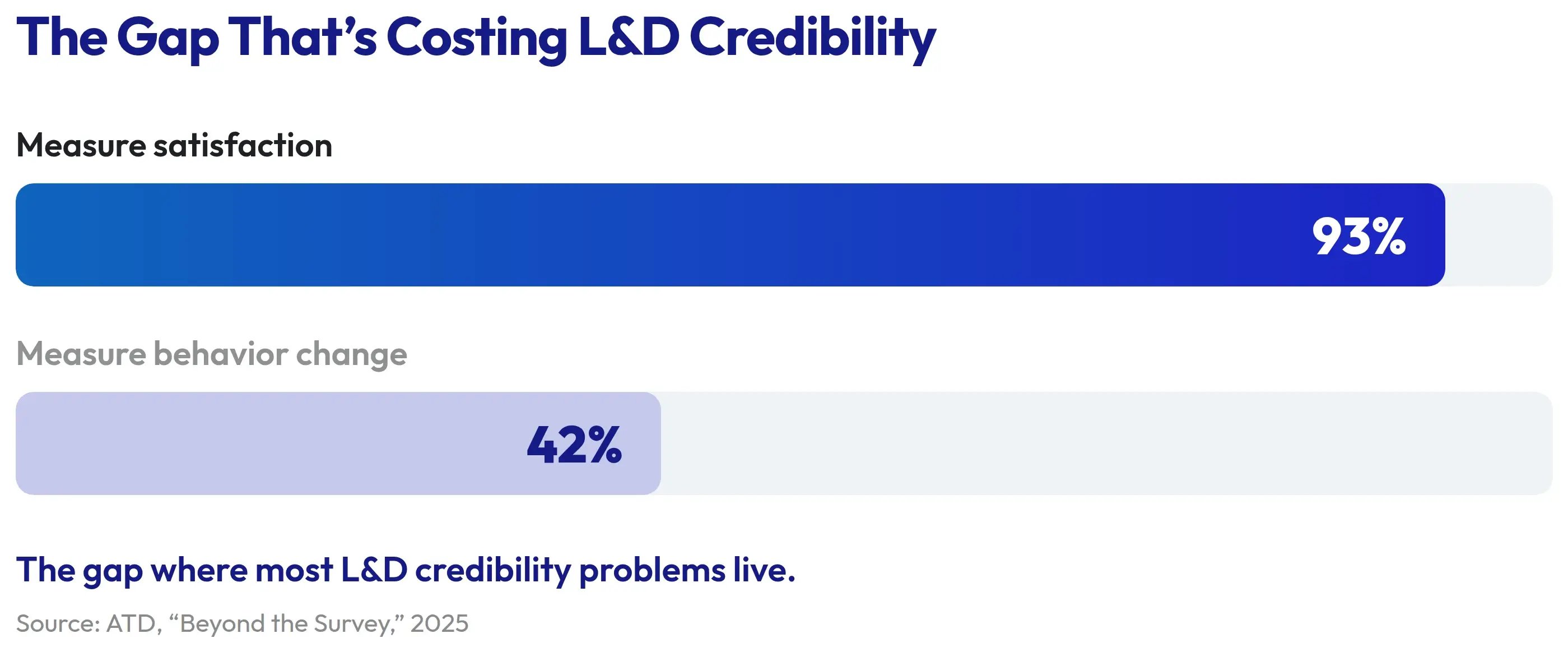
If you want to measure effectiveness in a way that stands up in a business review, you need to gather more than attendance rates. You need pre and post training data on the specific knowledge and skill your training programs target: a baseline before the work starts and another assessment after it ends.
What Most Training Evaluation Measures (And What It Doesn’t)
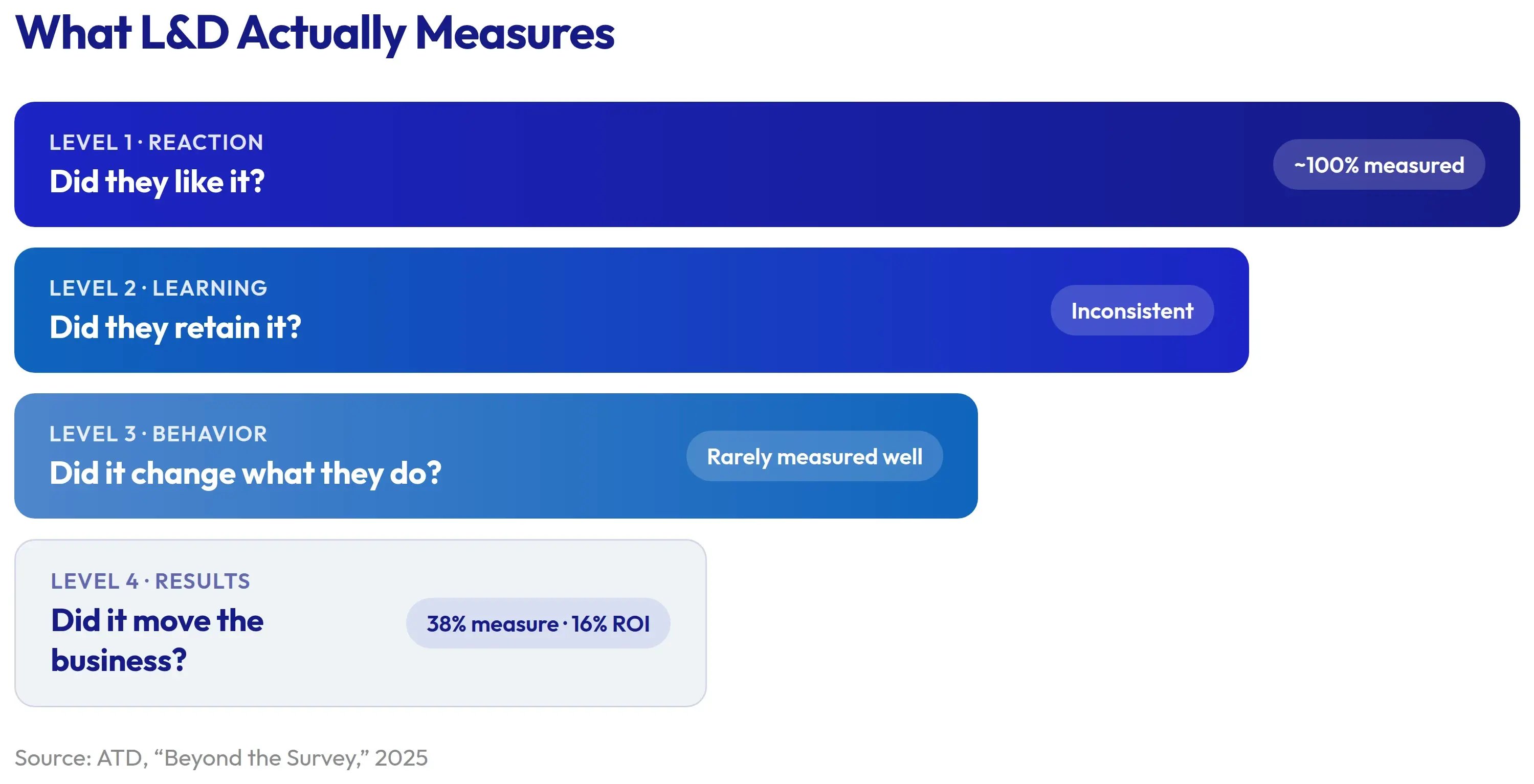
The Kirkpatrick model has dominated among training evaluation models for decades. L&D teams use the Kirkpatrick framework as a reference model for planning evaluation, deciding which data to collect, and communicating impact to stakeholders.
- Level 1 reaction is the one most organizations measure consistently, often through post-program surveys that look a lot like customer satisfaction instruments. These tell you whether people liked the experience, but Level 1 ratings correlate with actual learning outcomes at only about 10 percent.
- Level 2 learning is usually measured with knowledge tests or quizzes administered at the end of a program. At this level, you’re asking whether participants acquired the intended knowledge and skill, but a high score mainly reflects gained knowledge about concepts, not necessarily the knowledge skills required to use them in context. A manager who scores well on a post-training quiz about leadership frameworks may or may not apply what they learned when it matters.
- Level 3 behavior is most commonly measured through manager observation ratings: did this person’s behavior change on the job after the training, and did any real learning transfer occur into their day-to-day work? The problem is that two managers rating the same person's leadership growth after the same program can arrive at entirely different conclusions. The data is subjective, delayed, and nearly impossible to aggregate meaningfully across a cohort.
- Level 4 results is meant to capture the business impact of training (such as higher sales, better retention, faster project delivery, improved engagement, or stronger key performance indicators), but in practice it usually collapses into a vague before/after story that can’t isolate the effect of the program from everything else happening in the business.
Kirkpatrick is still useful because it gives L&D a simple, shared language for connecting training to impact, but it isn’t comprehensive enough on its own to capture complex, long-term skill development and all the contextual factors that drive performance.
Design Requirements for Pre-Training Assessment
A pre-training assessment must be designed in a way that gives you a reliable, meaningful baseline for the skills your program is supposed to move.
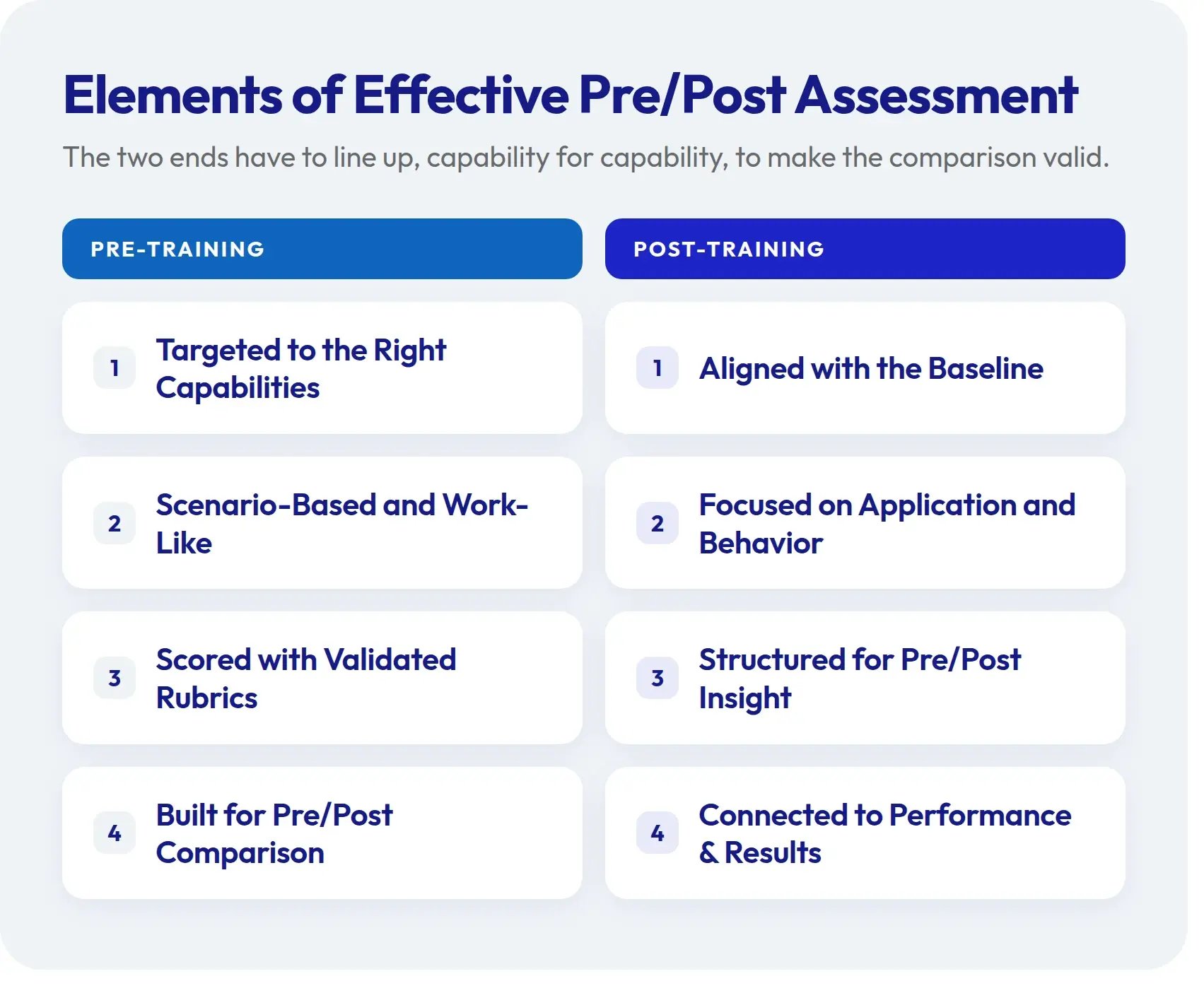
Targeted to the Right Capabilities
It must focus on the specific knowledge and skill the training program is designed to develop, not the entire competency model. A communication program, for example, should assess communication and collaboration behaviors, not every “Power Skill” you care about.
Scenario-Based and Work-Like
It must present realistic, work-like situations and ask participants to respond in their own words, rather than simply rating themselves on a scale. This kind of scenario-based design shows what people can actually do before training, not just what they say they know or how confident they feel.
Scored with Validated Rubrics
It must use clear scoring rubrics calibrated to expert judgment and checked for consistency and fairness. That scoring turns qualitative responses into reliable proficiency levels you can compare later, instead of vague impressions about readiness.
Built for Pre/Post Comparison
It must produce results on a scale that you can line up against post-training data, individual by individual, skill by skill. Without that kind of baseline, you can’t see learning transfer or measure effectiveness.
Design Requirements for Post-Training Assessment
A post-training assessment must be designed to show whether capability actually changed and whether people applied what they learned.
Aligned with the Baseline
It must measure the same capabilities, using the same or a parallel methodology and scoring framework as the pre-assessment. Mixing self-report before with scenario-based assessment after breaks the comparison, because the methods are measuring different things.
Focused on Application and Behavior
It must use tasks and scenarios that reveal how people make decisions, communicate, and execute differently after training. The emphasis is on whether they applied what they learned in realistic situations, not just whether they can recall content from the course.
Structured for Pre/Post Insight
It must report results on the same scale as the baseline so you can see movement in proficiency: who improved, who plateaued, and in which skills. That structure makes it possible to compare pre and post training data at both individual and cohort levels.
Connected to Performance and Results
It must be interpretable alongside relevant performance metrics and key outcomes: error rates, project delivery times, customer satisfaction, sales performance, or other indicators the program was meant to influence. That connection is where Level 4 results start to come into view.
How to Design a Pre/Post Assessment That Works
If you want pre and post training data that actually tells you whether a program worked, you can’t bolt the assessment on at the end. You have to build for it from the start.
Match the Assessment to the Program
The skills assessed pre and post should be the skills the program is designed to develop, not the full capability suite. A communication program warrants a communication and collaboration baseline; a leadership program might focus on decision making and feedback. Assessing every Power Skill for every program introduces noise and participant burden without adding measurement value, so scope the assessment to what this training actually targets.
Bracket the Program, Don’t Interrupt It
The pre-assessment should run before the first session and the post-assessment after the last. Assessments taken mid-program capture a work-in-progress rather than a program outcome. Timing also affects attribution: if the cohort baseline is taken a week before the program and the post-assessment three months after, factors other than the training may explain the change. Keep the window tight enough that the program is the plausible cause of any movement you see.
Use the Same Methodology on Both Ends
A self-assessment before combined with a scenario-based assessment after produces data that isn’t comparable, because the two methods measure different things. Consistency of method is what makes the comparison valid. Use the same construct, scoring approach, and scale in both directions so you can compare pre and post training results individual by individual, skill by skill. Switching instruments between pre and post is one of the most common design errors in training evaluation, and it renders the resulting data nearly meaningless.
Send Results Back to Participants
The data shouldn’t just flow up into leadership reporting; it should flow back to the people who took the assessments. Completion rates and program feedback rise when participants see their own assessment data used in ways that benefit them: informing a development path, shaping the next program, or clarifying what to work on. When results feed only into dashboards and slide decks, without closing the loop for participants, the assessment is harder to sustain at scale.
3 Ways to Put Pre/Post Training Data to Work
Evidence of skill change is worth having only if it changes what you do next. Pre/post capability data feeds three decisions that L&D leaders make every cycle.
- Budget Planning. Pre/post capability data lets an L&D leader track program impact. That is a qualitatively different conversation from reporting attendance, and it grows more defensible with each program cycle that adds to the longitudinal record.
- Program Improvement. Cohort-level pre/post data identifies which skills a program develops well and which it barely touches. A leadership program that reliably moves communication scores but leaves analytical thinking flat is telling you something specific about curriculum design. That feedback loop doesn’t exist when the only signals are completion and satisfaction.
- Individual Development Planning. Post-program profiles show where each participant landed, and because the baseline establishes where they started, the gap that remains is specific and actionable. The follow-on conversation changes from “here’s our standard next-step program” to “based on where you are, here’s what will move you most.”
Power Your L&D Budget Conversations with Better Pre/Post Assessment
The question isn’t whether to measure skills before and after programs. It’s whether you’re equipped to do it in a way that produces real evidence. Completion records and satisfaction scores aren’t going away, and they aren’t without value, but they don’t answer the business questions L&D is increasingly being asked to answer.