The Problem With Most Skills-Based Hiring
Everybody's talking about skills-based hiring (also called skill-based hiring). Almost nobody has figured out how to do it at scale.
A joint report from Harvard Business School and the Burning Glass Institute found that at large firms that publicly committed to skills-based hiring, the net increase in non-degree hires amounted to less than 1 in 700 new hires. Removing a degree requirement from a job posting changes almost nothing about who gets hired based on this criterion if the evaluation itself stays the same.
The reason most programs fall short is that the skills most predictive of on-the-job performance are also the hardest to assess. Technical skills can be tested. The capabilities that determine whether someone leads effectively, communicates well under pressure, and performs effectively in ambiguous situations require a fundamentally different measurement approach than most organizations have in place today.
What Is Skills-Based Hiring, and Why Does Skills Assessment Break Down?
Skills-based hiring means evaluating what candidates can demonstrate rather than what they can credential, such as with college degrees. Most organizations have interpreted this as removing barriers to entry, dropping degree requirements, and loosening work experience filters. That's a meaningful start.
The harder part is changing how candidates are evaluated once they're in the recruitment and hiring funnel. Most skills-based hiring practices stop at the sourcing stage and don’t extend to structured interviews. A behavioral interview with a non-degree candidate yields the same unreliable data as with anyone else. The evaluation methodology hasn't changed; only the eligibility criteria have.
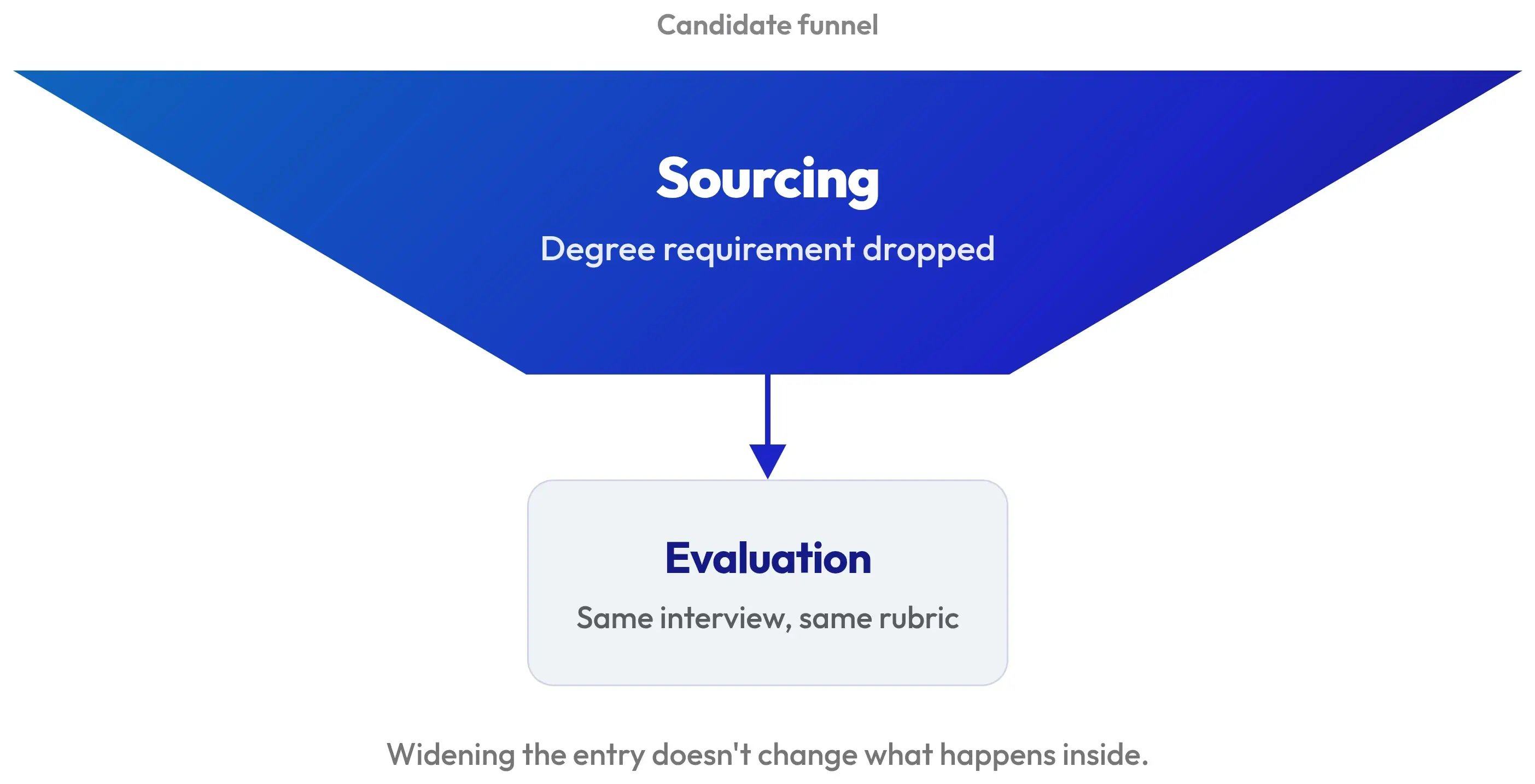
Demonstrated capability requires a specific kind of talent assessment to achieve real hiring outcomes, including realistic situations, constructed responses, and scores that are comparable across candidates and defensible under scrutiny.
For technical skills, this type of assessment is widely available. However, recruiters and hiring managers have historically lacked access to a comparable level of infrastructure for the soft skills that drive performance in most roles, such as how someone leads, communicates, collaborates, and thinks under pressure.
7 Power Skills That Predict Job Performance
The capabilities that predict whether a hire will succeed aren't the ones that show up most clearly on a résumé. In a workplace where AI handles more of the technical execution, the differentiating capabilities are the learnable interpersonal and cognitive ones. How does someone lead a team through ambiguity, communicate across functions, think creatively under constraint, and navigate performance without a clear playbook?
These aren't fixed traits you're born with; they are specific skills that grow with learning and development support and decay without it. Ignis measures seven of them, captured in a candidate's PowerSkillsPrint™, the profile that scores each skill independently rather than collapsing them into a single fit score.
- Leadership. Mobilizing people and resources through self-awareness, clarity, and integrity.
- Analytical Thinking. Interpreting information, identifying patterns, and making sound decisions under uncertainty.
- Collaboration. Building trust, working across teams, and turning diverse perspectives into shared outcomes.
- Communication. Conveying ideas clearly and persuasively while adapting to different audiences and contexts.
- Creative Thinking. Generating novel ideas, reframing problems, and designing effective solutions under constraint.
- Productivity. Focusing on what matters most and delivering consistent results with discipline.
- AI Fluency. Understanding, questioning, and responsibly using AI tools to enhance judgment and performance.
These are the skills that decide whether a candidate will grow into a role, build trust across a team, and perform when situations don't follow a script. They're also the hardest to surface with the tools most hiring processes currently use, which is exactly why they get left out of the evaluation. These skills are often known as “soft skills,” which unfortunately minimizes how essential they are in today’s workplace.
3 Reasons Skills-Based Hiring Is Hard to Do Well
Three challenges account for most of the gap between adopting skills-based hiring in theory and actually seeing success in practice.
Interviews Reward Rehearsal, Not Ability
Behavioral interviews ask candidates to describe how they've handled situations in the past. The premise has some merit, but interviews are inconsistent across candidates, gameable with preparation, and heavily influenced by how articulate someone is under artificial pressure. Articulateness is one component of communication. It isn't the same as how someone listens, leads, or navigates conflict in a real work situation. The confident talker who interviews far better than they work is a familiar hiring mistake for a reason.
Self-Reports Measure Self-Image, Not Capability
Personality inventories and ratings for skills and competencies ask candidates to characterize themselves. They produce reliable data about self-image, which is a poor proxy for demonstrated capability. We all want to believe we are top talent, and we tend to overestimate our communication skills and underestimate our analytical thinking. That’s why self-reporting and observation often point in opposite directions. Two candidates can score identically on a strengths assessment and perform very differently in a real leadership situation. The relationship between self-reported traits and behavioral performance is weak, a long-term pattern that holds across decades of psychometric research and shows up directly in Ignis's validation data.
Personality Tools Weren't Built to Measure Skill
Many organizations layer instruments such as CliftonStrengths, Hogan, SHL, or DISC into their talent assessment processes. These personality and preference assessments have value for coaching, team composition and self-awareness but replacing credential filters with personality profiles swaps one proxy for another.
Ignis AI was designed to measure behavioral capabilities.
How to Assess Skills Before You Hire
How to implement skills-based hiring comes down to one shift: Rigorous skills assessment for these capabilities requires putting candidates in realistic situations and evaluating how they respond. Not how they describe past behavior, but what they demonstrate when faced with a work-like challenge.
Consider this example: A candidate is handed an ambiguous project brief with competing priorities, a slipping timeline, and no clear owner, then asked what they'd tackle first and why. There's no single correct answer, but there are clearly better and worse ones. Someone who jumps in and starts working immediately is demonstrating something qualitatively different from the person who asks questions to identify the real constraint, sequences the work against it, and explains the tradeoff they're accepting. That response shows analytical thinking and judgment in a way no résumé line can.
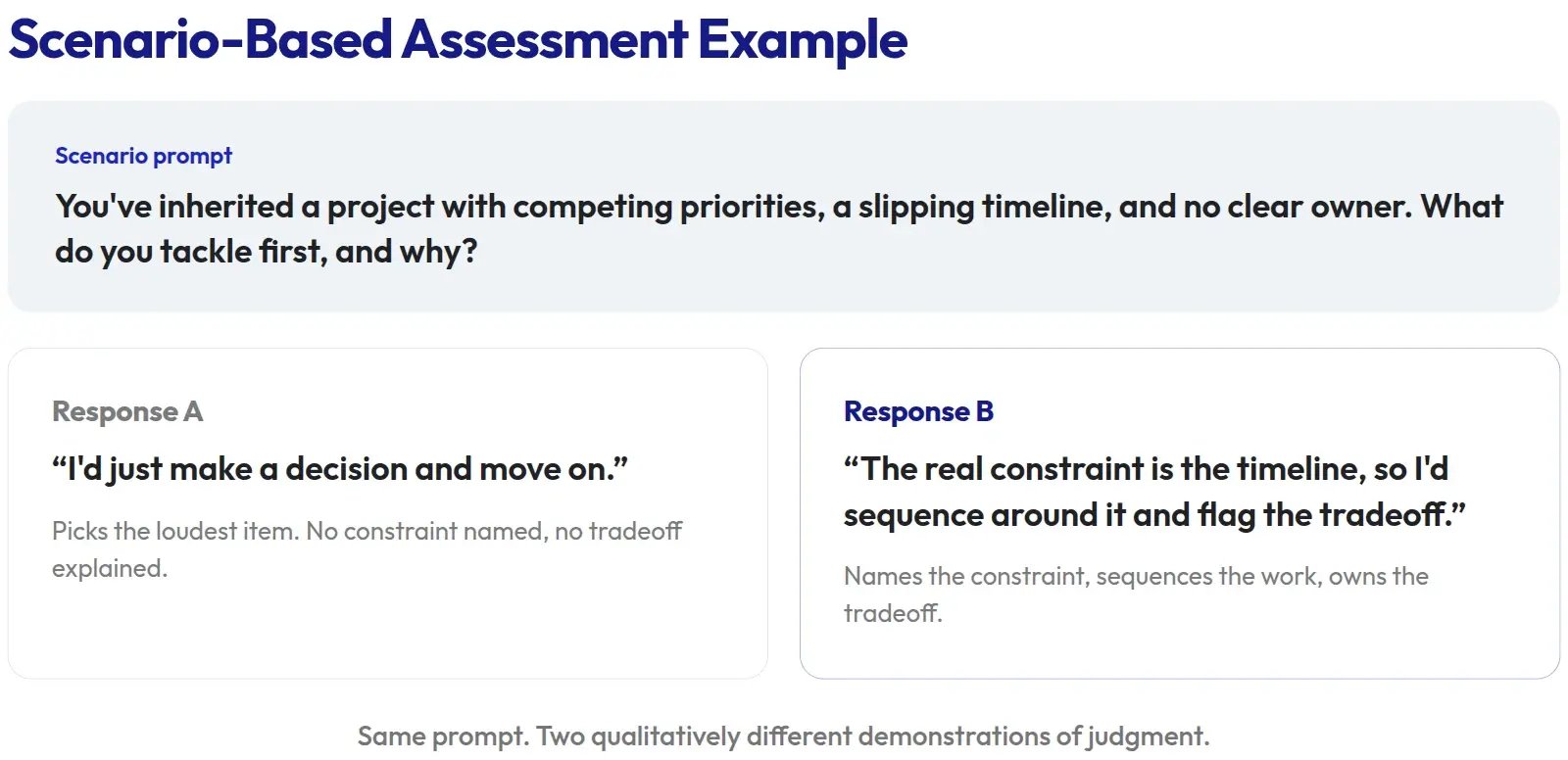
Scoring such responses reliably takes rubrics built by assessment scientists, AI calibrated to expert judgment, and multiple independent scoring models to reduce variance.
The structure behind that scoring has three parts.
- First, a scenario is designed around a real job demand, like the ambiguous brief above, so the task itself focuses on the target skill instead of general aptitude.
- Second, multiple independent AI scoring models rate the response against the same rubric, which cancels out the bias any single model would introduce.
- Third, those scores feed a latent variable proficiency estimate, a statistical model that infers the underlying skill level a candidate is likely to carry into the job, rather than just averaging raw scores.
That structure, not any single scenario, is what makes the output comparable across candidates and roles.
Realizing the Potential of Skills-Based Hiring
The premise behind skills-based hiring is sound and can identify large talent pools of qualified candidates when done right. Currently, the gap is that most programs stop at credential removal and call it done. Measuring the capabilities and specific competencies that predict performance, the ones that don't have answer keys, requires a different kind of assessment infrastructure than most organizations have invested in building. Hiring is also only half the equation; the same capabilities that decide who gets hired have to be reinforced with skills-based training and development once someone is on the team. Skills-based recruiting works only when the measurement changes, not just the eligibility screen in front of it.
Frequently Asked Questions
What is skills-based hiring?
Skills-based hiring is a talent acquisition approach that evaluates candidates on demonstrated capability rather than credentials or job history. Instead of inferring what someone can do from their résumé or degree, skills-based hiring uses structured assessment to observe what candidates do in situations that reflect the demands of the role.
What's the difference between skills-based hiring and traditional hiring?
Traditional hiring infers capability from credentials such as degrees, job titles, years of experience, and brand-name employers. Skills-based hiring evaluates demonstrated performance directly. The difference matters most for the capabilities that are hardest to credential, including leadership, communication, collaboration, and creative thinking.
Why do most skills-based hiring programs fall short?
Most programs replace degree requirements with other proxies: behavioral interviews, personality assessments, years-of-experience filters. None of them solves the underlying measurement problem. Rigorous skills-based hiring requires scenario-based assessment that produces comparable, evidence-based scores. Most organizations still use tools that produce ratings and opinions rather than comparable evidence of capability.
What is scenario-based assessment?
Scenario-based assessment presents candidates with realistic, work-like situations and evaluates how they respond. Unlike multiple-choice tests or self-report inventories, scenario-based assessment produces observable behavioral evidence that can be scored against validated rubrics. This is the method that produces the comparable, defensible data required of skills-based hiring.
How do you measure soft skills in hiring?
Measuring soft skills in hiring requires scenario-based behavioral assessment, structured situations that require a constructed response, scored against rubrics developed by assessment scientists and calibrated to expert judgment. Self-report tools and behavioral interviews aren't reliable proxies for demonstrated soft skills capability.
What role do assessments play in skills-based hiring?
Assessment is where skills-based hiring either works or doesn't. Removing degree requirements changes who enters the funnel but doesn’t necessarily close skills gaps. Assessment determines whether the evaluation itself measures capability or merely replaces one proxy with another. Without a validated, scenario-based assessment, a skills-based hiring program is a sourcing change, not a measurement change.
Is skills-based hiring better for diversity and inclusion?
It can be, but only when the assessment is designed to avoid the bias patterns that traditional hiring reinforces. Scenario-based behavioral assessment, when built and validated correctly, reduces the influence of pedigree, self-presentation, and familiarity effects that favor certain candidate profiles. Ignis's validation research showed no adverse impact by race or gender across its seven Power Skills assessments, but that outcome depends on assessment design, not on the decision to drop degree requirements alone.