Workforce Assessment in the Age of AI
Your org chart shows who holds which title. It doesn't show who can do the work. For that, you need a comprehensive workforce assessment.
And thanks to AI, you need a system that can conduct those assessments more often than once a year. The skills a role requires are shifting faster than most assessment tools were designed to track. Employers expect 39% of workers' core skills to change by 2030, according to the World Economic Forum's Future of Jobs Report 2025.
What Is a Workforce Assessment?
A workforce assessment measures capability rather than credentials. Run at the individual level, it tells a manager what one person can do. Aggregated across a team or a company, it tells a CHRO or a CEO what the organization can do. A complete assessment covers three things:
- Technical or job-specific skills: the specific, teachable parts of a job, like running the software, following the process or applying a certification.
- Behavioral and interpersonal tendencies: how someone tends to work, drawn from structured interviews or self-report tools.
- Power Skills: applied capabilities such as communication and analytical thinking that determine how someone performs once the technical requirements are met.
Benefits of Regular Workforce Assessments
Run once, an assessment is a snapshot. Run on a cycle, it becomes evidence a manager can point to when defending a hiring, promotion or training call.
- Keep pace with evolving roles. The skills that mattered at last year's assessment aren't guaranteed to be the skills that matter now, especially where AI has changed what the work involves.
- Track growth in real time. People develop unevenly and often quickly. Someone six months into a role has a different capability profile than they did at six weeks, and a one-time assessment can't show that movement or credit it.
- Create a dynamic view for workforce planning. Individual results compound into organizational insight. Enough current, comparable data points build a live map of what the workforce can do collectively.
How Do You Assess Workforce Capability at Scale?
Assessing one person well isn't hard. Assessing the whole workforce, on a cadence that keeps pace with how fast roles and skill needs change, is a different problem.
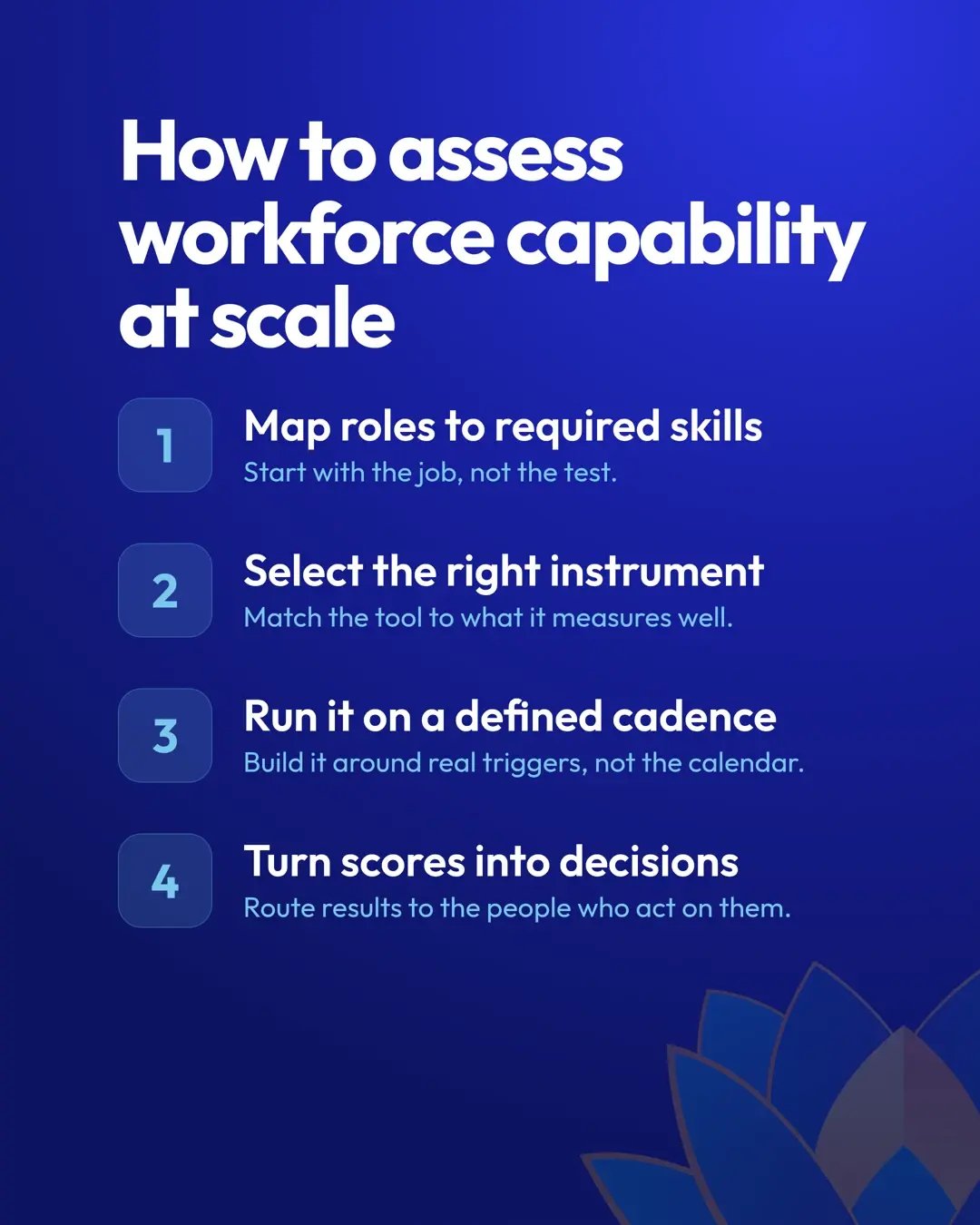
Map Roles to Required Skills
Start with the job, not the test. Define which technical skills, behaviors and Power Skills each role depends on before choosing an instrument, so the assessment measures what the job needs rather than whatever a vendor already sells.
- Pull the skill requirements from the role itself: the tools it uses, the decisions it makes, the people it depends on.
- Separate must-have skills from nice-to-have ones. Testing everything with equal weight dilutes the signal on what predicts performance.
- Revisit the map when the role changes, not on a fixed annual schedule.
Select the Right Instrument for Each Skill Type
Match the tool to what it measures well. A single test format forces every skill through the same lens, which is why technical skills, behaviors and Power Skills need different instruments.
- Technical and job-specific skills: structured skills inventories or task-based simulations tied to the actual tools and processes a role uses.
- Behavioral and interpersonal tendencies: structured interviews or situational judgment tests that produce comparable, role-relevant signal.
- Power Skills: scenario-based assessments that score a person's own response against an expert-built rubric. These skills don't reduce to a multiple-choice answer key.
Run the Assessment on a Defined Cadence
A single assessment event is a project. A recurring one is a system. Build the cadence around real triggers, not a calendar default.
- Assess before a hire, at a promotion or succession decision, and around a training program, at minimum.
- Add a scheduled cycle, at least annually, so the data stays current between those trigger events.
- Keep the format and scoring consistent across cycles so results are comparable over time, not just within one round.
Turn Scores Into Decisions
The value of an assessment comes through when its output reaches the people who act on it.
- Route individual results to the manager making the actual hiring, promotion or development call.
- Roll results up for leadership so capability gaps show up in planning and budget conversations, not just individual files.
- Close the loop and retest after a role change or training program to confirm the gap closed.
Why Your Workforce Assessment Can't Wait
Annual reviews and one-time hiring tests were built for a workforce whose skill requirements held steady for years at a stretch. Few roles hold still that long anymore.
Frequently Asked Questions About Workforce Assessment
How often should a company conduct a workforce assessment?
Most organizations get the most value from assessing on a cycle tied to real change: at least annually, and again after a major shift such as a reorg, a new tool rollout or a training program. Some scenario-based tools, including Ignis's, are sensitive enough to detect meaningful skill development within 30 to 60 days, which supports a tighter before-and-after cycle around specific programs instead of waiting for the annual cycle to catch up.
What's the difference between a skills assessment and a full workforce assessment?
A skills assessment measures one thing for one purpose, such as testing a specific technical skill during hiring. A workforce assessment is broader: it evaluates technical, behavioral and Power Skills together, typically across a group or an entire organization rather than one candidate at a time. The output is a comparable dataset across people and roles, not a single pass or fail result for one person.
Does a workforce assessment cover technical skills, behavioral skills or both?
A complete workforce assessment covers technical skills, behavioral and personality traits, and Power Skills such as leadership, communication and analytical thinking. Most legacy tools test only one category well, which is why organizations often end up running separate assessments from separate vendors instead of one coherent view. Combining all three produces a fuller, more comparable picture of what a person, or a workforce, can do.
How is AI changing the tools used for workforce assessment?
Older assessment tools relied on multiple-choice tests, bubble sheets or self-report questionnaires, formats built for scoring at scale rather than capturing real behavior. AI-scored, scenario-based tools score a person's own words against an expert-built rubric instead of a fixed answer key, which makes it practical to measure harder-to-test capabilities, like Power Skills, at the same scale and speed as a traditional multiple-choice test.
Who should be involved when a company runs a workforce assessment?
HR or L&D usually owns administration, but the people who should act on the results are broader: line managers making day-to-day development and staffing calls, and business leaders who need an organizational capability view for planning and budget decisions. Results reach their full value when they feed manager conversations and leadership planning, turning a data-collection exercise into a decision-making tool.