Skills Assessment Software: A Quick Guide (2026)
Skills assessment software isn't one thing. Self-assessment tools, skills inventories, personality instruments, technical tests, and AI-scored scenario assessments all get marketed under the same label, and they overlap with performance management and LMS platforms too.
Get oriented on the landscape fast. Know the main categories of skills assessment software, how each fits into your workforce planning or people development strategy, and how to choose the right one for the problem you're solving.
What Is Skills Assessment Software?
Skills assessment software measures what a person can do in a defined skill area, then organizes that data so it can be used, for workforce planning, succession decisions, or figuring out where a team's real gaps are. It's one piece of the broader talent assessment landscape, specifically the tools organizations use to measure and manage capability inside the workforce they already have, not just candidates coming in the door. The category spans a wide range of methods, from self-assessment and manager ratings to knowledge tests and AI-scored, scenario-based tools, and an equally wide range of what gets measured, from technical or role-specific skills to the applied capabilities behind performance that Ignis and others in the category call Power Skills.
Types of Skills Assessment Software
Skills assessment software breaks down into seven main types, each measuring something different.
- Self-assessment. Employees rate their own proficiency against a defined framework. It's the fastest type to deploy and useful for building self-awareness, though the result reflects how a person sees themselves rather than independently verified ability.
- Skills inventory and skills management software. These platforms organize skill data from any source, including self-assessment, manager validation, peer review, and test results, into a single, searchable record of who can do what across the organization. The output is only as reliable as the weakest input feeding it.
- Performance management platforms. These are widely used for gathering manager and peer feedback, often through 360-degree reviews. That feedback touches on skills, how a person shows up and communicates day to day, but it's a byproduct of a performance conversation, not a purpose-built skills measurement. It's a real signal, shaped by relationship dynamics and how much visibility a rater has, not a validated assessment.
- Knowledge and technical tests. These offer structured tests, often multiple-choice or coding-based, measuring what a person knows or can execute in a specific domain. Strong for technical or role-specific skills, less suited to interpersonal or judgment-based capabilities.
- Personality and trait assessments. These measure traits, preferences, and behavioral style. Useful for self-awareness and team dynamics, but they don't directly measure capability or predict job performance on their own, a gap self-reporting alone can't close.
- Cognitive and aptitude tests. These measure reasoning, problem-solving, and learning speed. These tests are useful for gauging how quickly a person picks up new material, though they say less about how a skill shows up in the work itself.
- AI-scored, scenario-based assessments. These present realistic, work-like situations and score constructed responses. This is where Ignis's own Power Skills Assessment sits too, alongside a growing set of tools built around applied, observed behavior rather than self-description or multiple-choice recognition.
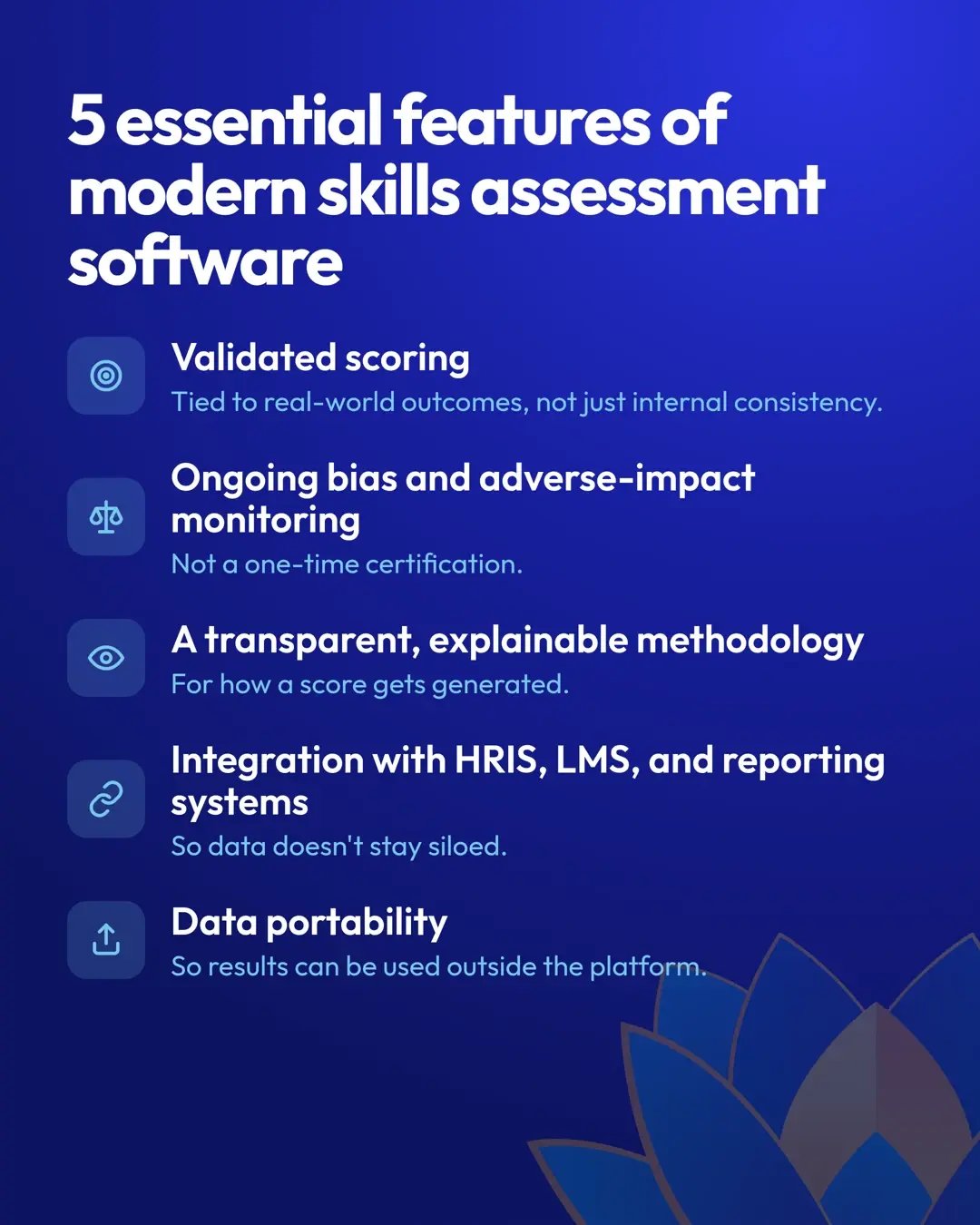
Essential Features of Modern Skills Assessment Software
Regardless of type, the strongest tools in this category share a few things in common:
- Validated scoring tied to real-world outcomes, not just internal consistency.
- Ongoing bias and adverse-impact monitoring, not a one-time certification.
- A transparent, explainable methodology for how a score gets generated.
- Integration with HRIS, LMS, and reporting systems, so data doesn't stay siloed.
- Data portability, so results can be used outside the platform.
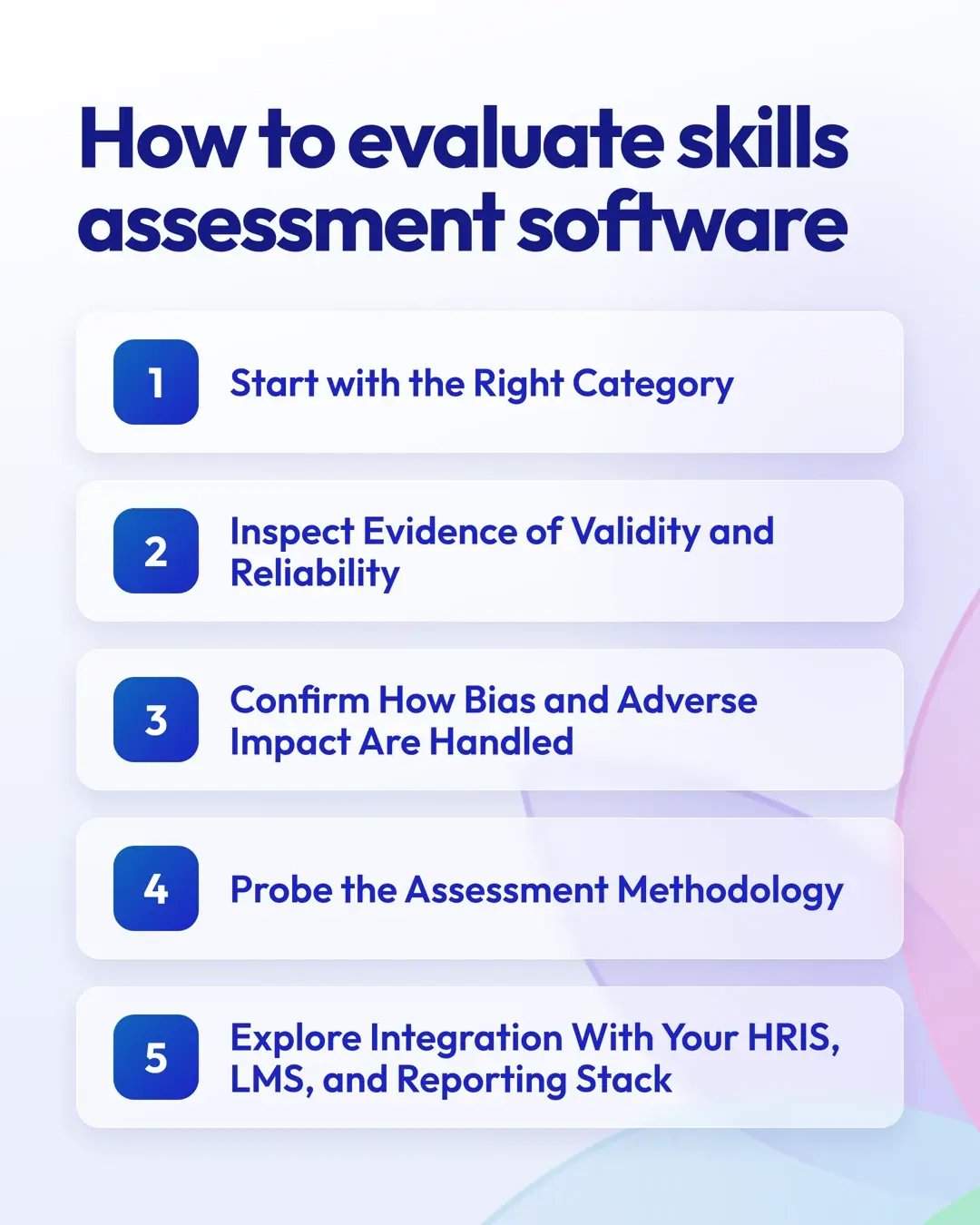
How to Evaluate Skills Assessment Software
Once you understand the type of tool you're looking at, a few questions determine how much you can trust the score it produces.
Confirm You're Considering the Right Category
Skills assessment software overlaps with performance management and LMS platforms, and features from all of them get marketed under the same "assessment" label. Before evaluating a specific tool, confirm the category fits the problem: a defined skill or broad, ongoing performance, a point-in-time decision or continuous tracking, current employees only or candidates too. If the real need is a searchable record of skill data across the org rather than a single measurement, look at skills inventory and management software specifically, not a general assessment tool.
Ask for Evidence of Validity and Reliability
Look for a validation study connecting a tool's scores to real job performance, not just an internal consistency statistic showing it agrees with itself. Those are different claims, and only one of them tells you the score means anything. A vendor confident in its methodology can walk you through what the study covered and make it available to review.
Check How Bias and Adverse Impact Are Handled
Bias testing works best as an ongoing practice, not a one-time certification from years ago. Some jurisdictions require it by law. New York City's Local Law 144 mandates an independent bias audit for automated employment-decision tools, with results posted publicly. Ask how often testing is repeated and whether the results are available to review.
Probe the Assessment Methodology
Ask what a specific assessment item looks like, not just which category it falls into, and whether the scoring model is explainable or proprietary. Knowing exactly what evidence a score is built on matters before you rely on it for a hiring or development decision.
Confirm Integration With Your HRIS, LMS, and Reporting Stack
Assessment data that flows into the systems where hiring and development decisions get made is far more useful than data locked in a standalone dashboard. Confirm what integrates natively versus what requires custom development, and what format the underlying data exports in.
5 Questions for Your Next Skills Assessment Software Demo
Evaluating a skills assessment vendor comes down to five questions. Ask each one before you sign:
- Can you share validation studies connecting scores to real job performance?
- How often do you test for adverse impact, and can we see the results?
- What does a specific assessment item look like, and how is it scored?
- Is your scoring model explainable, or a black box?
- Is a qualified person reviewing AI-generated scores, or is scoring fully automated?
Choosing Skills Assessment Software: Evidence Over Guesswork
Choosing skills assessment software comes down to evidence, not marketing claims: validated scoring, ongoing bias testing, a transparent methodology, and real integration with the systems you already use.
Frequently Asked Questions About Skills Assessment Software
What Should You Look for in Skills Assessment Software?
Look for evidence that a tool's scores are validated against real job performance, not just internally consistent with themselves. Confirm how bias and adverse impact are monitored, understand what the assessment methodology measures and how, and check that the tool integrates with the systems where hiring and development decisions get made.
What Do Skills Assessment Tools Measure?
Skills assessment tools can measure several different things, and it's worth knowing which one you're buying. Some focus on technical or role-specific skills, like coding ability or software proficiency. Others measure cognitive ability, like reasoning and problem-solving speed. A growing set focus on the applied capabilities behind performance, what Ignis and others in the category call Power Skills, such as communication, collaboration, and analytical thinking. The best fit depends on the decision behind the purchase, not on which category sounds most advanced.
How Is Skills Assessment Software Different From Personality Testing Tools?
Skills assessment software measures what a person can do. Personality testing measures traits and preferences, like how a person tends to communicate or make decisions. The two serve different purposes. Personality data supports coaching and self-awareness. Skills data supports decisions about hiring, placement, and development that depend on demonstrated ability.
How Do You Know if a Skills Assessment Is Valid and Unbiased?
Ask for a validation study connecting scores to real job performance, not just a statistic showing the tool is internally consistent. For bias, ask how often adverse-impact testing is repeated and whether results are available to review, since ongoing monitoring is a stronger signal than a one-time certification.
What Questions Should You Ask a Skills Assessment Vendor?
Ask for validation studies connecting scores to job performance, how often bias testing is repeated, what a specific assessment item looks like, whether the scoring model is explainable, and whether a qualified person reviews AI-generated scores before they're finalized.
Can Skills Assessment Software Integrate With Your HRIS or LMS?
Most established platforms offer some level of integration, but the depth varies by vendor and by system. Confirm what connects natively versus what requires custom development, and ask what format the underlying data exports in. Data that stays locked in a standalone dashboard is far less useful than data that flows into the systems where decisions get made.