Employee Assessment Tools: A Buyer's Guide in the AI Era
Searching for employee assessment tools today will result in bold claims about AI assessment software that will modernize how you measure your workforce. These solutions branded "AI-powered" vary wildly in what they measure. They usually just run the same guesswork faster. The ones worth buying use validated data and tell you what someone can actually do.
What you think you're getting and what you buy might be misaligned because there are four structurally different categories of solutions within the employee assessment software category. And you likely won't know which you're buying until it's too late.
The World Economic Forum reports that 63% of employers see skills gaps as the primary barrier to workforce transformation through 2030. Before you can invest budget to close that gap, you have to see the challenges and opportunities clearly and choose the right solutions.
This buyer's guide will help you understand what those tools actually measure and make the right choices. By the end of this piece, you'll easily discern the assessments built on applied, verified evidence compared with others that just automate self-reported and manager guesses. Knowing the difference matters now more than ever.
What Employee Assessment Tools Actually Measure (and the 4 Categories Buyers Confuse)
Employee assessment tools are designed to measure different aspects of capabilities, potential and performance:
- Skills assessment tools. These measure applied capability, including what a person can actually do in a work-like scenario, evaluated against a defined rubric rather than a job title or self-description.
- Performance management software. Sometimes marketed as employee evaluation software, these tools track output and goal completion over a review cycle, such as quotas hit, projects closed, and manager ratings assigned. It measures activity, not underlying capability.
- 360-degree feedback tools. These aggregate opinions (a manager's, a peer's, a direct report's) into a composite view of how someone is perceived. The shortcoming here is that these tools capture structured perception instead of observed behavior.
- Behavioral assessment software. These are personality and workstyle instruments that infer traits or preferences from self-reported data and hold them static over time.
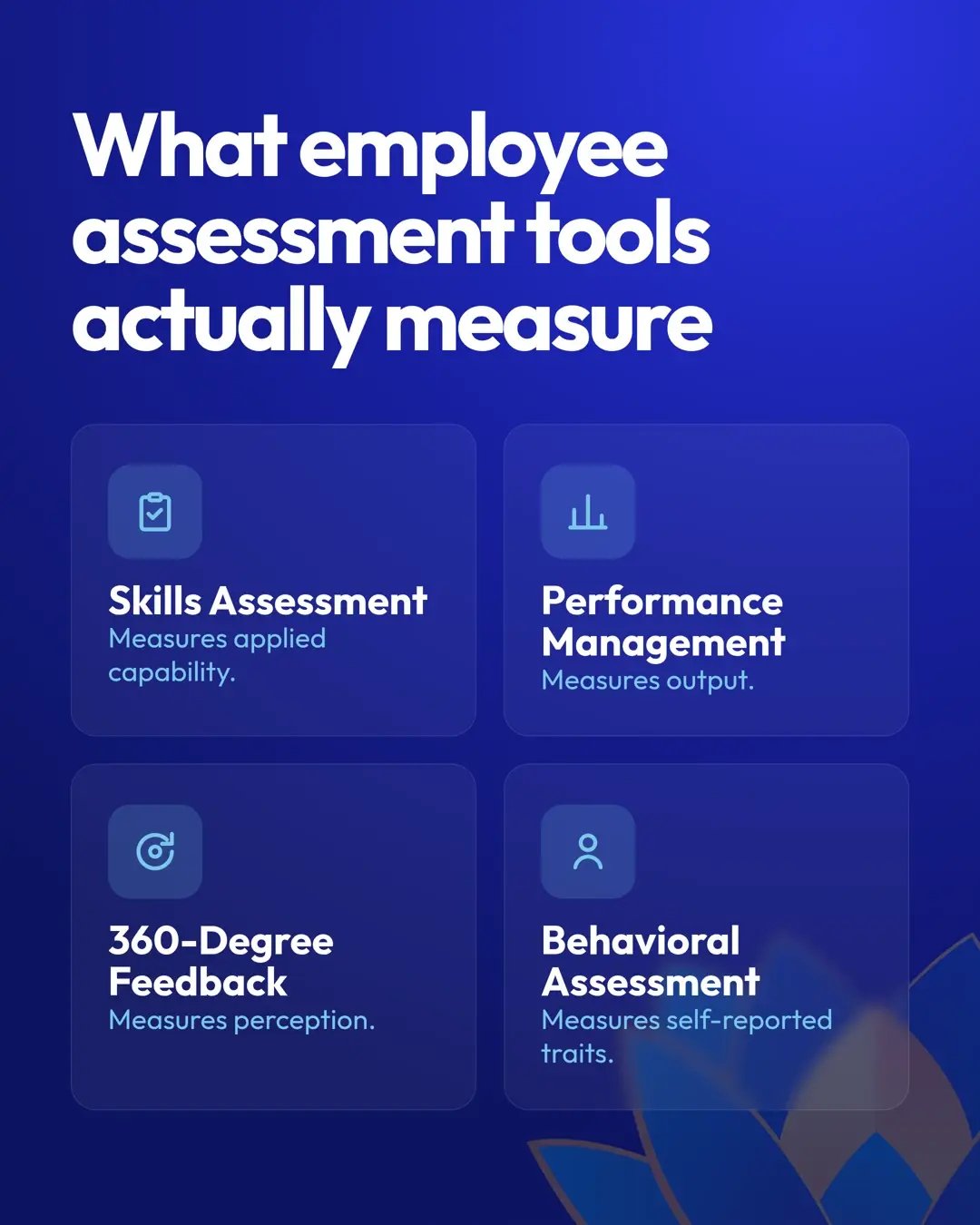
Nothing about the word "AI" changes which of these four categories a tool belongs to. AI can score any of them faster, but it cannot turn a self-report into an observation just by processing it through a model. The question that actually differentiates one "AI-powered" tool from another is which of the four it automates and whether that changes what's being measured, or just how quickly the same input gets scored.
Why Legacy Assessment Proxies Break Down in the AI Era
Performance reviews, 360s, manager feedback, and self-reported skills inventories all produce something that looks precise (a rating, a percentile, a score out of five) but the data underneath is unverified. A review reflects what a manager noticed and remembered, filtered by recency and the rater's relationship to the ratee.
A self-reported skills inventory measures confidence, not capability, and confidence correlates poorly with actual performance. None of that was disqualifying when the alternative was nothing. It becomes disqualifying when a workforce has to move fast, such as during reskilling, restructuring, or deciding who gets developed and who gets managed out. Treating skill as a fixed trait on a resume, rather than a live variable that changes with practice, means every one of those decisions runs on data that was stale the day it was collected.
Choosing the correct skills assessment for an area of need becomes a resource-allocation question. Getting it wrong doesn't just produce a bad performance review. It produces a bad bet on which teams can actually execute the work in front of them.
The Evaluation Framework: Questions to Ask Before You Buy
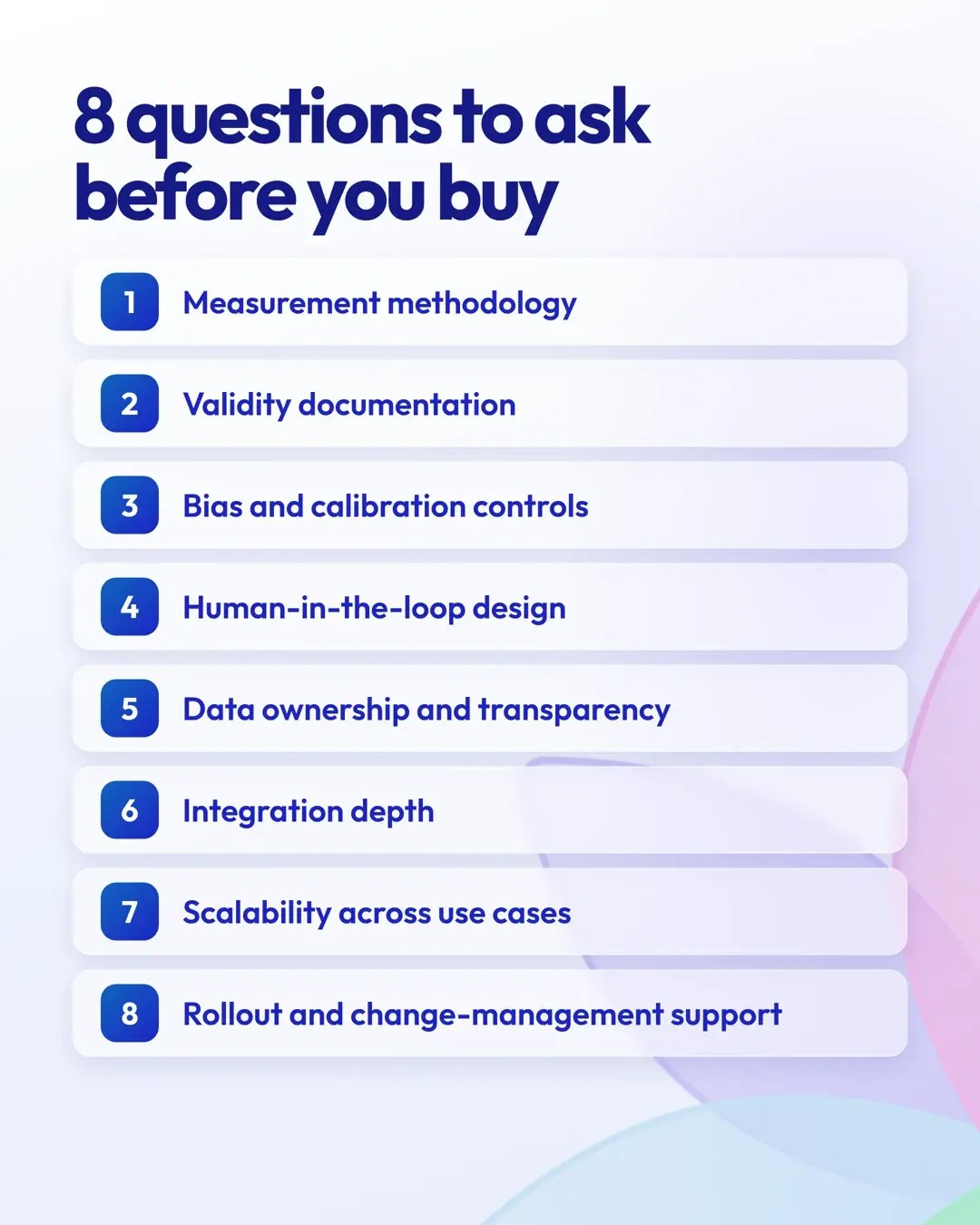
Before comparing features or price, run every vendor through eight questions about what's actually happening under the hood:
- Measurement methodology. Does the tool observe applied behavior in a realistic, work-like scenario, or does it infer capability from self-report, manager opinion, or resume and activity-log proxies?
- Validity documentation. Can the vendor produce evidence that its scores correlate with actual on-the-job outcomes, not just internal consistency between items on the same instrument?
- Bias and calibration controls. Is adverse-impact monitoring across demographic groups a standard, ongoing deliverable, or an add-on the vendor mentions only when asked?
- Human-in-the-loop design. Does a qualified human (ideally someone with psychometric training) review or validate AI-generated scores, or is scoring fully automated end to end?
- Data ownership and transparency. Can your HR team explain, in plain language, why the tool produced a given score for a given employee?
- Integration depth. Does the tool connect natively to your HRIS and existing performance workflows, or does it require manual data re-entry that quietly degrades adoption?
- Scalability across use cases. Does the same measurement approach hold up whether you're using it for skills, performance, 360, or behavioral assessment? Or does accuracy silently drop outside its original use case?
- Rollout and change-management support. Does the vendor provide a documented implementation plan and manager-training path, or just a login and a help center?
Put these to any vendor directly: what evidence do you have that scores predict real job performance, can I see the underlying study, and what happens when a manager disagrees with a score the system produced? A vendor who answers specifically, with a document you could hand to Legal, has done the harder work already. One who answers in marketing language has told you what you need to know.
Red Flags That Signal an Outdated or Unvalidated Tool
Five patterns that emerge during the buying process that should slow down a purchase decision:
- The vendor can't describe its scoring methodology in plain language, and can't point to independent validation beyond an internal consistency statistic.
- The "AI" layer turns out to be a rebranded survey or manager-rating form, with no observed-behavior component anywhere in the pipeline.
- Bias and adverse-impact monitoring isn't mentioned at all, or gets described as something on the roadmap rather than something running today.
- Scores are presented as fully automated, with no human review path and no way to flag or override a result that looks wrong.
- The vendor can't clearly explain what happens to employee data after the assessment period ends, including where it's stored, who can see it, and when it's deleted.
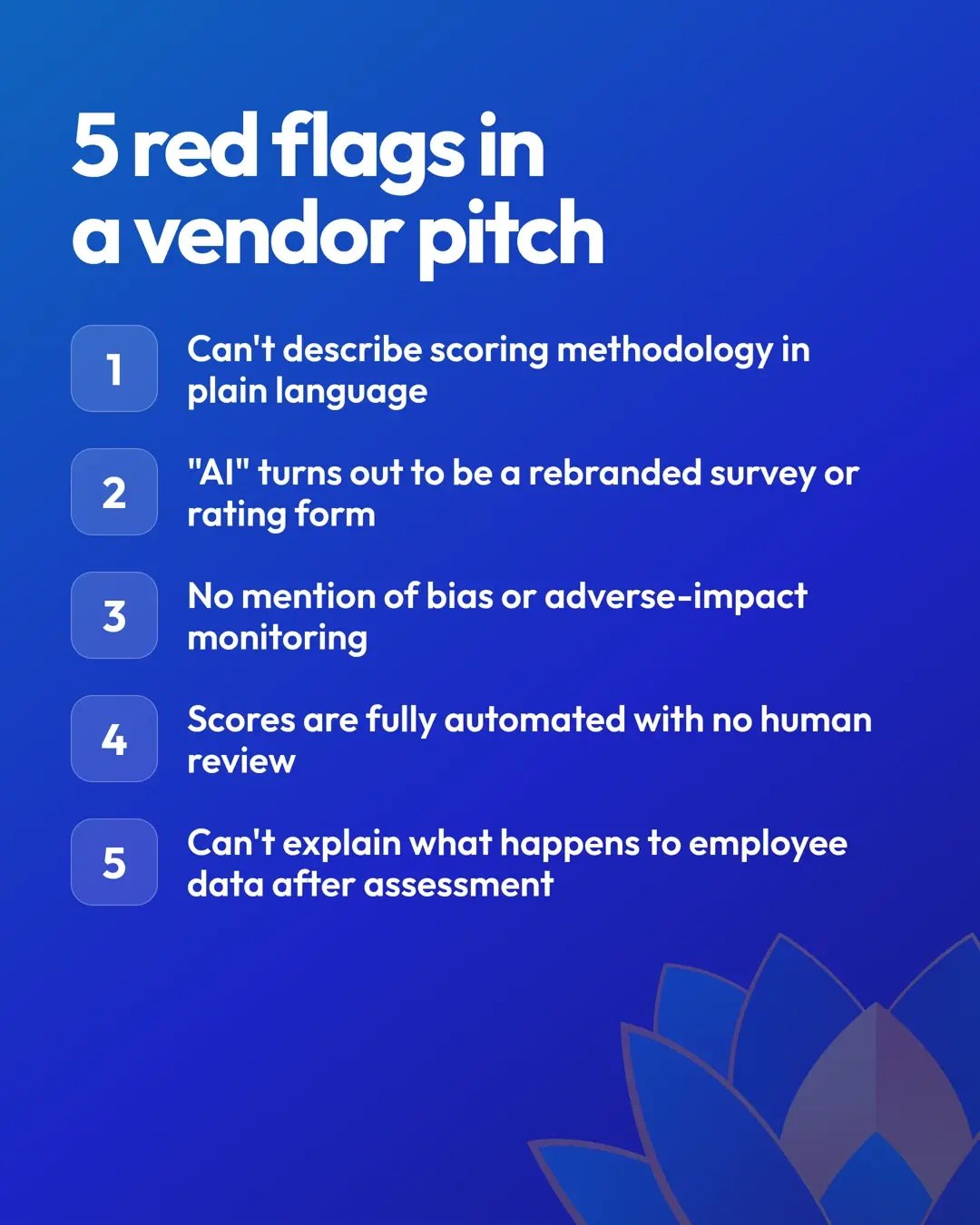
When two or more of these surface, the tool is likely automating the same unverified proxy it claims to replace.
Data, Privacy, and Bias Criteria for AI-Scored Assessments
The compliance bar for AI-scored workforce tools is rising even as federal enforcement priorities shift. The EEOC's 2026 National Enforcement Plan deprioritized disparate-impact theory in favor of intentional-discrimination and anti-DEI enforcement, but that only moved where the bar sits. Some states are now requiring bias audits, employee notice, or impact assessments for automated employment tools, and those requirements are shifting state to state, with more expected to follow.
A vendor whose compliance posture assumes federal enforcement is the only enforcement that matters is already behind.
The technical term worth knowing is Differential Item Functioning, or DIF: whether a given question behaves differently for equally capable people in different demographic groups. DIF is narrower and more precise than "no bias found" and it tests individual items, not hiring outcomes. A vendor who can name which items they tested and flagged is showing real methodology, not a badge.
Ask any vendor whether an employee can be told, in plain language, why they received a given score. If the honest answer is "the model decided," that becomes a defensibility question that will surface the first time a score gets challenged internally.
How to Match a Tool to Your Use Case (Skills, Performance, 360, or Behavioral)
Start with the decision the assessment should inform, not the category that's easiest to buy. A pre/post skills baseline for a leadership cohort needs a skills assessment tool built for repeat measurement on the same scale, not a performance review system repurposed for the occasion. A quarterly check-in on goals needs performance management software, not a skills instrument never designed to track output.
A read on team dynamics is what 360 feedback is built to capture, and no amount of AI scoring turns aggregated perception into an observed-behavior measurement. Self-report behavioral tools are reasonable for gauging sentiment, as long as no one downstream treats the output as a measurement of capability.
The mismatch that causes the most damage is using a confidence-and-preference instrument to make a capability decision. When promoting individuals or restructuring a team around self-reported data, those decisions are based on tools that weren't built to predict performance. Match the instrument to the decision first, and the category question from earlier gets easier to answer.
Rollout and Change-Management Checklist for HR Leaders
A validated tool with a botched rollout produces the same outcome as an unvalidated one: data nobody trusts. Before the first assessment goes out, confirm four things with the vendor and with your own team:
- A documented implementation timeline, including HRIS integration, not a verbal estimate.
- A manager-training path that explains what the scores mean and, just as important, what they don't mean. A skill score is not a performance rating and shouldn't be treated as one in a review conversation.
- Employee-facing communication that states plainly what's being measured, why, and what happens to the results, before anyone takes the assessment.
- A defined review cadence. Most instruments built to track change, rather than assess performance continuously, need a minimum window between uses (30 to 60 days is typical) to avoid conflating noise with progress.
Skip any of these and the rollout itself becomes the reason the data gets ignored six months in, regardless of how rigorous the underlying methodology was.
The question a buyer's guide is supposed to answer is which tool to choose. The more useful question is whether you can tell the difference between a tool that observes what your workforce can do and one that automates what people already assume about them. Most organizations can't, not because the technology doesn't exist, but because the label "AI-powered" has made it easy to stop asking.
Getting beyond the gut check starts with naming, honestly, which of the four categories the tool in front of you actually belongs to, before a contract makes the answer expensive to change.
Ignis built its Power Skills Assessment against this same standard: scenario-based observation instead of self-report, documented bias testing across gender, race, and ethnicity, and a human reviewer in the scoring loop rather than a fully automated score. Run it through the evaluation framework above the same way you would any other vendor.
Book a demo to learn more about the Power Skills Assessment and how to deploy your own red-flags checklist.
Frequently Asked Questions
What is the best employee assessment tool?
The best employee assessment tool depends on the job you need it to do. There isn't a single best employee assessment tool, because "employee assessment tools" spans four structurally different categories (skills, performance, 360-degree feedback, and behavioral or engagement assessment) and the right choice depends on the decision it needs to inform.
A tool built for a defensible before-and-after skills baseline is the wrong tool for a quarterly performance check-in, and vice versa. The more useful question than "which is best" is which category matches your decision, then which vendor can document its methodology, validity evidence, and bias testing in verifiable terms rather than marketing language.
What are the different types of employee assessment tools?
The different types of employee assessment tools fall into four categories.
- Skills assessment tools measure applied capability against a scenario-based rubric, what someone can do, not what they say they can do.
- Performance management software tracks output and goal completion over a review cycle.
- 360-degree feedback tools aggregate manager, peer, and direct-report perceptions into a composite view.
- Behavioral and engagement assessments, including most personality instruments, infer traits or preferences from self-report.
Adding AI to any of these speeds up scoring; it doesn't change the tool's category.
How much does employee assessment software cost?
Employee assessment software costs typically follow one of three models: per-seat licensing, per-assessment pricing, or enterprise licensing bundled with a broader HR platform. Skills assessment tools tend to cost more than generic survey tools once validated methodology and human review are built into scoring. Before comparing prices, confirm you're comparing tools in the same category, a performance-management tool and a scenario-based skills assessment aren't priced against the same value.
What features should I look for in employee assessment software?
The features you look for in employee assessment software matter less than the eight criteria that determine whether a tool measures anything real: what it observes versus infers, whether it uses valid evidence and is tied to outcomes, whether bias monitoring runs continuously, whether a qualified human reviews AI-generated scores, how clearly it can explain a score to the employee, how deeply it integrates with your HRIS, whether accuracy holds across use cases, and whether the vendor provides a real implementation plan.
How is employee assessment different from performance management software?
Employee assessment software is different from performance management software because it measures capability, what a person can do, tested through scenarios or validated instruments. Performance management software measures output, whether goals were hit and quotas met over a defined cycle. The two answer different questions: a strong performance record can mask an untested capability gap, and a strong assessed skill can go unused in the wrong role. Relying on performance data alone to make development or promotion decisions is often a capability judgment made on output data never designed to measure capability.
Can AI-based employee assessment tools replace manager judgment?
AI-based employee assessment tools cannot replace manager judgment, and you should be skeptical of any vendor that claims otherwise. AI-based tools can replace unreliable inputs to manager judgment (self-reported confidence, resume proxies, unverified skills inventories) with more consistent, evidence-based signal about what someone can do. What they shouldn't replace is a manager's context about the work itself; the strongest tools build in a human reviewer specifically because ambiguous responses still benefit from human judgment. Treat AI-scored assessment as better input to a decision a person still makes, not a replacement for the person.