Types of Talent Assessments: A Plain-Language Guide
The types of talent assessments on the market have exploded into skills tests, cognitive batteries, personality inventories, situational judgment exercises, and integrity screens, and each one runs on a different methodology. None of them measures the same thing, and some are far better suited to a given decision than others.
Use of talent assessments is expanding rapidly. Skills-based hiring, the practice these assessments exist to support, grew from 56% of employers in 2022 to 73% in 2023, according to a TestGorilla survey of 3,000 international employers reported by SHRM. That surge means more organizations are choosing among more assessment types than ever, often without the track record to know which one answers their question. Talent assessments exist to close that gap, but only the ones matched to the actual decision being made.
Match the type to the decision, and the assessment becomes much more reliable.
What Is a Talent Assessment?
A talent assessment is a structured way for an employer to evaluate whether a job candidate or current employee has the skills, knowledge, work style, and behaviors that align with success in a particular role.
They are designed to supplement resumes, interviews, performance reviews, 360s, and manager feedback with more consistent, quantitative evidence.
A skills assessment is one type of talent assessment that focuses narrowly on whether someone can do a specific, definable task, such as writing a SQL query or resolving a customer ticket. That distinction, talent assessment vs skills assessment, matters because the broader category includes methods that test judgment and behavior, not just a single task.
Proxy Evidence vs. Applied Evidence in Talent Assessments
- Applied evidence: direct, observed performance of the job task itself. The candidate does the thing, and an evaluator watches it happen.
- Proxy evidence: an indirect signal that correlates with job performance without observing the task itself, such as a score, a trait, or a self-report that predicts the outcome instead of demonstrating it.
5 Types of Talent Assessments at a Glance
| Type | What It Measures | Proxy vs. Applied | Best Used For |
|---|---|---|---|
| Skills and work-sample assessments | Direct demonstration of a job-relevant task, watched in real time. | Applied evidence, the candidate performs the actual task. | Pre-hire screening; reskilling verification |
| Cognitive ability assessments | A timed or scenario-based measure of reasoning, pattern recognition, and learning speed. | Validated proxy, predicts performance but doesn't observe it directly. | Pre-hire screening, paired with a skills test |
| Personality and behavioral assessments | A self-reported inventory of traits and tendencies, usually via questionnaire. | Proxy evidence, self-report, not observed behavior. | Context and conversation, not a deciding input |
| Situational judgment assessments | Realistic job scenarios with a "how would you respond" structure. | Closer to applied evidence, scenario-based reasoning, not a fixed task. | Promotion and internal-mobility decisions |
| Integrity assessments | Overt or covert screening for honesty and rule-following. | Proxy evidence, predicts behavior, not capability. | Layered on top of another type for high-fiduciary or safety-sensitive roles |
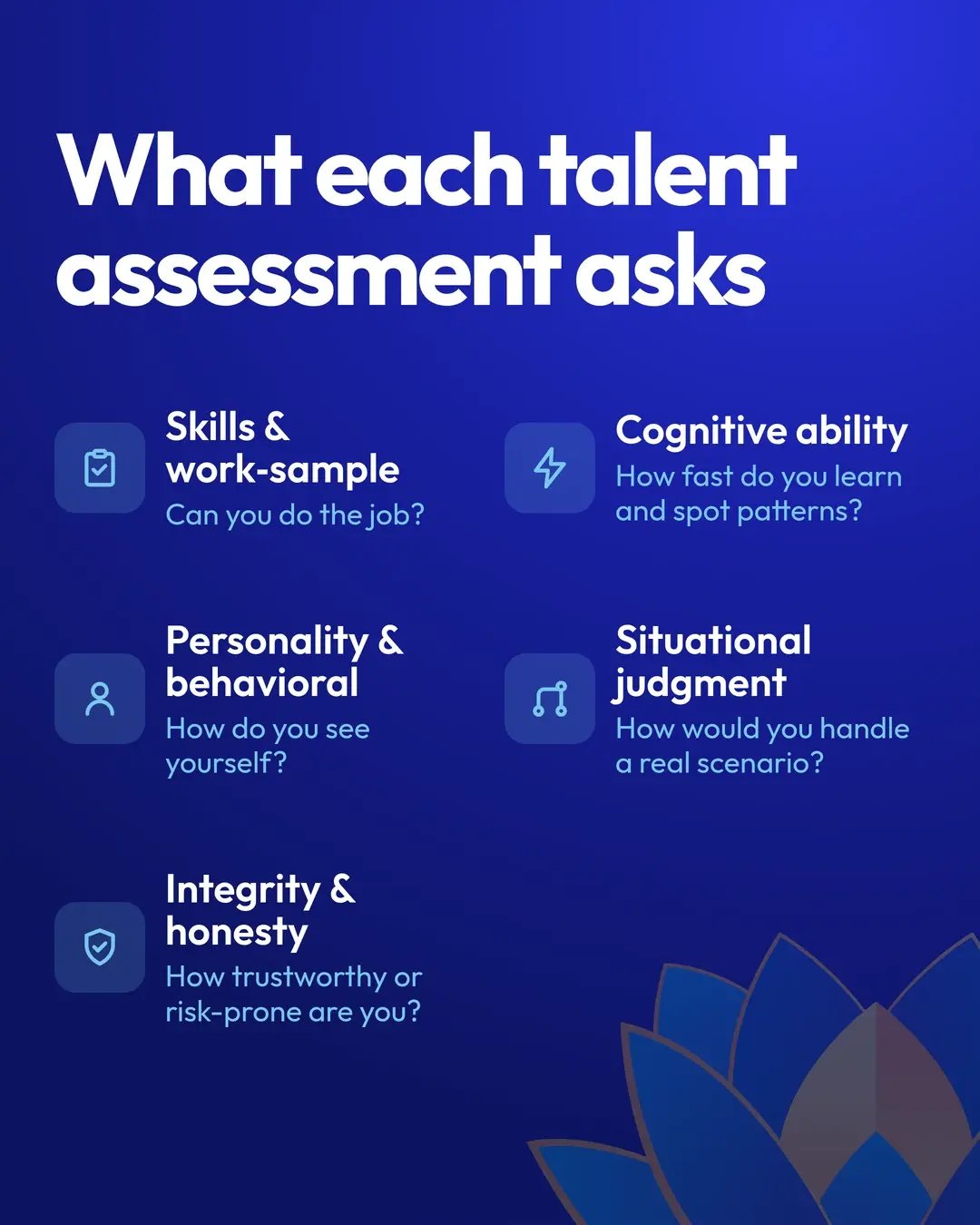
What Each Talent Assessment Type Verifies, and What It Doesn't
Each of the five most common types of talent assessments differs in what it verifies and how directly that verification connects to job performance.
Skills and Work-Sample Assessments
A work-sample assessment asks the candidate to perform the actual task, such as writing the code or resolving the ticket, and an evaluator watches what happens. There's no inference layer standing between the test and the job.
That directness is also the limitation. A work-sample test tells you if someone can do this task, today, under test conditions. It doesn't tell you whether they can learn a new one or lead a team through the same work next year. Treat these assessments as the strongest signal for a narrow, well-defined capability question, not as a stand-in for potential or adaptability. AI-scored versions of this format are changing what's practical to run at scale, which makes it worth understanding how to evaluate an employee skills assessment built for AI.
Cognitive Ability Assessments
Cognitive tests measure how quickly someone picks up something new or recognizes patterns. Decades of industrial-organizational research back cognitive ability as one of the stronger predictors of job performance across roles, especially in jobs where the work itself keeps changing.
But "strong predictor" isn't the same as "complete picture." A cognitive score says nothing about whether someone can execute in your specific environment or work with your team. It's a proxy for potential, useful upstream in a hiring process, but nowhere near sufficient on its own.
Personality and Behavioral Assessments
Personality and behavioral assessments are popular, but they come with real limits on predicting job performance. Common behavioral assessment examples include self-report inventories, 360-degree reviews, and manager behavior ratings.
They rely on self-assessment, which measures confidence, not capability. Someone can rate themselves highly on "collaboration" and still struggle to collaborate under deadline pressure, which is exactly the blind spot a soft skills assessment is built to catch. Use these assessments for context and conversation, not as the deciding input on a hire or promotion.
Situational Judgment Assessments
Situational judgment tests present realistic, job-relevant scenarios and ask how someone would respond under competing pressures, rather than what they'd claim about themselves in the abstract. That structure gives it an edge over pure personality testing: it's harder to answer generically, and it stays closer to how someone behaves under pressure, day to day.
This is the type of talent assessment best suited to promotion and internal-mobility decisions. The real question there is whether this person can handle the ambiguity that comes with more responsibility, which is a different question than the defined-task test a skills assessment answers. It's not immune to self-reporting bias entirely, but it's a meaningfully closer approximation of applied judgment than a trait or skill inventory.
Integrity and Honesty Assessments
Integrity assessments screen for predicted trustworthiness, rule-following, and counterproductive-behavior risk, most often for roles with financial, safety, or fiduciary exposure. They come in two forms. Overt integrity tests ask direct questions about past behavior and attitudes toward theft, safety violations, or policy breaches. Covert, personality-based integrity tests infer the same risk indirectly, through broader trait questions rather than direct admissions.
Both forms predict behavior, not capability, and that distinction matters more than the score suggests. A candidate who screens as low-risk on an integrity assessment hasn't demonstrated they can do the job, only that they're unlikely to work against it. Low-risk is not the same as high-capability. Use it as a layer on top of whichever core assessment already fits the decision, in high-fiduciary or safety-sensitive roles specifically, not as a replacement for one.
Best Use Cases for Each Type of Talent Assessment
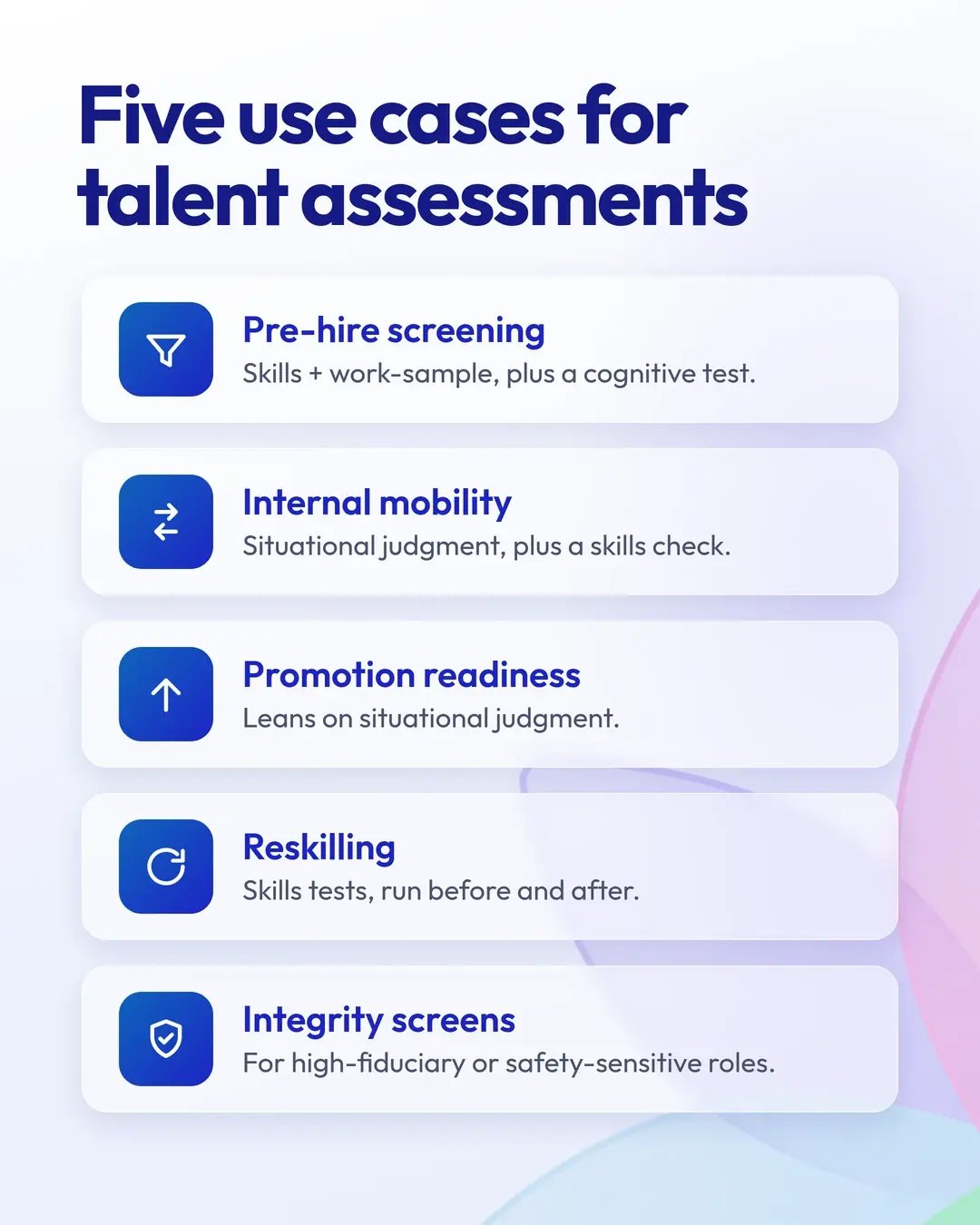
The table above maps each type to its best-fit use case in shorthand. Here is what that looks like as an actual decision, one at a time.
These five pre-employment assessment types stop being an abstract taxonomy the moment you tie each one to the decision in front of you.
- Pre-hire screening calls for skills and work-sample assessments paired with a cognitive ability test for hiring purposes. The organization is verifying whether a stranger can do the job and learn quickly inside it, and neither question has an internal track record to lean on.
- Internal mobility decisions favor situational judgment assessments, supported by a skills check for the specific capabilities the new role demands.
- Promotion readiness leans on situational judgment assessments first, because the real question is how someone reasons under real conditions, not whether they can perform one fixed task.
- Reskilling calls for skills and work-sample assessments, run before and after a program, to verify the capability moved rather than assuming it did because someone completed a course.
- High-fiduciary or safety-sensitive roles add an integrity assessment on top of whichever core type already fits the decision, never as a replacement for it.
Many roles benefit from more than one type, but rarely all five. A pre-hire process for a technical role might combine a skills test with a cognitive assessment. A promotion decision might pair situational judgment with the manager's direct observation. What matters is how well the instrument aligns with the decision it supports.
Frequently Asked Questions About Types of Talent Assessments
What are the different types of talent assessments?
There are five main types: skills and work-sample assessments, cognitive ability assessments, personality and behavioral assessments, situational judgment assessments, and integrity assessments. Skills and work-sample assessments test whether someone can do a specific, defined task right now. Cognitive ability assessments measure how quickly someone learns and reasons. Personality and behavioral assessments capture self-reported traits and tendencies. Situational judgment assessments present realistic scenarios and score how someone reasons through them. Integrity assessments screen for predicted trustworthiness and rule-following, not job skill.
What is the difference between a talent assessment and a skills assessment?
A talent assessment is the broader category: any structured method, skills, cognitive, personality, situational judgment, or integrity, used to evaluate whether a candidate or employee fits a role's requirements. A skills assessment is one type of talent assessment, narrowed to a single, definable task, such as writing a SQL query or drafting a client email. Every skills assessment is a talent assessment; not every talent assessment is a skills assessment. A skills assessment verifies applied ability on one task, while a full talent assessment strategy usually combines several types to cover ability, judgment, and behavior together.
Which type of talent assessment is best for hiring vs. for existing employees?
For external hiring, skills and work-sample assessments paired with cognitive ability tests verify whether a stranger can do the job and learn quickly inside it, since there's no internal track record to draw on. For existing employees, especially promotion and internal-mobility decisions, situational judgment assessments work better because they test how someone reasons through ambiguity rather than whether they can execute one predefined task. Reskilling calls for a before-and-after skills assessment to confirm the capability moved. There's no single best type. The right one follows the decision, not a fixed rule about hires versus incumbents.
Are personality tests or skills tests more predictive of job performance?
Skills and work-sample tests are the stronger predictor for a specific, definable task because they measure applied capability directly: the candidate performs the actual work under test conditions. Personality assessments rely on self-report, which measures confidence and self-perception, not verified capability; someone can rate themselves highly on collaboration and still struggle under deadline pressure. Cognitive ability tests sit in between: decades of industrial-organizational research find them a strong predictor of performance across roles, but a score alone doesn't confirm someone can execute in a specific environment. For anything you need proven, not just claimed, skills and cognitive tests carry more weight than personality inventories alone.
How many types of assessments should a company use for one role?
Most roles need more than one type, but rarely all five. A pre-hire process for a technical role might pair a skills test with a cognitive assessment; a promotion decision might pair situational judgment with direct manager observation. Alignment between the instrument and the decision matters more than the count. Layering matters most in high-fiduciary or safety-sensitive roles, where an integrity assessment sits on top of whichever core type already fits the decision, rather than replacing it. Running every available assessment type on every role adds cost without adding evidence.
What is a situational judgment test and when should it be used?
A situational judgment test presents a realistic, job-relevant scenario and asks how someone would respond, rather than what they would claim about themselves in the abstract. That structure makes it harder to answer generically and keeps it closer to how the work shows up day to day. Use a situational judgment test for promotion and internal-mobility decisions, where the real question is whether someone can reason through ambiguity and competing pressures, not whether they can perform one fixed, predefined task. It's a meaningfully closer approximation of applied judgment than a personality inventory, though it isn't immune to self-reporting bias entirely.