Talent Assessment Software: What the Demo Can't Show
The last talent assessment software demo you watched scored a candidate the vendor created, inside an ATS the vendor configured. Every part of it worked, and none of it ran on your systems. This isn’t ideal if you are trying to make the right buying decisions.
That demo may still be the closest look you get before you sign, and the decision has to hold up in your hiring process and in front of Legal. But how do you make the call?
You need to test what you can in your own environment to start. For everything else, ask for two kinds of documents: evidence the vendor already has, and commitments it will sign. This talent assessment software buying guide gives you the six decision criteria you need to test or verify and commitments to get in writing.
| Criterion | Ask for | Evidence worth accepting |
|---|---|---|
| Implementation success | A week-by-week rollout plan | Dated milestones from integration setup through manager training, each with a named owner at the vendor |
| ATS and HRIS integration | A live test in your own environment | Invite, completion, score and stage update on the candidate record, including a bulk run |
| Security and data terms | Certificate, scope statement and data processing agreement | An ISO 27001 or SOC 2 Type II report whose scope names the product and hosting environment |
| Evidence behind scores | Validation and fairness documentation | Reliability figures labeled by type and documented fairness testing, with a plain statement of where the evidence stops |
| Human oversight | The process when a score and a hiring manager disagree | A documented review and override path |
| Contract service terms | SLA, escalation path, exit terms and three-year pricing | Written response times, data export and deletion terms, and a price schedule at your volume |
There’s one more question you need to answer for yourself: Do you build or buy? How you answer that question decides whether the other criteria apply at all.
What Talent Assessment Software Means as a Platform Purchase
Talent assessment software is the platform that runs assessments for candidates or employees and sends scores to the applicant tracking system and HRIS where hiring decisions are made.
Choosing the right assessment for a role is a different decision. That's where you weigh a cognitive test against a situational judgment test, a job simulation, a work sample or a structured interview. Our talent assessment tools overview covers those types, and our talent assessment guide covers the full category.
The two decisions fail in different ways. A poorly chosen assessment measures the wrong thing. A poorly chosen platform can measure the right thing and still let you down, with a score that reaches the recruiter two days after they've moved on, or a security review that stalls rollout for a quarter.
Most buying guides spend their pages on the first decision, even though the post-purchase surprises tend to come from the second.
Implementation and Time-to-Value: The Date a Recruiter First Acts on a Score
For talent assessment software, time-to-value is the date your first live requisition runs through the platform and a recruiter acts on the result with no workaround. Ask the vendor to name that date before you sign.
A credible rollout plan lays out week-by-week milestones from integration setup and assessment configuration through administrator and manager training. Each milestone has an owner on the vendor side, by name.
Four questions show whether the plan is real:
- Which milestones depend on your IT and ATS teams, and how many hours will the vendor need from them?
- When does the first live requisition run, and on which role family?
- Who trains hiring managers to read a score, and what does that training cover?
- What does the vendor own after go-live, and what moves to your team?
Give the third question the most weight. A hiring manager who doesn't know what a score measures can't weigh it against an interview. They fall back on instinct, which is where they were before you bought a platform meant to get them beyond the gut check. Our employee assessment tools guide includes a rollout checklist you can hold the vendor's plan against.
ATS and HRIS Integration Depth: What to Verify in Your Own Tenant Before You Sign
Integration is the area a demo hides best.
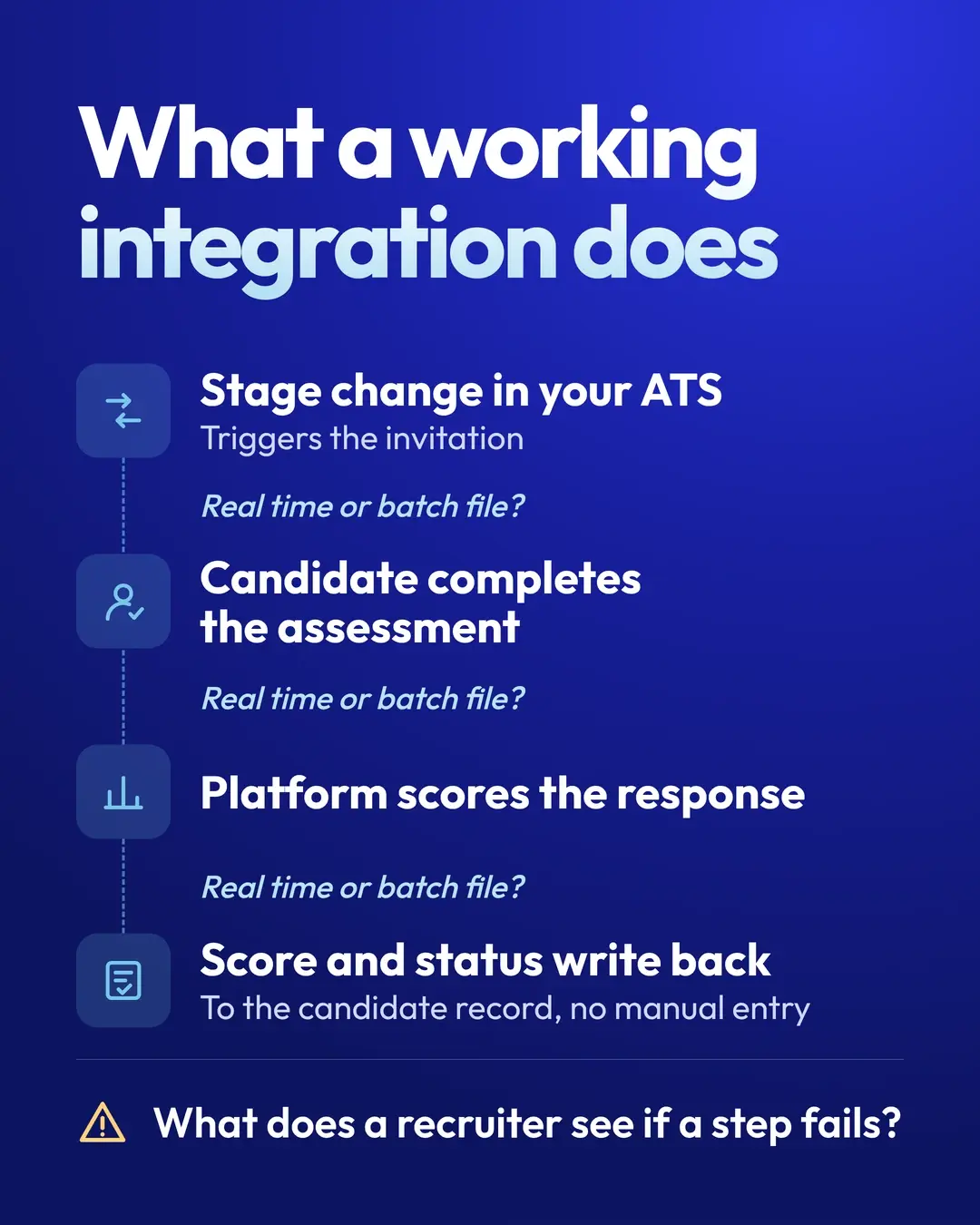
Vendors tend to describe integration with the word "native" and a list of supported systems. Neither tells you how data moves. Ask to see the sequence instead: a stage change in your ATS triggers the invitation, the candidate completes the assessment, the platform scores it, and the score and status write back to the candidate record. For each step, ask whether it runs in real time or through a batch file, and what a recruiter sees when it fails.
Then test it where your data lives. A sandbox that mirrors your production configuration is the best option. If neither the vendor nor your ATS provider can offer one, a limited pilot on a single role family in your live tenant still tells you more than a scripted walkthrough.
Run four tests either way:
- One candidate, start to finish. The result should reach the candidate record with no manual entry.
- A bulk run at peak volume. Use the applicant count from your busiest hiring week.
- A deliberate failure. Break the connection. Watch how the platform surfaces the error and whether it retries on its own. Then check what the candidate experiences, since a silent failure looks to them like being ignored.
- An administrator login through single sign-on. If recruiters need a separate password, adoption will suffer.
A vendor confident in its integration will usually agree to all four.
Data Security, Privacy and Compliance: Read the Certificate's Scope
Assessment platforms hold candidate responses and the identifying details attached to them, so every enterprise purchase needs a security review. Hearing that a vendor is "certified" is where that review starts.
An ISO 27001 certificate includes a scope statement, and the scope matters. It should name the product you're buying and the environment that will host your data. A certificate held by a parent company or a different business unit doesn't cover your purchase. Certified organizations also go through surveillance audits between recertifications, so ask when the last one happened and request the paperwork. Some security teams prefer a SOC 2 Type II report instead. Find out which yours requires before you start vendor calls.
Certification sits alongside four contractual documents:
- A data processing agreement. Where GDPR applies, a controller needs a binding agreement with every processor.
- Data residency and sovereignty terms. Residency is where the data sits. Sovereignty is which jurisdiction can compel access. Get both in writing.
- A sub-processor list, with a commitment to notify you of changes.
- A model-training statement. Ask whether your candidates' responses train models used for other customers, and get the answer into the contract.
Close the review with retention. Ask how long the vendor keeps responses and scores, including for candidates in a talent pool, and how it verifies deletion when the contract ends.
Talent Assessment Software Validity and Adverse Impact Monitoring: Ask Where the Evidence Stops
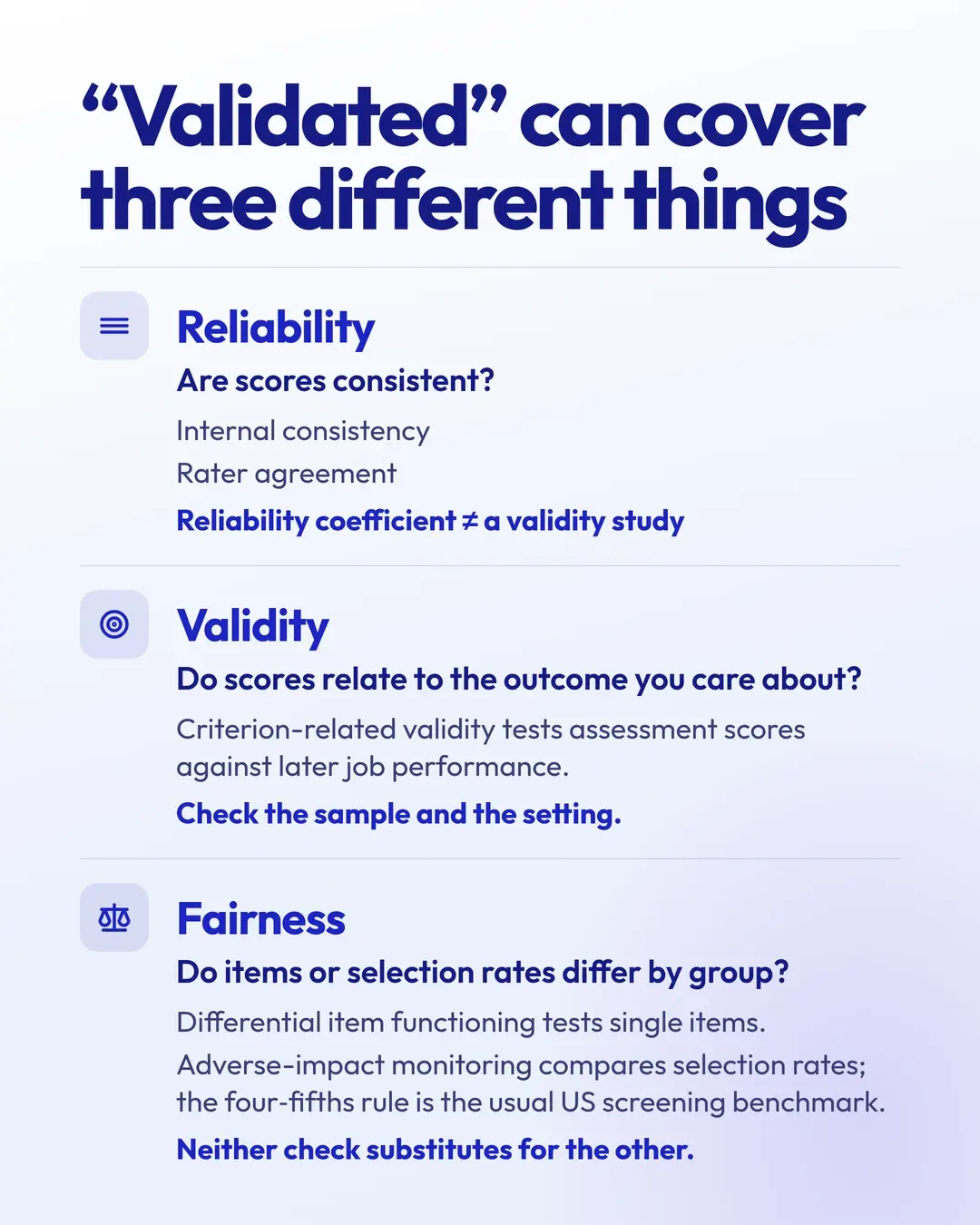
"Validated" appears in almost every pitch in this category and means little on its own. It can refer to reliability, validity or fairness, and each one is a separate claim with its own evidence.
Reliability is consistency. Internal consistency, usually reported as Cronbach's alpha, shows whether items on a scale agree with each other. Rater agreement, often reported as quadratic weighted kappa, shows whether independent scorers land on matching scores for the same response. Both are useful. They answer different questions, so any reliability figure should arrive labeled with its type. An unlabeled number is a reason to ask more.
Validity is whether scores mean what the vendor says they mean. The evidence should match the claim's scope. If a vendor says its scores predict job performance, ask for the criterion-related study behind that statement. If the claim is narrower, such as consistent measurement of a defined skill, the evidence should match the narrower claim, and the vendor should say so plainly. Then check the sample and the setting. A study of adult volunteers in a low-stakes setting supports different conclusions than one run with applicants in a live hiring process, and the documentation should tell you which one you're reading.
Fairness is tested at two levels. Differential item functioning analysis checks individual items, asking whether an item scores differently for equally capable people in different groups. Adverse impact analysis checks outcomes by comparing selection rates across groups for the decisions your organization makes, usually against the four-fifths rule in the U.S. Because adverse impact depends on how you use scores in your own process, you run the analysis. Ask each vendor for its documented item-level fairness testing, including the groups it covered. Then ask what data the platform gives you to monitor your own selection outcomes.
A vendor that tells you where its evidence ends has given you something you can take to Legal.
For established methods, decades of published research lets you check claims. Schmidt and Hunter's 1998 review set long-cited benchmarks for cognitive tests, structured interviews and work samples. Sackett and colleagues' 2022 reanalysis revised several of them downward and ranked structured interviews highest. A vendor still quoting the 1998 figures is working from outdated conclusions. Newer methods rely on studies the vendor ran itself, so ask for them by name and watch for research on one method presented as if it covered another.
What the Score Is Built From
Evidence also depends on what the assessment observes. Some assessments score traits or cognitive proxies and infer how someone will work from them. Self-report measures confidence, which isn't the same as capability.
Scenario-based assessments take a different route. A candidate receives a message from a colleague whose project slipped two weeks and who needs help explaining the delay to a client. The candidate writes back in their own words. That response shows how they communicate and how they reason through a problem in a way a résumé line can only assert.
That's the method behind measuring Power Skills, the applied human capabilities that determine how people perform in real work, such as communication and AI fluency. They overlap with what many teams still call soft skills, a label that undersells how much they matter and how measurable they are. When a vendor says it measures them, ask to see a scenario and a scored response.
When the Score and the Hiring Manager Disagree
Every platform will eventually produce a score a hiring manager doesn't believe. What happens next tells you how the platform was designed.
Some platforms give a human evaluator a score along with the reasoning behind it, and document how that person can override it. Others automate the go or no-go decision with no override at all. As AI takes on more of the scoring, the override path matters more, both for the quality of the hire and for explaining the decision afterward.
Ask the vendor to walk you through a disagreement from start to finish, including what gets recorded. Our AI candidate screening guide covers what automated filters can and can't tell you.
Build vs. Buy: When an In-House Talent Assessment Tool Actually Makes Sense
Settle this before you compare platforms. AI coding tools have made building a working prototype faster, and the case for building in-house is control and fit.
A prototype isn't a production system, though. Production needs validated content, a defensible scoring model, fairness testing, a security certification, ATS and HRIS integrations and an audit trail, plus staff to keep all of it current as regulations and models change.
Volume decides how long a build takes to pay back its development, and the organizations that seriously consider building usually run hundreds of thousands of assessments a year. Volume alone doesn't settle it. The working rule is to buy for parity and build for advantage, which means building only when both of these hold:
- The assessment itself differentiates how you hire, in ways no vendor's content covers.
- You employ the psychometric and security staff to validate and maintain it for years.
Whoever owns the system owns every challenge to a score, from a candidate or a regulator, at any volume. If either condition doesn't hold, buy, and hold the vendor to the integration, security, evidence and contract tests in this guide.
Red Flags in Talent Assessment Software SLAs and Contracts
When a sync fails mid-requisition, the talent acquisition team feels it first. The contract decides who fixes it and how fast. Ask for:
- A written SLA with uptime and response commitments covering live assessment windows, beyond business hours
- A named contact and an escalation path for an active hiring cycle
- Breach-notification timelines
- Data export in a usable format and verified deletion at exit
- A three-year price schedule at your expected volume, including per-candidate, overage and integration-support charges
Model the pricing structure separately. Per-candidate pricing rises with every applicant, so a surge in applications hits the bill directly. Per-seat pricing follows the number of recruiters and administrators. An enterprise license covers an agreed volume, so the overage rate is the number to check. Model each option at two or more volumes, since hiring plans rarely survive a three-year contract unchanged.
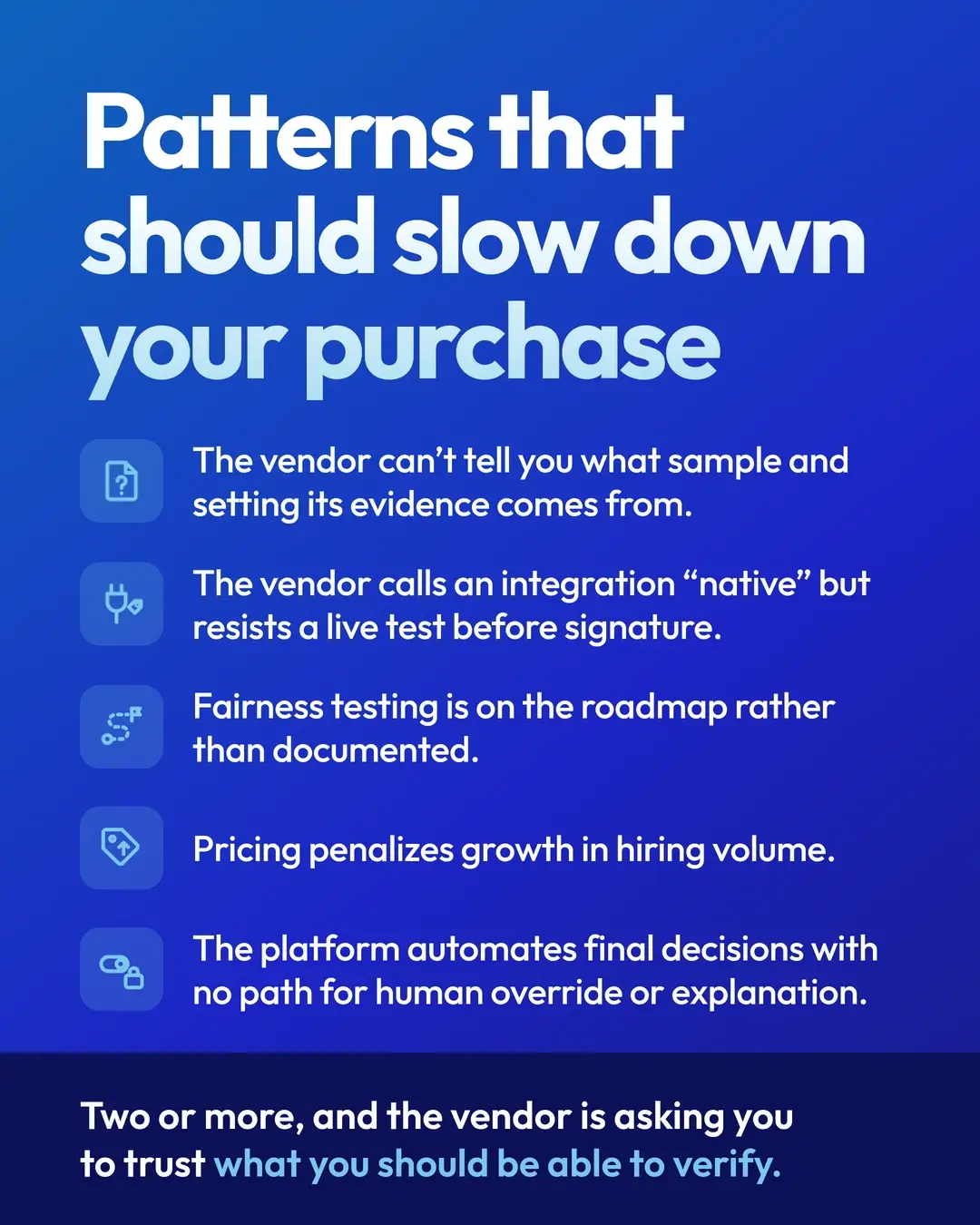
Slow down if you see these patterns:
- The vendor can't tell you what sample and setting its evidence comes from.
- The vendor calls an integration "native" but resists a live test before signature.
- Fairness testing is on the roadmap rather than documented.
- Pricing penalizes growth in hiring volume.
- The platform automates final decisions with no path for human override or explanation.
Two or more, and the vendor is asking you to trust what you should be able to verify.
Choosing Talent Assessment Software Means Reading the Documents First
Send every vendor on your shortlist the same six requests:
- A dated rollout plan
- An integration test in your own environment
- The security certificate with its scope statement
- Validation and fairness documentation that says where the evidence stops
- The override process
- A three-year price schedule at your volume
Compare what comes back in writing. The strongest vendors send it without being chased, and a stall on any of the six shows you where to slow down.
The next time a vendor offers to walk you through the platform, ask for the folder first. The demo will still be there afterward.
Every criterion, question and red flag in this guide fits on one page. Download this vendor-neutral evaluation checklist so you can score every platform on your shortlist, including Ignis. If you would like to see Ignis for yourself, schedule a conversation.
Frequently Asked Questions About Talent Assessment Software
How do I choose talent assessment software for my company?
Decide which type of assessment fits the role, then evaluate the platform on six points: a dated implementation plan with named owners, ATS and HRIS integration tested in your own environment, a security certificate whose scope names the product, validation and fairness documentation that states its sample and setting, a documented override path when a hiring manager disagrees with a score, and contract terms covering service levels and pricing at your volume, plus data export at exit. Send every shortlisted vendor the same requests and compare the written responses. A vendor that declines a pre-signature test has shown you where to look harder.
What integrations does talent assessment software need?
Talent assessment software needs a two-way connection with your applicant tracking system. A stage change triggers the invitation, and the score and completion status write back to the candidate record. For employee assessment, the connection runs to your HRIS or learning management system. Real-time sync with field-level write-back differs from batch file import, which delays results and leaves administrators reconciling records by hand. Recruiters and administrators also need single sign-on. Test each connection in your own environment with a bulk run, because a list of supported systems doesn't show how a connection behaves under load.
How are validity and reliability measured in a talent assessment platform?
Reliability measures consistency. Internal consistency, such as Cronbach's alpha, shows whether items on a scale agree. Rater agreement, such as quadratic weighted kappa, shows whether independent scorers give the same response-matching scores. Validity measures whether scores mean what the vendor claims, and the evidence should match the claim. A claim that scores predict job performance needs a criterion-related study linking scores to later performance. A narrower claim needs narrower evidence. A high reliability figure doesn't establish validity on its own, so ask what was measured and in which sample and setting.
How do companies assess talent through job simulations?
A job simulation places a candidate in a realistic work scenario, such as responding to a colleague's request or working through a problem with incomplete information, and scores how they handle it. Because it observes behavior on a task that resembles the job, a simulation can measure Power Skills like communication and analytical thinking that self-reports and résumés can only describe. When a vendor uses simulations, ask to see a sample scenario and a scored response, and ask for the validation studies run on that method, including the sample and setting each study used.
Is it better to build an in-house assessment tool or buy a platform?
Buying is the stronger default for most organizations. Teams that seriously consider building usually run hundreds of thousands of assessments a year, and even then a build makes sense only when the assessment itself differentiates how they hire and they employ the psychometric and security staff to maintain it. A prototype can come together quickly. A production system also needs validated content, a defensible scoring model, fairness testing, a security certification, ATS and HRIS integrations and an audit trail, maintained as regulations change. Whoever builds the tool owns every challenge to a score.
What security and compliance certifications should talent assessment software have?
Ask for a current ISO 27001 certificate or a SOC 2 Type II report, depending on what your security team requires, with a scope that names the specific product and hosting environment holding your data. Request documentation from the most recent audit. Certification sits beside four contractual documents: a data processing agreement, written data residency terms, a sub-processor list with change notifications, and a statement on whether your candidates' data trains models used for other customers. A certificate held by a parent company or a different product doesn't cover your data.
How much does talent assessment software cost per candidate or per seat?
Talent assessment software is usually priced per candidate, per seat or through an enterprise license covering an agreed volume. Per-candidate pricing suits low volume and rises with every applicant. Per-seat pricing follows the number of recruiters and administrators. Enterprise licenses suit predictable volume, so the overage rate matters most. Ask each vendor for a three-year schedule at your expected volume and at a hiring surge, including overage and renewal terms, and compare vendors only at the same volume assumptions.