Talent Assessment: A Quick Guide for HR and L&D Leaders
Talent assessment is intended to de-risk high-stakes decisions about who to hire, develop, and promote, but many HR and business leaders are still working with thin, unreliable data instead of a data driven process for making the call.
Personality inventories, unstructured interviews, and manager gut feel can all add texture, yet none of them reliably answer the question that matters most: Can this person actually do this job well?
After all, a candidate can ace a personality assessment and still struggle in the role, or score poorly and still be exactly the right hire, because the instrument was built to describe who they are, not what they can do. The same gap shows up in internal talent decisions, where promotion and development choices may be driven by bias or other irrelevant factors rather than demonstrated capability.
Learn what a talent assessment is, the five main types and what each one measures, how assessment applies differently to hiring versus development, the four things that separate a rigorous instrument from a superficial one, and how to build a strategy for implementing a talent assessment across your organization.
What Is a Talent Assessment?
A talent assessment is a structured process for evaluating a person's capabilities and fit for a role using consistent, job-relevant evidence rather than relying only on resumes. It's designed to measure specific skills, behaviors and sometimes cognitive abilities in ways that help HR and L&D leaders make better decisions about hiring, development, promotion and succession planning.
While the term 'talent assessment' may sometimes be used as shorthand for tests given to candidates, most HR leaders use the phrase more broadly to mean the talent assessment framework, the whole set of tools and methods the organization uses to systematically evaluate someone's skills and potential.
Common Types of Talent Assessments
Different types of talent assessments measure different things, and each brings its advantages and blind spots. Understanding what each method captures (and what it misses) helps match the right tool to the decision.
- Personality assessments. Measure traits, preferences, and style (for example, how someone tends to communicate, make decisions, or respond to stress). Useful for self-awareness and team dynamics, but they do not directly measure capabilities or predict job performance.
- Cognitive and aptitude tests (also called cognitive ability tests). Measure general problem-solving ability, reasoning, and learning speed. Strong predictors of how quickly someone can pick up work in the area tested, but they say little about how a person will handle interpersonal dynamics, ambiguity or organizational realities.
- Behavioral and situational judgment assessments. Present work-like scenarios and ask people what they would do, often through multiple-choice or ranked responses. Capture patterns in judgment and decision-making, but can still reward test-taking skill and recognition of "right" answers rather than fully revealing behavior under pressure.
- AI-scored scenario-based assessments. Ask people to respond in their own words (written or spoken) to realistic, role-specific situations, then score those responses using models trained on expert ratings. Capture how someone reasons, communicates, and prioritizes in context, with more fidelity than fixed-option tests, while still scaling across many candidates.
- 360 and manager ratings. Aggregate feedback from managers, peers, and sometimes direct reports about how someone shows up day to day. Provide a real-world view of behavior in a specific environment, but can be influenced by relationship dynamics, local culture, and the quality of raters, so they are strongest when combined with more structured evidence.
Comparing 5 Types of Talent Assessments
| Assessment Type | What It Measures | Best For |
|---|---|---|
| Cognitive and Aptitude Tests | Reasoning, numerical ability, and problem-solving speed | Predicting training success across large candidate pools |
| Personality and Preference Inventories | Traits, motivations, and working style | Self-awareness and coaching conversations; predictive validity for job performance varies by specific instrument |
| Situational Judgment Tests | Choosing the best response to a scenario from a list | Efficient screening with documented, if modest, validity beyond cognitive ability alone |
| AI-Scored, Scenario-Based Assessments | Open-ended, constructed responses to realistic, work-like situations, scored against validated rubrics | Decisions that depend on demonstrated behavior rather than recognition of it |
| 360 and Manager Ratings | Observed behavior from people who work with the person | Confirming how someone performs in a role, through others' eyes |
Elements of a Rigorous Talent Assessment
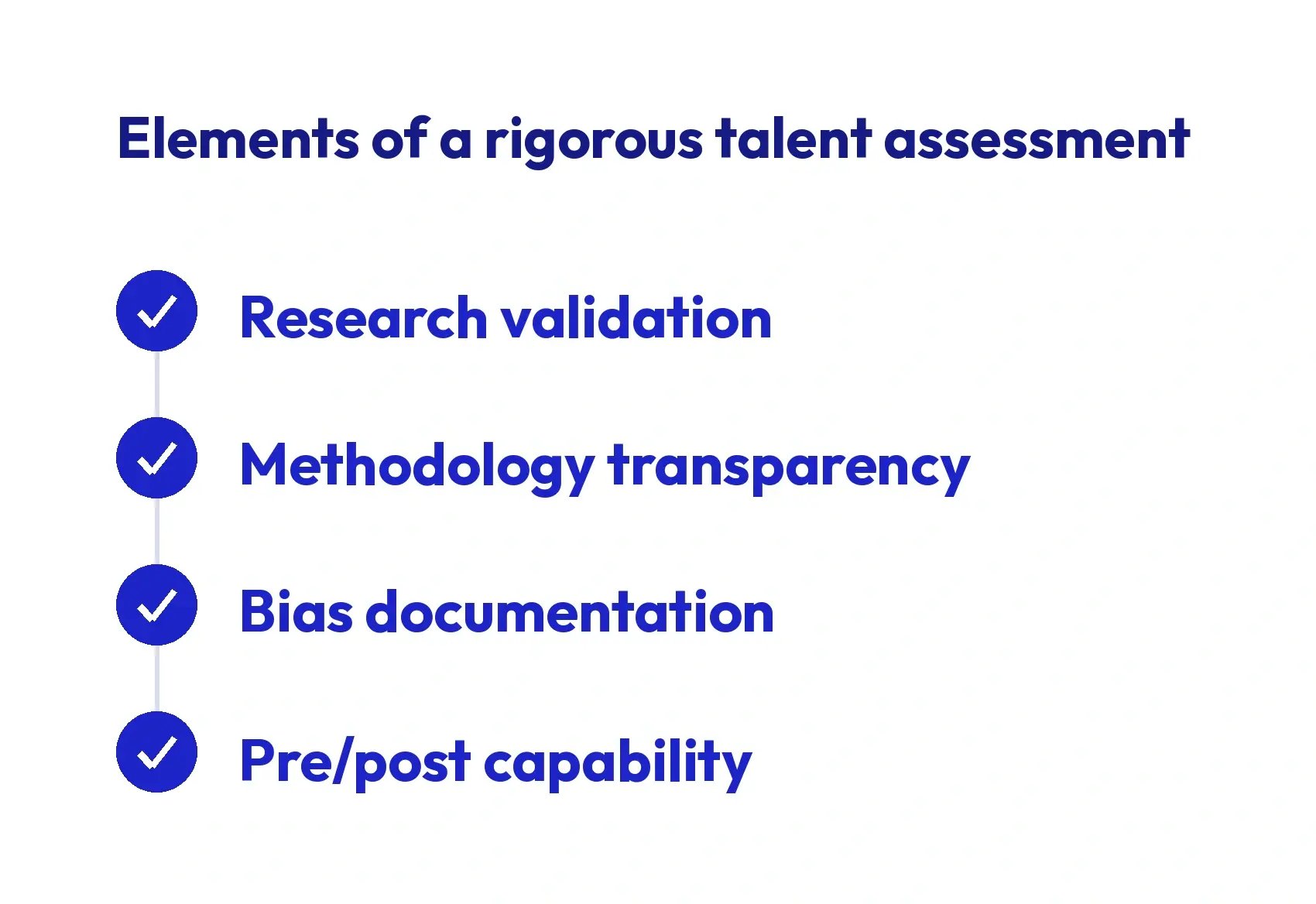
A rigorous talent assessment is built on clear evidence, transparent design and repeatable measurement, so you can trust the scores to make high-stakes decisions. Ensure that any assessment you are considering meets all of these requirements.
- Research validation. A rigorous talent assessment is backed by evidence that its scores predict outcomes that matter, such as performance, promotion or retention. That means documented reliability and validation studies, not just vendor claims or testimonials.
- Methodology transparency. Strong assessments are clear about how they work: what they measure, how scenarios are designed, how responses are scored and how scores should be interpreted. This transparency lets HR and L&D leaders judge whether the instrument matches their roles, culture and decisions.
- Bias documentation. Any serious assessment includes analysis of potential bias and adverse impact, showing how different groups perform and what safeguards are in place to reduce unfair disadvantage. This documentation is essential for using results in high-stakes decisions without amplifying inequities.
- Pre/post capability. Robust talent assessment supports measurement over time, not just a single snapshot. The ability to establish a baseline, reassess after hiring or development and compare capability across time turns talent decisions and targeted development investments into something that can be tracked, tested and improved.
Top Talent Assessment Use Cases
Talent assessment is often associated with hiring, but the same tools can play a critical role in learning and development, succession planning, and closing skills gaps inside the organization.
Talent Assessment for Talent Acquisition
Candidate assessment uses structured, job-relevant exercises, such as scenario-based tasks or work samples, to capture how candidates apply problem solving skills, communicate, and make decisions under realistic constraints. By adding this layer of evidence early in the process, hiring teams can move beyond "best interviewer wins" and toward a more consistent, comparable view of who can truly do the work.
Rigorous candidate assessment can create a common language for discussing strengths and risks, helps surface hidden stars who may not interview as smoothly, and reduces the influence of rapport, bias and first impressions. Instead of relying solely on gut feel, talent acquisition teams can anchor their decisions in demonstrated behavior, while still using interviews to probe fit, motivation, and context.
Talent Assessment for Learning & Development
Participants complete a baseline assessment that captures how they handle realistic situations related to the target skills, such as leading a team, managing conflict or prioritizing competing demands. After the program, they complete the same or a parallel assessment, generating a scored profile that shows where capabilities have strengthened and where they remain flat.
Those profiles can feed directly into succession planning and internal mobility decisions, identifying employee readiness for other roles and where critical skill gaps still exist. L&D leaders can show that specific capabilities improved, tie those improvements to readiness for key roles and use the data to prioritize future investments in talent.
4 Common Mistakes in Talent Assessment
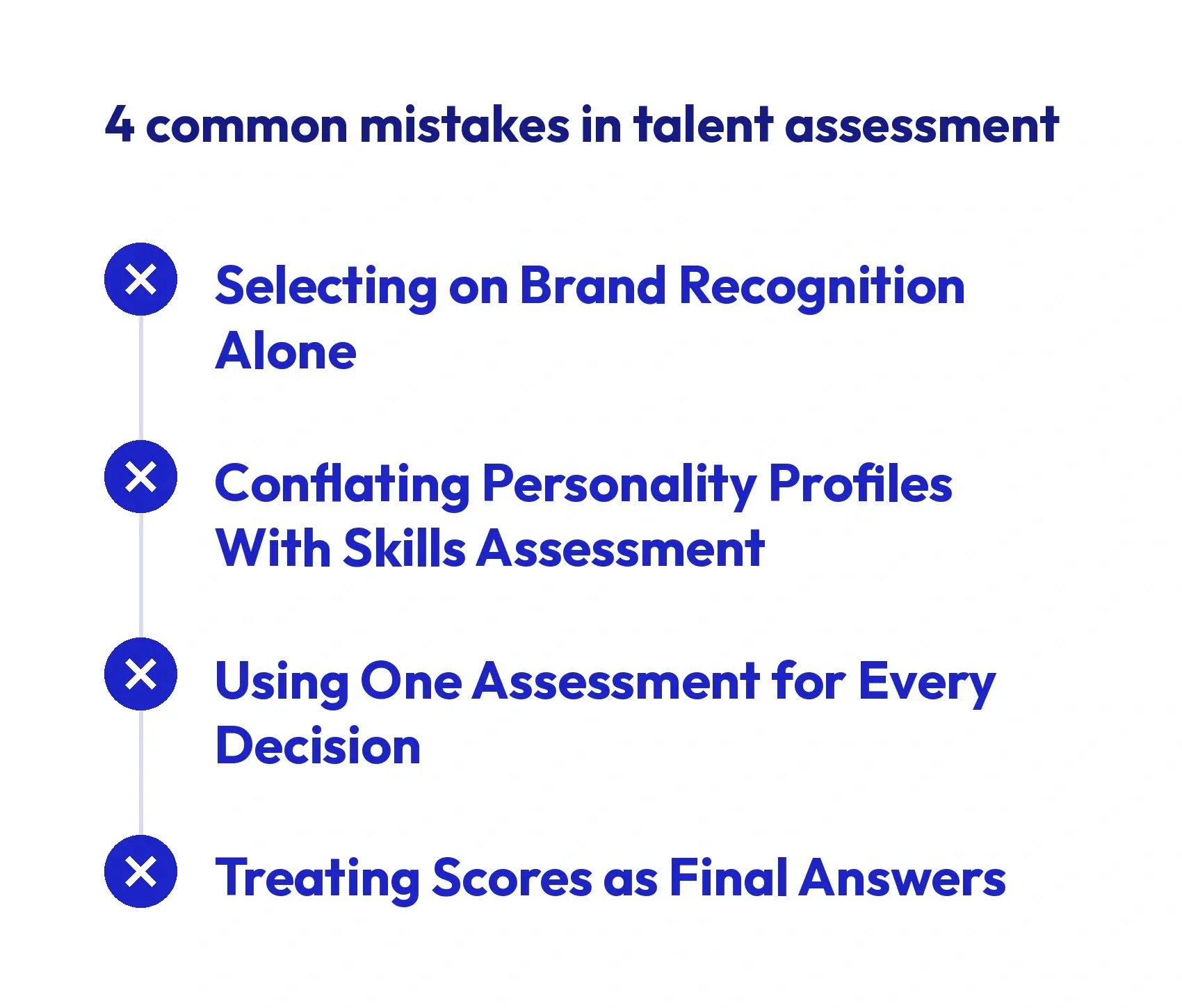
A handful of predictable errors show up again and again. Spot them early to improve your odds of success.
- Selecting on Brand Recognition Alone. The most familiar name in the room isn't automatically the most valid instrument for your decision. Familiarity tracks marketing spend, not predictive power. Evaluate the methodology, not the logo.
- Conflating Personality Profiles With Skills Assessment. A personality profile tells you how someone tends to operate, not whether they can do the job. Using a trait inventory to make a competence decision is the wrong instrument, and no amount of rigor in the personality tool fixes that mismatch.
- Using One Assessment for Every Decision. Hiring, development and succession are distinct decisions with different stakes and different time horizons. A single assessment stretched across all three usually serves none of them well. The strongest assessment programs mix and match instruments to the decision.
- Treating Scores as Final Answers. A score is evidence, not a verdict. The strongest talent processes use assessment data to sharpen human judgment, structure a development plan, or challenge a gut call, not to end conversations.
How to Design a Better Talent Assessment Strategy
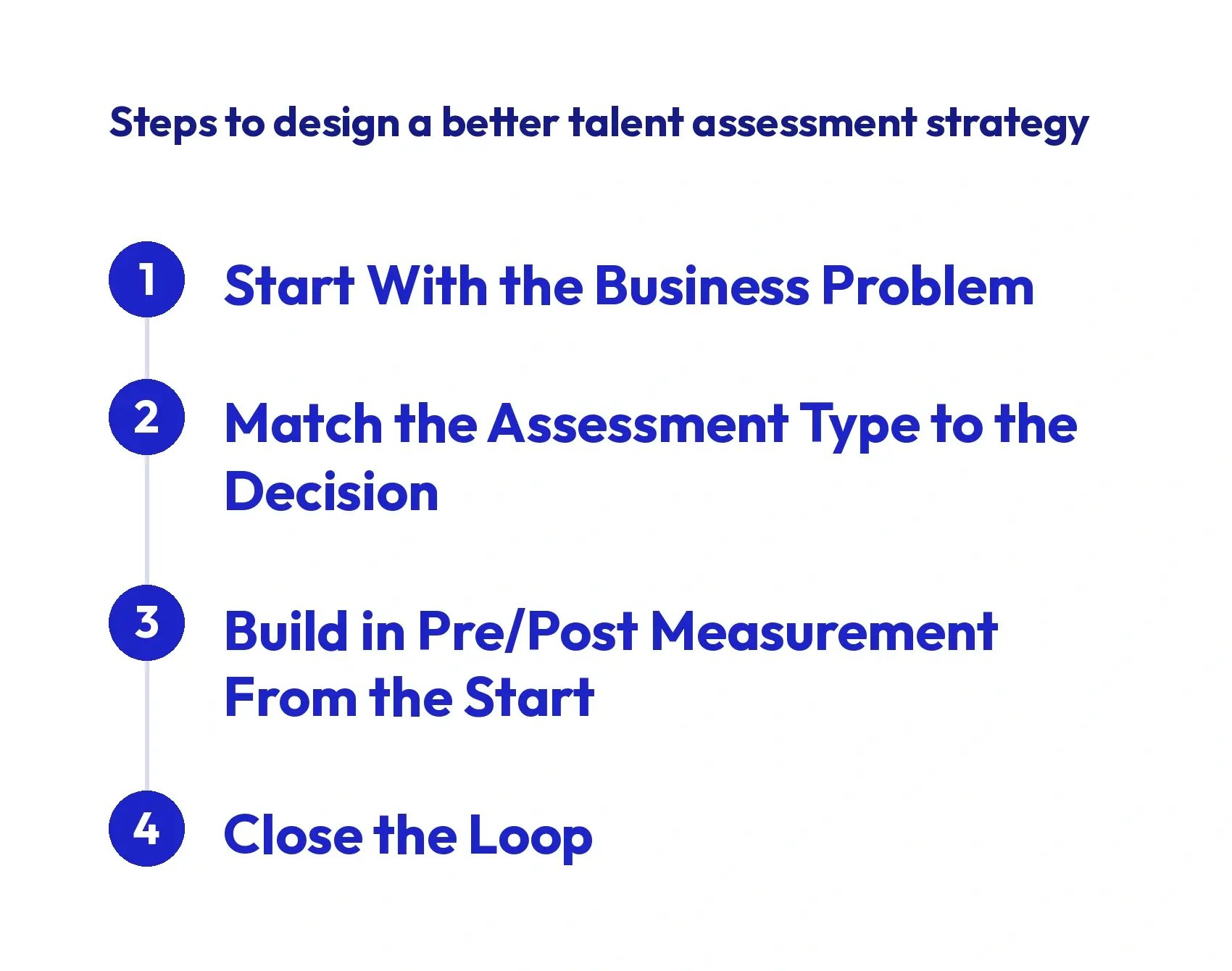
Building a great talent assessment program doesn't have to be complicated.
- Start With the Business Problem. Name something specific you're trying to improve (a hiring stage, a promotion gate, identifying high potential talent, a development investment) and define what a good outcome looks like before you evaluate a single tool. Everything else follows from that decision.
- Match the Assessment Type to the Decision. If the decision hinges on demonstrated skill, use a demonstrated-response assessment. If you need coaching context, a personality tool fits better. Compare the method against the decision at hand, not against what's popular.
- Build in Pre/Post Measurement From the Start. If development is in scope, establish a baseline capability before you intervene. The cost is minimal to do early and impossible to reconstruct later. The baseline is what turns "we ran a program" into "we can demonstrate impact."
- Close the Loop. Track whether the assessment's signal matches real outcomes: Did strong scorers perform well? Did development move the numbers you baselined? Is it showing up in stronger employee retention? Feed that back into how you use the tool.
That's when talent assessment stops being "extra paperwork" and becomes a durable way to prove impact across talent management: better hires, smarter promotions, targeted development, and visible skill movement that you can track.
Frequently Asked Questions About Talent Assessments
What Is Talent Assessment?
Talent assessment is a structured process for evaluating a person's capabilities to support decisions about hiring, development, or promotion. A strong talent assessment focuses on what someone can actually demonstrate in job-relevant situations, rather than relying only on self-reported strengths or personality traits, which makes the results more predictive of real performance.
How Do You Assess Talent Potential?
Talent potential is best assessed by measuring demonstrated capability in realistic, role-specific situations instead of depending on self-descriptions or generic trait inventories. Candidates or employees are placed in work-like scenarios, their responses are captured and scored against a clear rubric, and potential is inferred from how quickly and how far those capabilities move when measured before and after targeted development.
What Is a Talent Assessment Test?
A talent assessment test is a standardized tool used to evaluate specific capabilities, such as personality, cognitive ability, situational judgment, or job-relevant skills. Different tests measure different things. Some focus on traits and preferences, while scenario-based tests capture how a person behaves.
How Do Talent Assessment Tools Improve Hiring Decisions?
Talent assessment tools improve hiring decisions by replacing the most subjective parts of interviews (rapport, first impressions, and halo effects) with a consistent, job-relevant sample of behavior that every candidate produces under the same conditions. When those results are scored with a validated rubric, documented with a clear rationale, and regularly checked for bias, they give hiring teams more reliable evidence to support their judgment and make selection decisions easier to explain and defend.