Employee Skills Assessment in the Age of AI
Skills are changing faster than the tools built to measure them. By 2030, employers expect 39% of core workplace skills to shift, according to the World Economic Forum's Future of Jobs Report 2025. Meanwhile, most organizations still grade people and potential using employee skills assessments, annual reviews and rubrics that weren't designed for the current level of technological and workplace transformation.
AI is changing which capabilities separate top performers from everyone else. Less obviously, it's changing how employee skills assessment itself gets done. It's closing the distance between how fast skills shift and how often anyone actually checks.
What Is an Employee Skills Assessment?
An employee skills assessment is a structured, scored evaluation of demonstrated capability, technical or interpersonal, tied to tasks that require a person to perform the skill. The output is a score attached to a specific skill at a specific point in time.
It's a narrower instrument than talent assessment, which also covers personality and culture fit tools sometimes used in hiring and promotion decisions. An employee skills assessment deliberately narrows its scope to capability rather than disposition. Disposition is largely fixed.
5 Types of Employee Skills Assessments
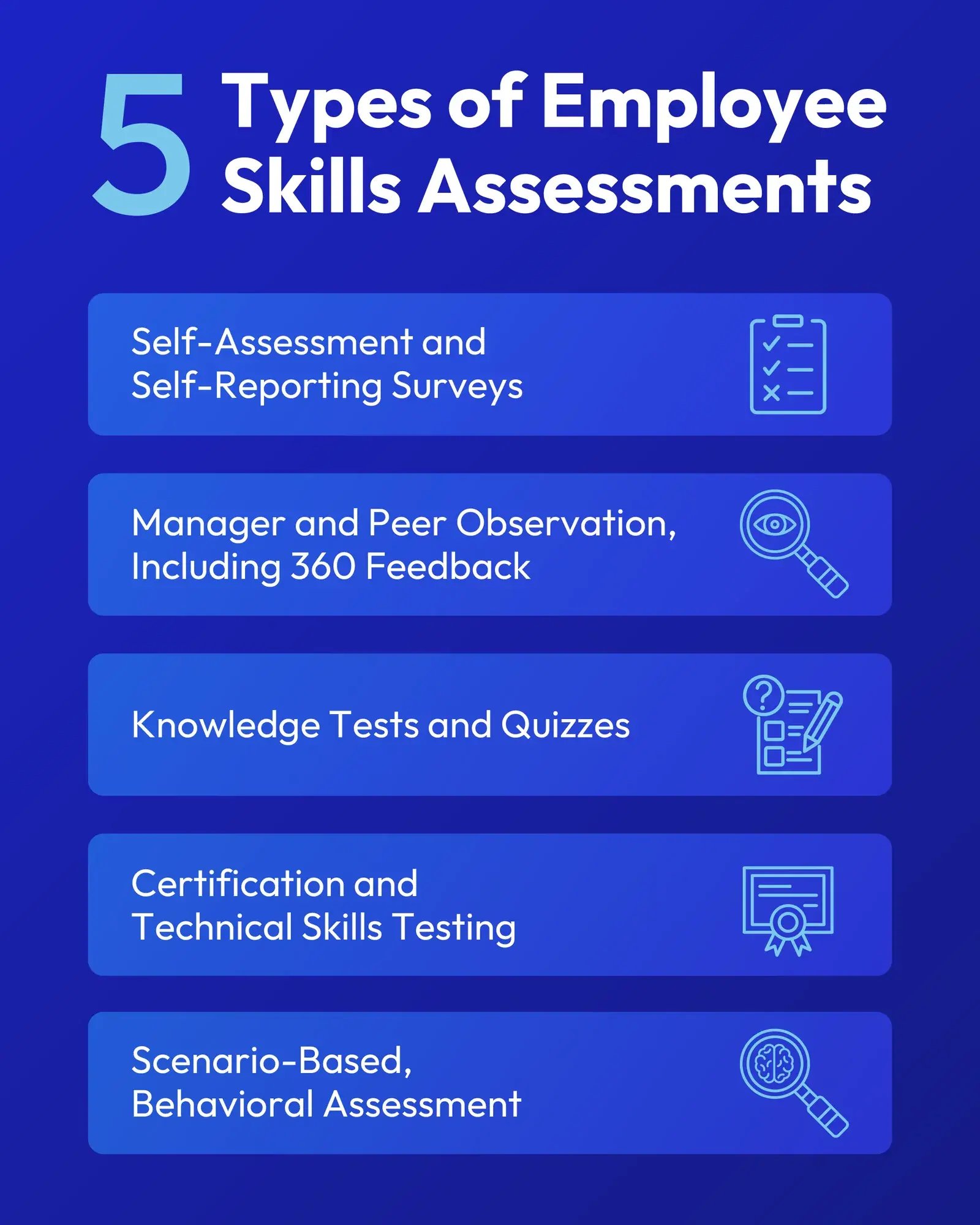
Employee skill gap assessment programs generally include a mix of assessment types:
- Self-assessment and self-reporting surveys. The default method in most organizations, and the least defensible one: 71% of employees misjudge their own skill level (Workera, 2024), which means the data most development budgets are planned against is, for most people, simply wrong.
- Manager and peer observation, including 360 feedback. An aggregate of subjective impressions shaped by team dynamics and recency, not a standardized measurement.
- Knowledge tests and quizzes. Confirm recall, not applied capability. A useful check on whether training content landed, a poor proxy for whether anyone can act on it under real conditions.
- Certification and technical skills testing. The most objective method available, and it's best for right-or-wrong skills.
- Scenario-based, behavioral assessment. The only method on this list that holds up for both categories. Participants respond to a realistic situation and get scored against a validated rubric, which is what makes interpersonal skills measurable at all.
5 Ways AI Is Transforming Employee Skills Assessment
AI is changing employee skills assessment at multiple points in the process:
- Scores open-ended, scenario-based responses at a volume no team of human raters could sustain, applying the same rubric to response #1 and #10,000.
- Turns soft-skill scoring into a number that holds constant no matter who's being measured or when, rather than an impression that lives in one manager's head and doesn't survive a reorg.
- Makes genuine before-and-after tracking possible at the cohort level, not just the individual one. In an illustrative example, not client data, a cohort's average Leadership score moves from 61 to 72 over the course of a program.
- Removes single-rater subjectivity by running multiple independent scoring passes on each response, then checking that scoring for bias across the populations being assessed. That's a check most self-reporting or interview-based processes don't run at all.
- Extends measurement to capabilities long treated as too fuzzy to score, including creative thinking and collaboration. These are the same soft skills that have historically been difficult to measure reliably without falling back on self-reporting.
How to Evaluate an AI-Powered Employee Skills Assessment
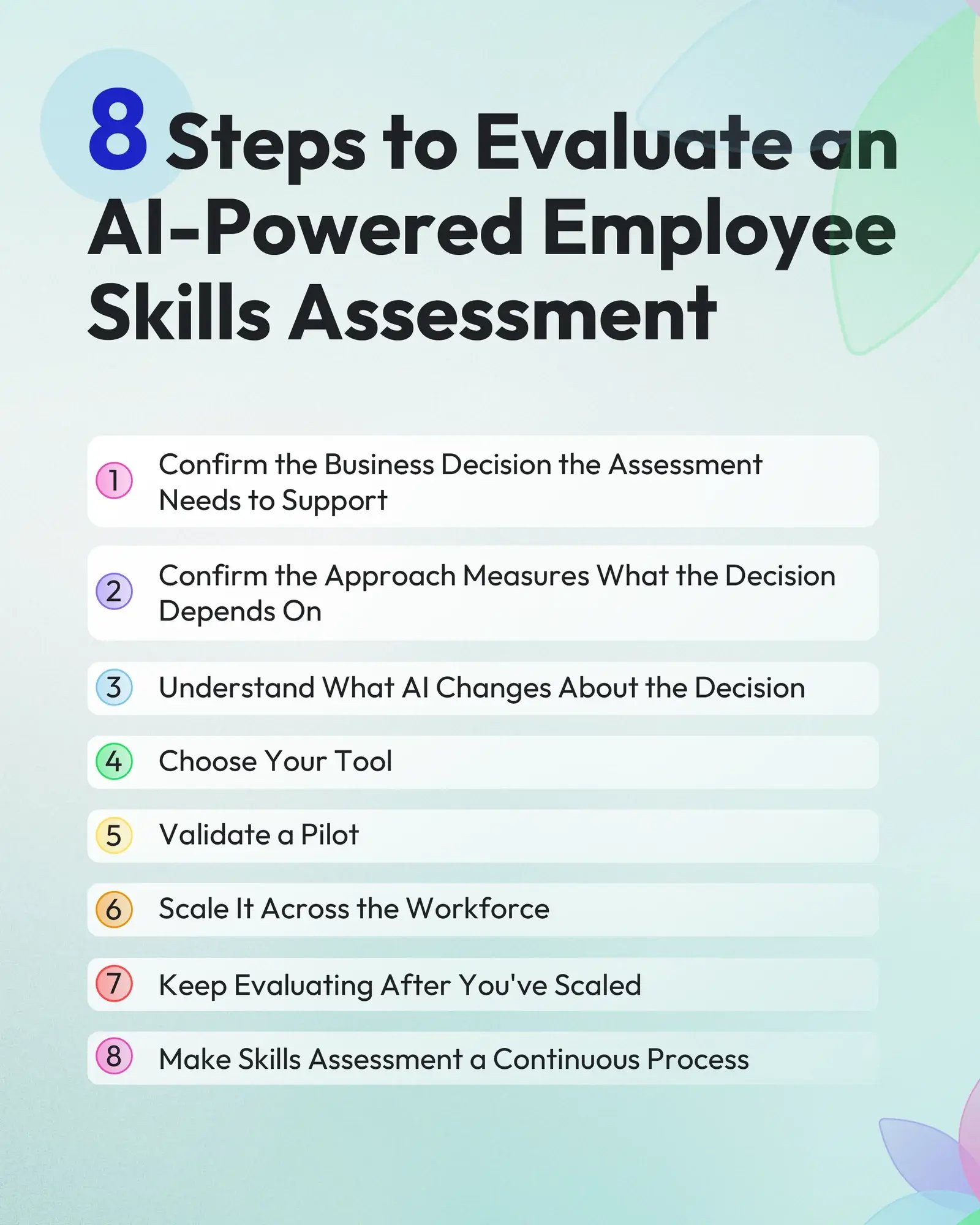
Evaluating an AI-powered employee skills assessment means deciding what your workforce needs before you compare products. Start with what you need to decide, then confirm what has to be measured to make that decision. Only after that does it make sense to ask what's different now that AI can do the measuring. Choosing a tool comes next, with piloting and scaling to follow. Skip any one of these steps, and the number you end up with isn't one you can trust.
Confirm the Business Decision the Assessment Needs to Support
A training investment in a specific capability needs evidence that someone changed, not just attendance records. Confidence in someone's demonstrated ability is what allows a stretch-role placement instead of a call made on instinct, and without it the decision defaults to guesswork. Succession planning needs a defensible answer for who's ready, instead of stalling on the same uncertainty every cycle. Each of these predates any conversation about tools or AI. Naming which one the organization needs answered comes before anything else, including whether AI belongs in the answer at all.
Confirm the Approach Measures What the Decision Depends On
The decision determines what has to be measured, and that determines the approach, not the other way around. Missing technical knowledge calls for a knowledge test. A question about whether someone can handle an ambiguous, high-stakes decision needs a scenario with competing priorities and no clear owner, then a look at what someone does when they're handed one. Someone who jumps straight to the loudest problem is demonstrating something different from someone who finds the real constraint first and works from there. A placement or succession decision needs to see that difference, and that's exactly what a knowledge test or self-reporting can't show.
Understand What AI Changes About the Decision
AI shows up in assessment at several different layers, and they don't all matter equally for this decision. It can help write job requirements, adjust question difficulty in real time, score constructed responses, or project retention and promotion odds after the fact. Of those, only the scoring layer changes what's possible for an employee skills assessment specifically. Scoring is what removes the old ceiling on rigorous, demonstrated-capability measurement, a ceiling set by how many people a trained facilitator could personally evaluate rather than a full workforce. That ceiling is also why self-reporting and annual reviews became the default for most organizations, since nothing else was operationally possible at that scale. The same rigor that once applied to twenty people in a pilot can now apply to two thousand, on the same cadence, scored the same way every time.
Choose Your Tool
Once you've confirmed the decision and the method, and you know the scale AI makes possible, the tool choice narrows considerably. It has to run that specific method at that specific scale. Nothing less specific will do. Some tools in this category are built around adaptive, multiple-choice-style testing; others around video or voice interviews scored mainly for communication style and delivery. Both can be useful for other decisions. Neither runs the scenario-based, demonstrated-capability method a placement or succession decision depends on. What's left after that filter is a shorter list than most vendor comparisons suggest.
Validate a Pilot
A pilot's only job is to show whether this works for your organization's specific version of the problem, not the vendor's demo version. Run it with a group small enough to review closely, but large enough that the results mean something beyond a handful of individual cases.
Scale It Across the Workforce
Once the method is validated, scaling means running the same task and rubric, scored the same way, across the full population it needs to cover, not a new version built for speed or a simplified version built for cost. Whatever made the pilot's results trustworthy has to survive the jump to a workforce of thousands.
Keep Evaluating After You've Scaled
A method that's validated in a pilot can still drift once it's running across a full workforce. Raters calibrate differently over time, and a rubric that fits one moment stops fitting as roles change. Keep checking the results against the same business decision this process started with. If the assessment stops producing evidence that decision can stand on, treat that as the signal to recalibrate, not as a reason to ignore it.
Make Skills Assessment a Continuous Process
Many organizations still treat skills assessment as an annual event, a test at hire and maybe a check-in ahead of a promotion cycle. That cadence assumes the skills that matter hold still between measurements. They don't, and the assumption gets more expensive as the gap widens between how often you measure and how fast the work itself changes. The organizations ahead of this treat assessment as an ongoing investment in talent, one that produces a current picture of capability as the work changes.
See the methodology behind how Ignis measures skills, including the research and bias testing it's built on.
Frequently Asked Questions About Employee Skills Assessments
What is a skill gap assessment?
A skill gap assessment measures the difference between the skills a role or team currently has and the skills the work requires, then flags where the two don't match. It can run at the individual level, showing where one person needs to grow, or at the team or organizational level, showing where gaps repeat across a group or a workforce. The result only helps if it's specific. A report that rates someone 'below average' on communication doesn't tell a manager much. A report that shows the gap is specifically in written communication, or in handling ambiguous audiences, gives the manager somewhere to start.
How often should you run an employee skills assessment?
Run an employee skills assessment on a fixed, repeatable cycle, typically quarterly or twice a year, not as a single annual event. Most organizations still default to one test at hire and a check-in before a promotion decision, which assumes the skills that matter stay the same in between. That assumption gets more expensive each year. Core skills are shifting fast enough that the World Economic Forum's 2025 Future of Jobs Report puts disruption at 39 percent of core skills by 2030. A fixed cycle also keeps the comparison valid, since running the same task and rubric each time is what makes a later score mean something against an earlier one.
What's the difference between an AI-powered assessment and a traditional one?
The real difference between traditional and AI employee assessments depends on which layer of the process the AI is doing the work in, not whether AI is present at all. AI shows up in assessment at several layers, including writing job requirements, adjusting question difficulty in real time, scoring a response, or projecting outcomes like retention after the fact. Scoring is the layer that changes what's possible for measuring demonstrated capability. It lets a rigorous, scenario-based task run at a volume and consistency no human rater team could sustain, so the same rigor built for a twenty-person pilot can run across a workforce of thousands. A tool that applies AI to adjusting difficulty or projecting outcomes, while still scoring the underlying response the same static way it always did, hasn't changed the thing that matters for a skills decision.
How do you know if an employee skills assessment is free of bias?
No assessment can be guaranteed completely free of bias, but a few checks tell you a lot. Look for whether the tool has been through an independent bias audit, not an internal one the vendor ran on itself, and how recently that audit was done, since bias can reemerge as a model or the population being assessed changes. Ask who conducted the audit and what populations it covered. Then check whether the results are actually available to review, not just asserted. If the assessment feeds into a hiring or promotion decision, some jurisdictions require this by law. New York City's Local Law 144, for instance, mandates an independent bias audit every year with results posted publicly.