Employee Assessment Software: How to Tell If It Measures Anything
Employee assessment software is worth buying only when it can trace a score back to something an employee did. Many platforms sold under the label store self-ratings and manager opinions in a cleaner dashboard. A verified platform scores how people respond to realistic work scenarios against a documented rubric and publishes how often its scorers agree. Before you shortlist a vendor, ask it to walk one employee's score back to its source.
Every demo of employee assessment software typically shows the same screen: one employee, one skill, one number. Say it reads 4.2 out of 5 for collaboration, which looks precise. The data underneath is self-reported or a manager's gut check.
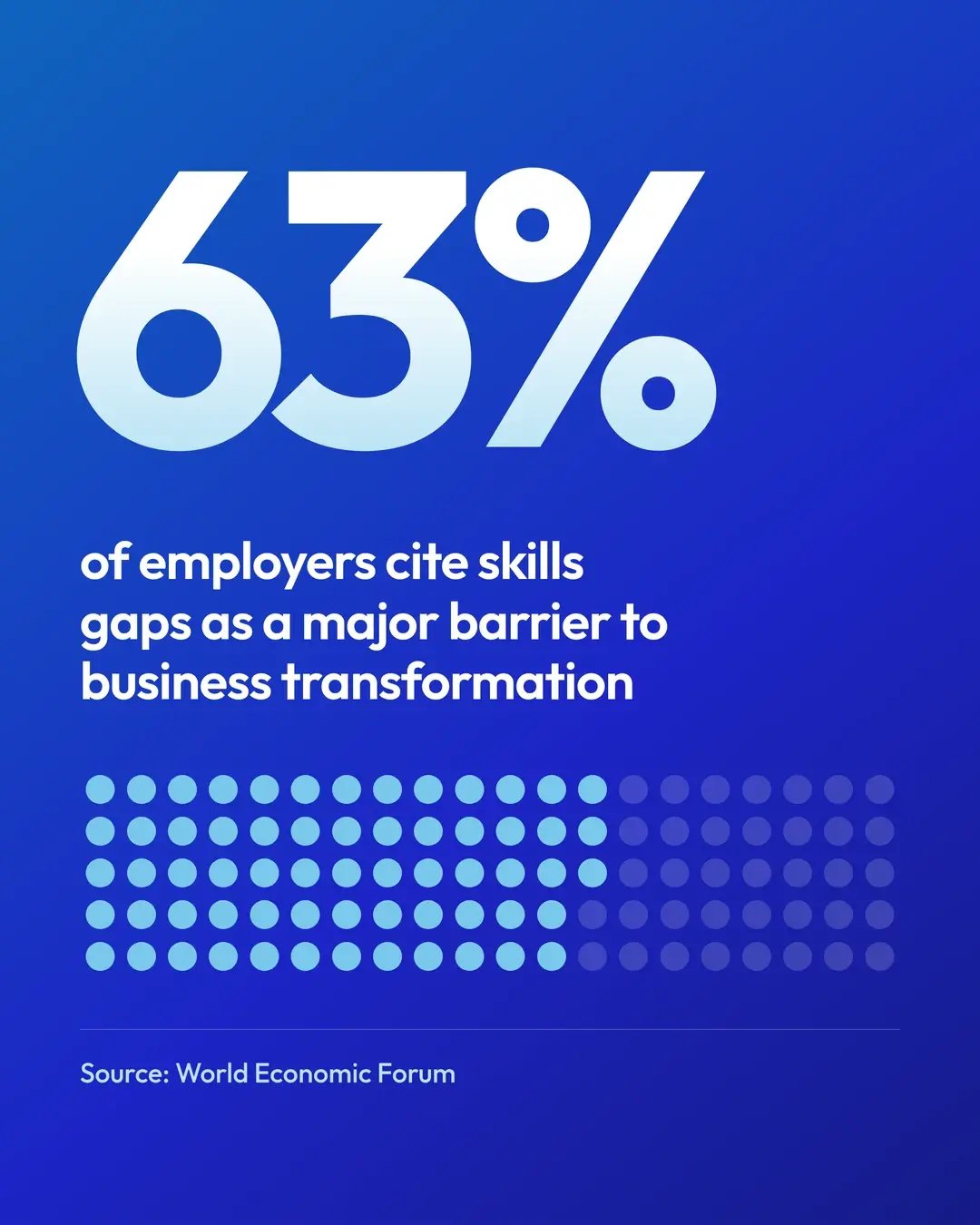
In the World Economic Forum's Future of Jobs Report 2025, skills gaps ranked as the biggest barrier to business transformation through 2030, and 63 percent of employers called them a major barrier. Employee assessment software is supposed to show where those gaps sit in your own workforce. A lot of it can't, because it moves the inputs your review cycle already produces (self-ratings, manager scores, 360 comments) into a cleaner dashboard. The guesswork stays the same and bad data infiltrates your talent systems.
The test that separates a platform that measures from one that records is traceability. Can an assessment vendor walk any single score back to something the employee did, under conditions you can inspect?
This guide gives you the comparisons and questions to bring to any employee assessment software on your shortlist, including ours.
Comparing a Digitized Survey and a Verified Employee Assessment Software Platform
Performance management software runs a process well: goals, check-ins, review cycles, reminders. Continuous feedback software adds comments between cycles. Both cut administrative overhead and leave a written record.
Neither was built to produce independent evidence of what an employee can do, the job most employee assessment tools claim to do. The table shows where a digitized survey and a verified platform part ways.
| Digitized survey | Verified assessment platform | |
|---|---|---|
| What the employee does | Rates themselves, or is rated by others | Works through a realistic scenario and writes an answer |
| What generates the score | An opinion entered on a scale | Observed behavior scored against an expert-authored rubric |
| Who sets the standard | Each rater, individually | A documented rubric applied the same way to everyone |
| What you can show Legal or Procurement | Completion rates and averages | Scorer-agreement data and documented fairness testing |
| What a second assessment tells you | Whether opinions changed | Whether demonstrated skill changed on the same instrument |
This is an illustrative example, not an item from any live assessment:
- Survey item: "Rate how effectively you resolve disagreements on your team (1–5)."
- Scenario item: "Two people on your team disagree about whether a client deliverable is ready to ship Friday. One says the quality isn't there. The other says the client has already slipped once. Write what you would say to each of them, and what you would decide."
The survey item tells you how the employee sees themselves. The scenario item gives a scorer something to evaluate: did the response surface both concerns, separate facts from positions, make a call and explain it?
Why Some Platforms Only Record Instead of Verify
Recording means capturing an opinion and storing it reliably. Verifying means generating new evidence that doesn't depend on that opinion. Many platforms sold as employee assessment software do the first job well and the second not at all.
That isn't always a product flaw. Most teams buy to cut administrative work first and worry about data quality later, often after the first round of results gets challenged.
Take the 9-box grid. A placement in the top-right box looks like a finding, but the input is usually one manager's annual judgment of performance and potential. Two managers rating the same person can land in different boxes, and the software displays both with equal confidence. Calibration meetings reconcile those opinions; they don't replace them with evidence.
The quickest diagnostic is to trace every score back to its origin. If each one starts with a person filling out a form about themselves or someone else, the platform is recording opinions, whatever its marketing calls it.
Recording alone puts the same spreadsheet into nicer software. The cost shows up when a promotion, a restructure or a development budget rests on those scores, because the decision is only as sound as the opinion underneath it. Verified scores move that decision beyond the gut check.
How to Demand Scoring Methodology Transparency From an Employee Evaluation Software Vendor
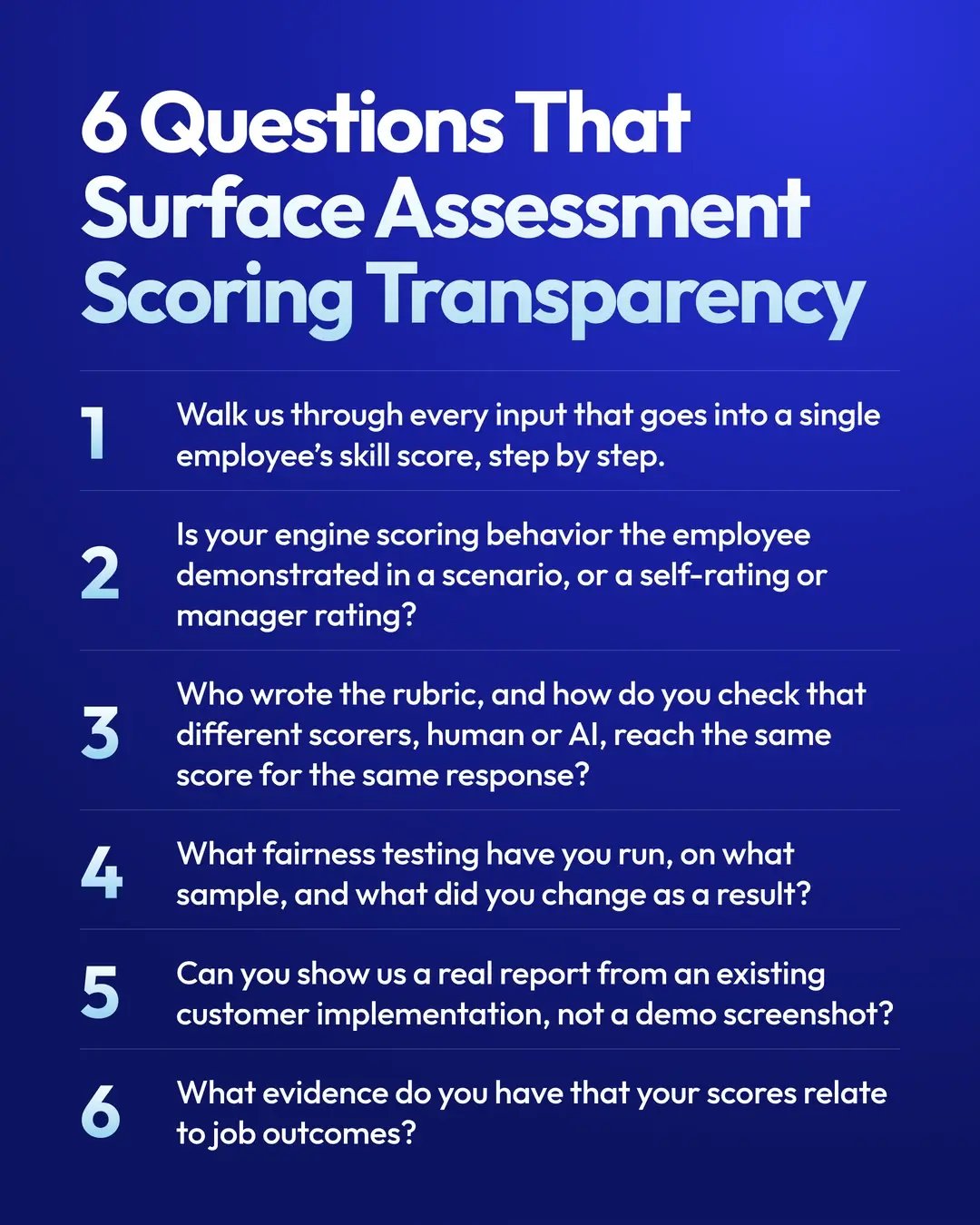
Scoring transparency means a vendor can explain, in plain language, exactly what behavior or output produced a given score. Most lists of employee evaluation software features skip this question because the answer is hard to give. Or the vendor lacks proven or published science behind its methodology. Ask it anyway, in these words:
- Walk us through every input that goes into a single employee's skill score, step by step.
- Is your engine scoring behavior the employee demonstrated in a scenario, or a self-rating or manager rating?
- Who wrote the rubric, and how do you check that different scorers, human or AI, reach the same score for the same response?
- What fairness testing have you run, on what sample, and what did you change as a result?
- Can you show us a report from an existing customer implementation, not a demo screenshot?
- What evidence do you have that your scores relate to job outcomes?
Vendors often blur three kinds of evidence. Internal consistency shows whether the items within a scale hang together. Scorer agreement shows whether two scorers give the same response the same score. Predictive validity shows whether scores relate to later performance. A strong figure on the first says nothing about the other two.
Watch for answers that end at "proprietary algorithm." A vendor can protect its model and still tell you what it scores, against what standard, and how often its scorers agree.
Comparing AI-Native and Legacy-Proxy Scoring
Nearly every vendor now sells some version of AI-powered employee assessment software, so the label tells you nothing. What matters is where the AI sits in the process.
In legacy-proxy tools, the AI sits on top of the old inputs: drafting review language, summarizing 360 comments, running sentiment analysis on feedback. Those features save managers time. But the AI is writing, and the score underneath still comes from a rating scale.
In AI-native scoring, the AI does the measuring. Employees construct responses to work-like scenarios, and a model scores those responses against expert-authored rubrics. The vendor documents how often the model's scores agree with trained human scorers on the same responses.
To tell which kind you're looking at, ask what would be left if you removed the AI. If the answer is a survey, the AI is a writing layer. If the answer is a set of scenarios no one could score at scale without it, the AI is doing the assessment.
General-purpose AI tools fail the same test: the output looks like an assessment but carries no reliability data or fairness testing.
What Genuine Capability Verification Looks Like in Employee Assessment Software
Verification has two halves. The measurement half determines whether the data is worth acting on. The operational half determines whether anyone will use it.
Those findings will drive talent and performance decisions, and someone will ask where each score came from.
On measurement, look for:
- Scenarios realistic enough that employees in that role recognize the situation
- Written scenario responses rather than self-ratings
- Published scorer-agreement data and documented fairness testing, with limits stated alongside results
- The same instrument before and after a development program, with a retake policy (a platform that allows a retake the next day is measuring practice)
On operations, look for:
- Reports that support a workforce decision without a manual export or a services engagement
- HRIS integration for employee assessment data, plus SSO, tested live before you sign, as you would with any talent assessment software
- Clear answers on what employee data is retained, for how long, and whether employees see their own results
- Employee assessment software cost per employee that scales predictably with headcount, with any separately billed items named up front
We hold ourselves to the same list. Ignis assesses Power Skills, the applied capabilities that determine how people perform in their jobs, such as leadership and communication. Participants write responses to work-like scenarios, and an AI model scores those responses against expert-authored rubrics. In a 400-response scoring study, the model's scores matched individual human scorers about as closely as those scorers matched each other (quadratic weighted kappa of 0.723 versus 0.708). A 613-person study tested items for differences by gender, ethnicity and age group and found no significant differences among any groups. Our research doesn't yet show that scores predict job outcomes, and we don't claim it.
After purchase, the question becomes whether development programs change anything, and answering it takes the same employee skills assessment run before and after.
Carry one question into your next employee assessment software demo: can the vendor take one employee and one score and show you what that person did to earn it?
Frequently Asked Questions
How Do You Evaluate Employee Assessment Software Before Buying?
Evaluating employee assessment software before buying starts with a single score. Ask each vendor to take one employee's result and show the evidence behind it: the scenario or question, the response, the rubric and who scored it. Then ask for scorer-agreement data and fairness testing on a named sample, and for a report from a live customer rather than a demo screen. A platform whose scores trace back to self-ratings or manager opinions is recording performance data; one whose scores trace back to observed responses is measuring skill. Ignis suggests running every shortlisted platform, its own included, through the same steps so the comparison stays fair.
How Do You Assess Employee Performance?
Employee performance assessment evaluates what someone delivered against agreed expectations over a set period. A sound process combines outcome data such as goals met, manager observations recorded during the period rather than reconstructed at review time, and structured evidence of the skills behind the results. Ignis keeps performance and capability separate: performance is past output in one role, while capability is what a person can do, including in situations they haven't faced. Calibrate across managers, because two managers rating the same work can disagree.
How Do You Assess Employee Potential?
Employee potential is a person's capacity to perform in a larger or different role. Most organizations infer it from current performance and manager nomination, often via a 9-box grid, which confuses what someone has done with what they could do. A stronger approach, and the one Ignis takes, defines the skills the next role requires, such as leadership or analytical thinking, assesses them directly through work-like scenarios, and repeats the assessment over time, so promotion decisions rest on demonstrated capability rather than one annual rating.
How Do You Assess Employee Skills and Competencies?
To assess employee skills and competencies, first define the skills each role requires, then choose a method by the evidence it produces. Self-assessment shows confidence. Manager ratings give a partial view filtered through one relationship. Certifications show prior knowledge. Scenario-based assessment, where employees write responses to realistic work situations, shows applied capability. Whatever method you choose, use the same instrument each time you measure, so results stay comparable across people and over time. Ignis measures applied capability this way, scoring written responses to work scenarios against expert-authored rubrics.
How Accurate Is AI Scoring in Employee Assessment Software?
AI scoring in employee assessment software is only as accurate as its agreement with trained human scorers, so ask every vendor for that figure. Agreement is usually reported as a quadratic weighted kappa, where 0 means chance-level agreement and 1 means perfect agreement. In Ignis's July 2026 technical white paper, the Ignis AI model's scores agreed with the consensus score of a panel of trained human scorers at a kappa of 0.788. A vendor that cannot report model-to-human agreement on a stated set of responses has not shown that its AI scoring is accurate. Scoring accuracy is also a separate question from whether scores predict job outcomes.
Can Employee Assessment Software Reduce Bias in Performance Reviews?
Employee assessment software can reduce bias in performance reviews only when the vendor tests its own scores and shares the results. Manager ratings carry each rater's habits, and software that digitizes those ratings carries the same habits forward. Ask for differential item functioning results, which check whether people of equal skill score differently on an item by group, such as sex, ethnicity or age. In a second April 2026 study of 431 people, Ignis's July 2026 white paper reports no significant differences among any group tested. Ask how often testing is repeated, since a one-time audit says little about a model that keeps changing.