AI Candidate Screening: What It Can and Can't Tell You About Soft Skills
AI candidate screening is now the default first filter in enterprise hiring, and trust in it is cracking on both sides of the funnel.
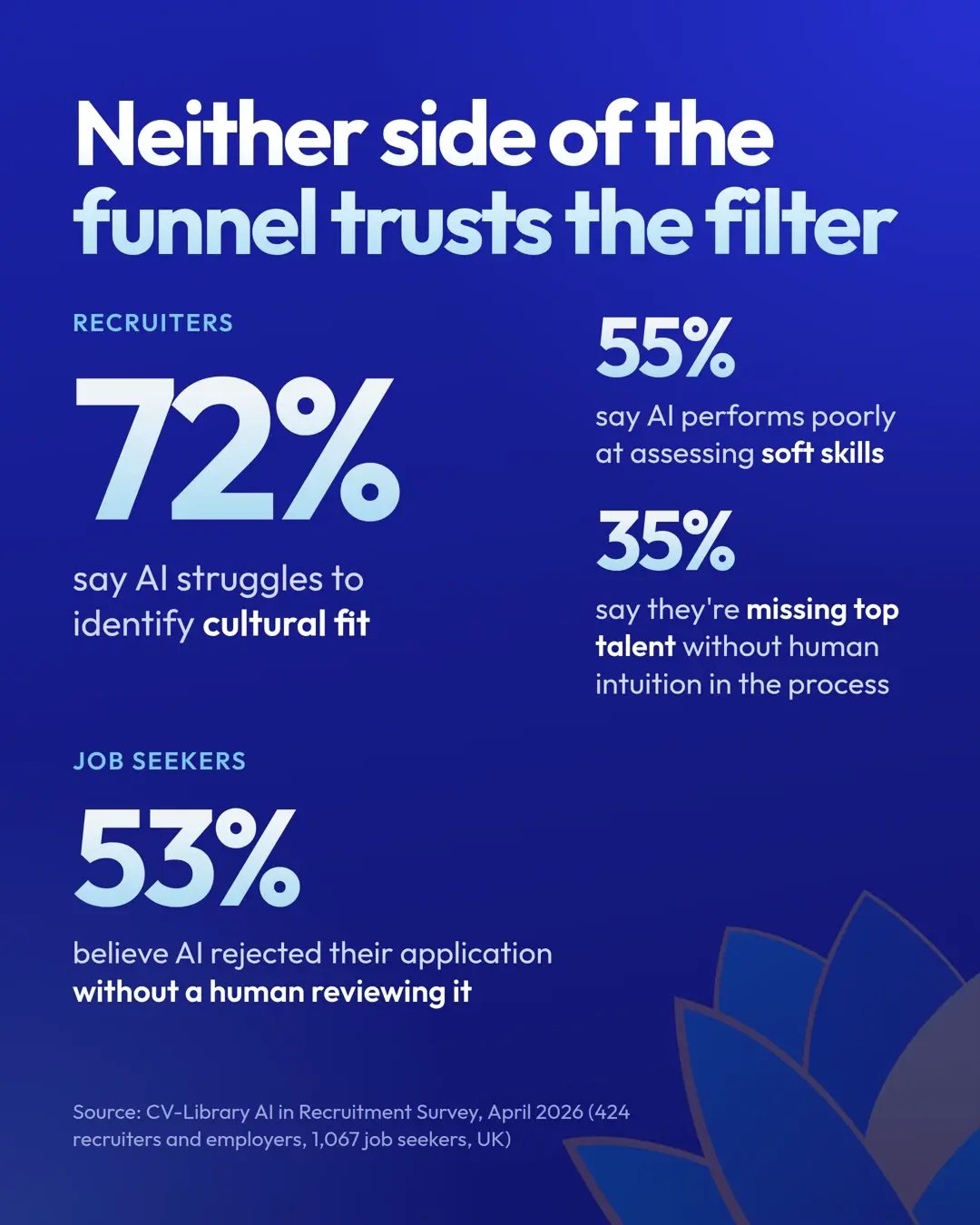
More than half of job seekers (53%) believe an AI rejected their application before a human ever looked. Recruiters have doubts of their own. In a 2026 survey of more than 400 recruiters and 1,100 candidates, 72% of recruiters said AI struggles to judge cultural fit, 55% said it struggles to assess soft skills, and one in three said it is causing them to miss their best candidates.
The tools are making calls on things they can't measure.
That isn't a reason to pull AI out of the funnel. Recruiters trust it to screen candidates against job descriptions, sort resumes and schedule interviews for the hiring manager, and they should. But an AI system shouldn't be the one deciding whether someone has the judgment, collaboration and communication skills a role demands. Knowing where artificial intelligence stops and human judgment takes over leads to better hires and a better candidate experience.
What AI Candidate Screening Actually Does Today
AI candidate screening tools do some combination of three things.
- They parse and match. The system reads a resume, extracts titles, skills, credentials and dates, and compares them against the job requirements. Newer versions use language models instead of exact keyword lists, so "managed a team of 12" can match "people leadership" without the exact words.
- They rank. Each candidate gets a fit score based on how closely their documented history resembles the role profile. Some tools score fit by how closely a resume resembles the resumes of previous hires.
- Some analyze language. Chatbot conversations, recorded video interviews and written responses are reviewed for word choice, sentiment and structure. Some tools also review tone of voice. The output gets labeled as communication, leadership or culture fit.
The first two are pattern matching on documents. The third is pattern matching on speech or text. None of them watch a candidate do the work.
What AI Screening Can Reliably Tell You
Used for the right job, AI screening earns its place.
- It handles volume. An enterprise requisition can draw thousands of applicants. AI can apply the same minimum-qualification criteria to each one in minutes, and apply them more consistently than a recruiter on application number 400.
- It confirms documented facts. Does the candidate hold the required license? Have they worked in a regulated environment? These are checkable claims, and AI does this well.
- It surfaces adjacent experience. Semantic matching can find a qualified candidate whose resume uses different words than the job description. Old keyword filters routinely rejected those people.
The common thread: AI screening is reliable when the question is about what a candidate has documented. It answers "who meets the bar on paper," not "who will perform."
What AI Screening Can't Tell You About Soft Skills (and Why)
Ignis calls these capabilities Power Skills: the applied human capabilities that determine how people perform. There are seven: creative thinking, communication, collaboration, leadership, analytical thinking, productivity and AI fluency.
They are observable, developable and measurable. Calling them "soft" is a big part of why so few organizations try.
That's not a soft HR question. It's a resource-allocation question. Every qualified candidate a screen filters out is talent you already paid to attract. Every hire made on a proxy score is a bet placed on data no one verified.
Measuring Power Skills takes evidence of behavior, and a resume contains none. It contains a candidate's description of past actions, written to persuade.
As candidates use AI to polish resumes for AI screeners, the signal in the document gets weaker. A screener scoring "collaboration" from a resume is mostly scoring how well someone writes about collaboration.
Claims of AI soft skills detection from short video or chatbot screens hit a version of the same wall. The model can measure how someone speaks, including pace, word choice and sentence construction. When a tool maps those speech features to a leadership score, it infers capability from a proxy. The number looks precise. The data underneath it is still unverified.
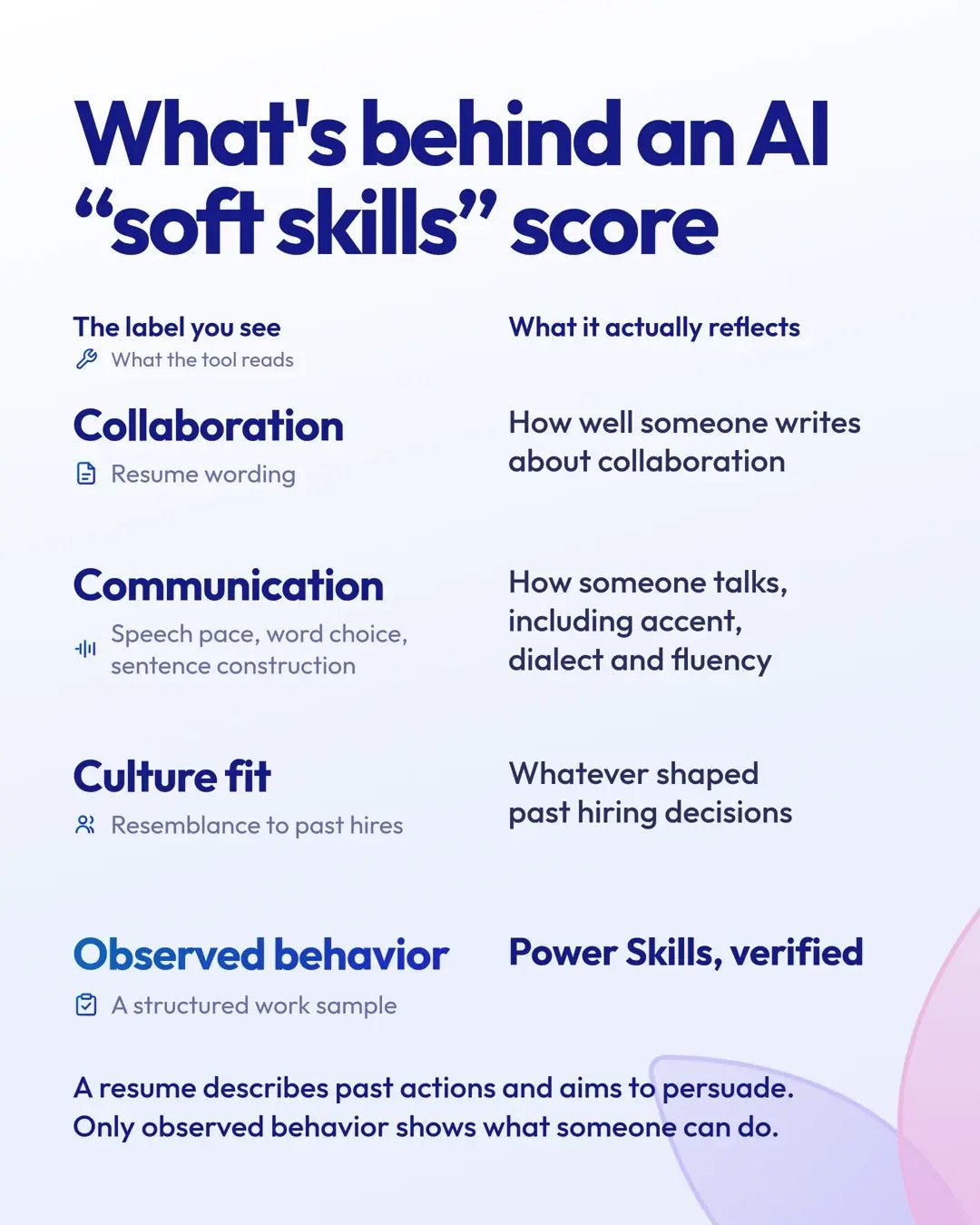
So, can AI detect soft skills in job candidates? Not from a resume or a brief language sample. It can flag patterns that sometimes correlate with Power Skills. It can't verify the capability is there.
The Bias and Compliance Risk Behind Resume- and Language-Based Scoring
Scoring people on resume wording and speech can tilt results against whole groups of candidates.
Research on AI resume screening bias keeps landing in the same place. A University of Washington study tested AI-driven language models used for resume retrieval. The models favored white-associated names in 85% of comparisons, and favored female-associated names over male-associated names in only 11%.
Research from Stanford HAI and MIT Sloan points to the same cause. AI hiring tools trained on past hiring decisions learn to repeat them. An AI model that ranks candidates by resemblance to past hires inherits whatever shaped those hires.
Language-based scoring adds its own risk of adverse impact. Accent, dialect and non-native fluency can lower a "communication" score without saying anything about how well someone will do the job.
The legal picture for AI hiring compliance has gotten harder to read, not easier. In 2025, the EEOC removed its AI hiring guidance from its website, and a federal executive order directed agencies to deprioritize disparate-impact enforcement. Federal anti-discrimination law still applies. The roadmap disappeared, and states are now drawing their own.
Illinois's amended Human Rights Act took effect Jan. 1, 2026. It bans discriminatory AI outcomes in employment decisions and requires notice to candidates.
Colorado shows how fast the patchwork moves. Its original AI Act would have required impact assessments for high-risk hiring systems. In May 2026, lawmakers scaled the law back and pushed its effective date to Jan. 1, 2027. The revised version centers on disclosure and preserves a candidate's right to meaningful human review of adverse automated decisions.
Meanwhile, a lawsuit against a major HR technology vendor alleges its AI screening is biased. The case is testing whether vendors can share liability for the tools they sell.
With standards shifting state by state, people leaders need a defensible record of how screening decisions get made. A tool sold to reduce bias shouldn't be the thing adding risk.
Where Work-Sample and Scenario-Based Verification Fill the Gap
If resumes and short language samples can't show Power Skills, something has to. Decades of selection research rank work samples as strong predictors of job performance. They ask candidates to do a realistic part of the job, measuring behavior instead of descriptions.
A structured work sample assessment lets you assess candidates on what they do, not what they claim. It puts each candidate into a scenario that mirrors the role. They might prioritize conflicting requests, respond to a frustrated stakeholder or use an AI tool to analyze a data set. Every candidate gets the same scenario and is scored against the same defined behaviors. We evaluate what they did.
That last scenario matters more every year. Candidates shouldn't only be screened by AI. For most roles, they should be assessed on how well they use it.
AI also changes what this costs. Scoring open-ended scenario responses at scale used to require trained human raters. Agentic, multimodal AI can respond to a candidate's choices and score observed behavior against a validated rubric, with a psychometrician reviewing the model so each score can be explained. In Ignis's validation research, scoring consistency ranged from 0.82 to 0.91.
It answers the compliance question more cleanly, too. A score based on observed, job-related behavior is easier to defend and explain to a candidate or a regulator than a score inferred from resume wording.
How to Use AI Screening Responsibly in a Pre-Hire Process
None of this argues for abandoning AI candidate screening. It argues for giving it the job it can actually do in your hiring process.
- Use AI for qualification triage, not judgment. Let it check documented requirements and organize volume. Keep it away from scoring Power Skills from resumes.
- Keep a human on rejections. If an AI decision ends a candidacy, a person should be able to review it and explain the basis. In Colorado, candidates are on track to have a legal right to that review.
- Ask vendors what the score is made of. If one of your AI screening tools reports a communication or culture-fit score, ask what behavior it observed. If the answer is word choice or tone, treat the score as a proxy.
- Audit outcomes, not just inputs. Compare selection rates across groups at each stage of the funnel and document the results. The four-fifths rule is a common starting benchmark. If a decision is ever challenged, that record is your defense.
- Verify Power Skills with evidence. For roles where judgment and collaboration decide success, add a structured, scenario-based assessment before the final round.
- Tell candidates. Notice is a legal requirement in a growing number of states. It also rebuilds trust with applicants who assume no human is reading.
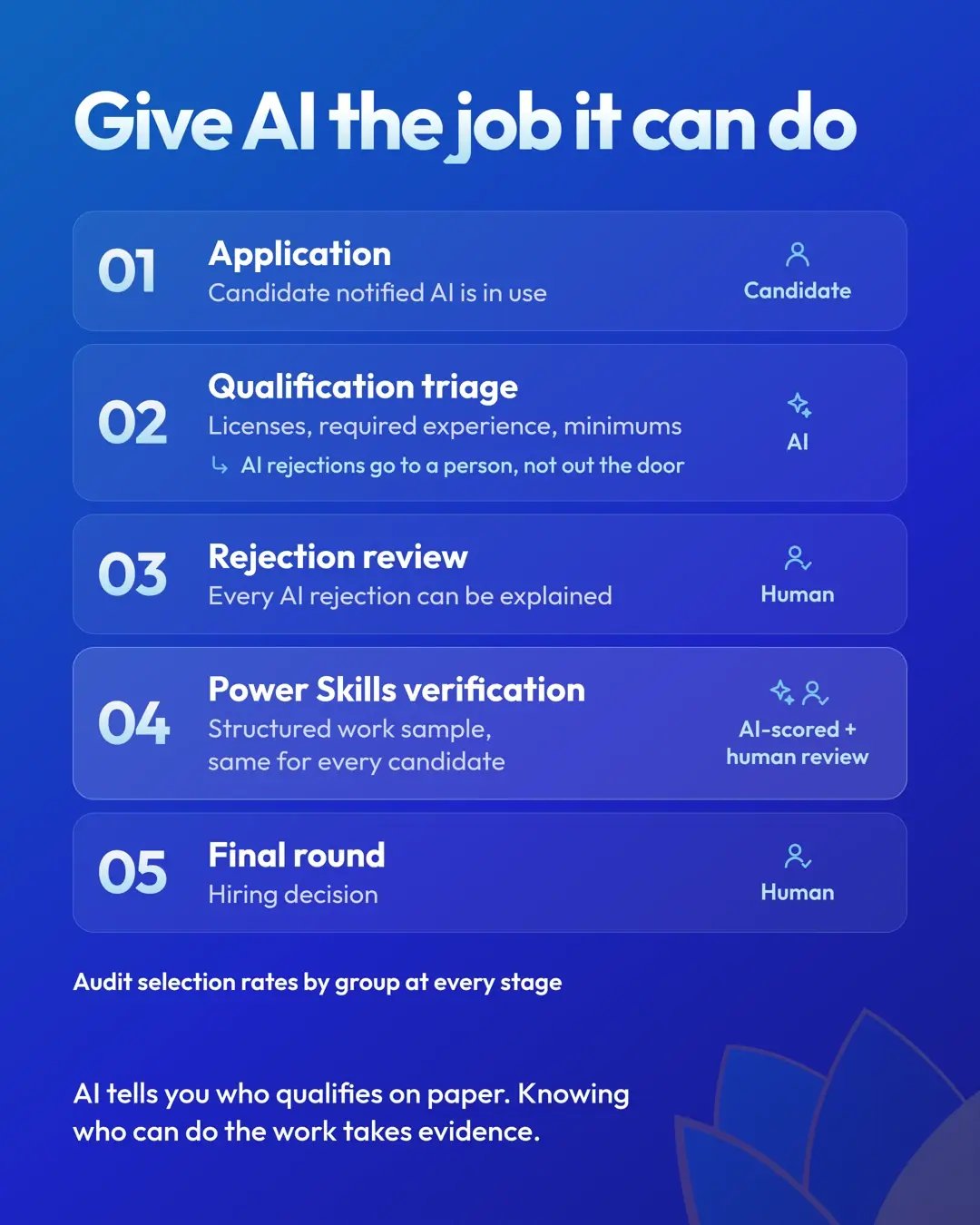
The honest version of AI candidate screening is narrower than the pitch, and more useful for it. It tells you who qualifies on paper. Knowing who can do the work takes evidence: beyond the gut check, and beyond the resume.
See how structured, scenario-based verification works in practice. Schedule a conversation with us to find out more.
Related reading: AI talent assessment covers verification after the hire. See also our talent assessment software buyer's guide and what Power Skills are.
AI Candidate Screening FAQ
Can AI detect soft skills in job candidates?
Not reliably from a resume or a short interview. AI can flag language patterns that sometimes correlate with skills like communication or leadership, but it can't verify the skill. That takes observed behavior, such as a structured, scenario-based assessment.
Is AI candidate screening biased?
It can be. Studies of AI resume screening have found models favoring white-associated and male-associated names, largely because they learn from past hiring decisions. Language-based scoring can also penalize accent, dialect or non-native fluency. Regular adverse impact audits are the best way to catch it.
What's the difference between AI resume screening and AI candidate assessment?
AI resume screening compares what a candidate has documented against job requirements. AI candidate assessment, done well, observes what a candidate does in a realistic scenario and scores that behavior against defined criteria. Screening tells you who qualifies on paper. Assessment tells you who can do the work.
How accurate is AI at predicting job performance from resumes?
It predicts resemblance, not performance. A resume-based score tells you how closely a candidate's documented history matches a role profile or past hires. It doesn't measure how they'll actually perform.
Should a human review AI screening decisions?
Yes, especially rejections. A person should be able to review any AI decision that ends a candidacy and explain the basis. Some state laws are moving to make that review a candidate's right.